
“She looks done in …”
How would your staff record this in standard English?
Many of us find it difficult to talk and write about feelings, especially when this relates to personal care. However, the ability to communicate in standard English is just one of the core skills needed to deliver high quality care. Communication is vital in a sector that often has to deal with sensitive issues, with individuals who may themselves have difficulty communicating.
Core skills are the crucial functional and employability skills that enable individuals to use information and communicate effectively. They include the ability to use English, maths and digital technology confidently, as well as the ability to problem solve, work with others and manage your own workload.
Skim below the surface and you will discover that it is not unusual to find people who struggle with those basic skills that many of us take for granted.
Can all staff read instructions, communicate effectively with residents, or measure out medicine? Can they measure a room that needs new carpet? How much detergent is needed for a particular surface area? And so the list goes on.
Everyone working in adult social care needs to be able to use information and communicate effectively, work with others, solve problems, learn and develop. What that means in practice varies according to a job’s particular circumstances, but the importance of these generic skills is growing.
Core skills enable individuals to work competently and develop. They are what make an individual valuable at work, whatever their role.
Skills for Care’s learning through work series: the pocket sized books that make a big difference
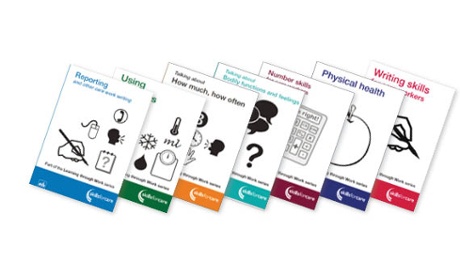
Skills for Care wants to promote core skills development across all parts of the adult social care sector in England. These skills play a vital role in ensuring social care employers meet key standards in the sector, such as The Care Certificate and The Social Care Commitment.
To help employers make sure their staff have the literacy and numeracy skills they need to carry out their duties, we have developed the Learning through Work resource.
The resource is a series of booklets that develop communication and number skills in the adult social care workplace. These pocket-sized booklets, which are for all staff, focus on the basic skills that people require to work in care. They’re a practical resource which workers can carry around with them as they undertake their day-to-day roles. However they’ve also been designed to help supervisors deliver bite-size chunks of learning wherever natural learning opportunities arise in day-to-day care work.
The booklets cover:
- reporting and other care work writing
- writing skills for care workers
- talking about bodily functions and feelings
- physical health
- using numbers in care work
- number skills for care workers
- talking about how much, how often.
This year, Campaign for Learning are hosting their Learning at Work Week on 18-24 May 2015, aiming to put the spotlight on the importance and benefits of learning and development. In support of this, we are offering discounts on our Learning through Work series until 31 May, available to purchase from our bookshop www.skillsforcare.org.uk/bookshop
You can find out what other resources and support we have to offer on our website: www.skillsforcare.org.uk/coreskills
Content on this page is produced and controlled by Skills for Care, sponsor of the Guardian Social Care Network leadership, learning and development hub