Early evening summary
- John Bercow, the Commons speaker, has granted an emergency debate tomorrow on allegations that Vote Leave broke election spending rules in the EU referendum. (See 5.39pm.) He took the decision as lawyers claimed a number of possible criminal offences may have been committed by members of the official Brexit campaign during the EU referendum.
- Theresa May has used a statement to MPs to welcome the news that the US, the EU, Canada and Ukraine have ordered the expulsion of dozens of Russian diplomats in response to the nerve agent attack in the UK, in a show of solidarity that represents the biggest concerted blow to Russian intelligence networks in the west since the cold war. In response Russia has vowed to expel dozens of western diplomats in retaliation.
- Jeremy Corbyn has firmed up his language about Russia being to blame for the Salisbury attack, while leaving open the possibility that the Kremlin did not directly order the attempted murder of Sergei Skripal and his daughter. (See 6.45pm.)
- Theresa May has revealed she has “full confidence” in her political adviser Stephen Parkinson after he was accused of outing a whistleblower to distract attention from allegations he made about Vote Leave’s spending during the referendum campaign. When Labour’s Angela Eagle put to it to May in the Commons that she should sack Parkinson May replied:
No, I’m sorry, that is not what I should be doing, my political secretary does a very good job. As I have said any statements that have been made were personal statement.
- The Jewish Leadership Council has stepped up its attack on Jeremy Corbyn, accusing him of being a figurehead for antisemitism and presiding over a party that has no safe spaces for Jews. Corbyn responded with a new letter offering a new apology to Jewish leaders for antisemitism in the Labour party, saying it was not just a matter of “a few bad apples”. (See 5.10pm.)
That’s all from me for today.
Thanks for the comments.
What Corbyn said about Russia being to blame, but not necessarily being directly responsible - Full quote and analysis
This is what Jeremy Corbyn said in his speech about the evidence for Russia being responsible for the Salisbury attack.
Based on the analysis conducted by government scientists, there can be little doubt that the nerve agent used in this attack was military-grade novichok of a type manufactured by Russia. Since that analysis was revealed by the prime minister two weeks ago the Russian state has had every opportunity to offer a plausible explanation as to how a nerve agent stock of this type came to be used in this attack.
They’ve offered nothing concrete in response except denials and diversion. Indeed, the only solid assertion they’ve offered so far in their defence was that all stocks of nerve agent were destroyed many years ago, an assertion that has been contradicted by intelligence reports. That suggests that just over a decade ago Russia invested in the use of nerve agents and developed new stockpiles of novichok to that end.
There is clear evidence that the Russian state has a case to answer and that they’ve failed to do so and we can therefore draw no other conclusion other than Russia has a direct or indirect responsibility for this.
This stance Corbyn is taking her is subtly different from the stance he was taking in the week straight after the Salisbury attack (the week before last). In his Guardian article on Thursday 15 March he referred to the possibility of a Russian mafia-like group being responsible. Here he does not explicitly float that possibility. Also, he expresses no doubt about the accuracy of UK intelligence (contrary to the line taken by his spokesman on Wednesday 14 March.) Most of what is in this statement echoes in tone the joint UK/US/France/Germany statement, and the joint EU statement issued on Thursday night. He even uses a version of the Boris Johnson argument that you can tell Russia is guilty because of the “smug sarcasm” (Johnson’s phrase) that Moscow has been deploying.
But Corbyn did not quite give full backing to the May/US/joint EU position. He gave himself a two-word let-out.
There is clear evidence that the Russian state has a case to answer and that they’ve failed to do so and we can therefore draw no other conclusion other than Russia has a direct or indirect responsibility for this.
Corbyn is still holding out the possibility that a third-party may have got hold of Russian nerve agent and used it to try to kill Sergei Skripal and his daughter. The UK government and its allies have dismissed this as a plausible theory. Corbyn hasn’t - although he was making the point that the Russians would deserve the blame even if a third-party were directly responsible (because they produced the nerve agent - he is not contesting that).
So, Corbyn has firmed up his stance on Russia being to blame, but still won’t say it was definitely directly responsible for ordering the attack.
Updated
Corbyn claims he has been criticising Russia for 20 years, but Labour MP tells him that’s not true
In the Commons Corbyn says he has been criticising Russia for 20 years.
The Labour MP John Woodcock intervenes. He says that is just not true. He recalls reading articles by Corbyn about Ukraine which did not criticise Russia.
Corbyn thanks Woodock sarcastically for his intervention.
- Corbyn claims he has been criticising Russia for 20 years, but Labour MP tells him that’s not true.
A Tory MP intervenes, and asks Corbyn for a clear answer: does he hold it responsible for the Salisbury attack, yes or no?
Corbyn says he has already answered that.
Vicky Ford, a Conservative MP, goes again. Can Corbyn confirm that he thinks there is no alternative explanation other than the Russian state being responsible?
Corbyn says he has been very clear. He suggests Ford is trying to deflect attention from what Corbyn is saying about Russian money.
The Labour MP Ben Bradshaw intervenes. Bradshaw (no Corbynite, by any stretch), says Corbyn has been clear; Corbyn said there was no alternative explanation to the Russian state being responsible, Bradshaw says.
Corbyn thanks him for what he said.
Corbyn says Russia has either direct or indirect responsibility for Salisbury attack
In the Commons Jeremy Corbyn is now speaking in the Russia debate, following May.
He condemns what happened in Salisbury. And he says the Russians have offered no plausible explanation for what happened.
There is clear evidence that Russia has a case to answer. It has failed to do that, and therefore there is no alternative other than that Russia has direct or indirect responsibility, he says.
- Corbyn says Russia has either direct or indirect responsibility for the Salisbury attack.
Back in the Commons May is winding up her speech now.
She says the UK does not want to be in a permanent state of dispute with Russia. Many of us thought that, after the cold war was over, a better relationship would be possible, she says. But she says the UK will do everything necessary to keep its people safe.
Here is Charles Grant, director of the Centre for European Reform, on why EU countries have been so willing to support the UK’s stance against Russia.
Why has EU been more supportive of UK on #Skripal than expected? 1) UK provided convincing intel on Russia's likely involvement; 2) Macron, Merkel & Tusk gave a firm lead; and 3) EU wants UK to contribute to European security post-Brexit - support on Skripal makes it more likely.
— Charles Grant (@CER_Grant) March 26, 2018
Jeremy Corbyn has posted on Twitter the text of the open letter he has sent to the British Board of Jewish Deputies and the Jewish Leadership Council. (See 5.10pm.)
I have written to the Board of Deputies and the Jewish Leadership Council. I will never be anything other than a militant opponent of antisemitism. In this fight, I am an ally and always will be. pic.twitter.com/QhQnFEpplU
— Jeremy Corbyn (@jeremycorbyn) March 26, 2018
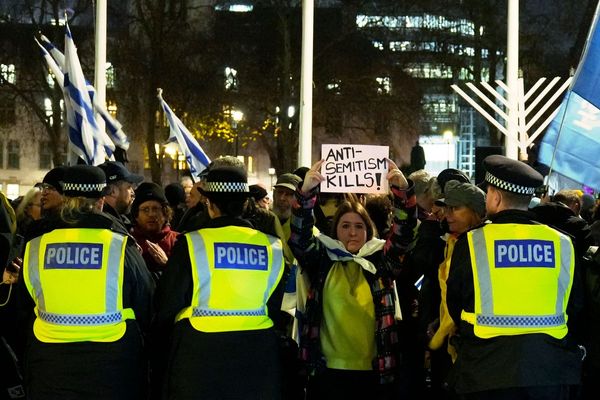
The Board of Deputies of British Jews, which has helped to organise the rally outside parliament protesting about antisemitism in the Labour party, has been tweeting from the event.
Members of the Jewish community, Labour MPs (including @LouiseEllman @ChukaUmunna and @wesstreeting) and anti-racist allies are amassing in Parliament Square to say #EnoughIsEnough pic.twitter.com/QgkidLgowq
— Board of Deputies of British Jews (@BoardofDeputies) March 26, 2018
.@JohnMannMP ‘’what is going wrong with our party when we have to hold this kind of event.’ pic.twitter.com/BtowufFCYq
— Board of Deputies of British Jews (@BoardofDeputies) March 26, 2018
Here is another picture of the protesters.

And her is the counter protest, organised by Jewish Voice for Labour. (See 1.59pm.)

Theresa May is now opening a general debate about national security and Russia.
She says Sergei Skripal and his daughter Yulia are still critically ill and “may never fully recover”.
She says 130 people in Salisbury may have been exposed to the novichok nerve agent that was used.
She says there is no plausible alternative to Russia being responsible.
She says the Russians have offered 21 alternative theories as to what might have happened. But they are “preposterous theories”. She says this is unworthy of the Russian people.
Speaker grants emergency Commons debate on allegations about Vote Leave breaking election spending rules
John Bercow, the speaker, says he is satisfied that this is a proper subject for an emergency debate. If there were to be a debate, it would be a general debate, he says. It would not be anything more or less than that. It would not be a matter of the Commons taking sides.
He asks if Brake has the leave of the House. MPs do not object, and so Bercow says Brake has the leave of the House.
- Bercow allows MPs to hold a two-hour emergency debate on election rules and allegations Vote Leave broke spending limits. It will take place tomorrow.
The Lib Dem MP Tom Brake is now making an application for an emergency debate on the allegations published in the Observer at the weekend about Vote Leave breaking the rules on referendum spending limits.
He says he has written to the Electoral Commission about these allegations.
Given the closeness of the referendum result, it would be a travesty if these matters were not investigated, he says.
He says he would not use an emergency debate to raise matters that were sub judice. But he would ask for assurances that election rules are robust.
During May’s statement the Labour MPs Ben Bradshaw and Angela Eagle both asked Theresa May to justify the decision of her political secretary, Stephen Parkinson, to out a whistleblower who accused Vote Leave of breaking EU referendum spending rules. (See 4.46pm and 4.49pm.)
They are both among the 16 Labour parliamentarians who have signed an open letter to May on this subject saying Parkinson should be sacked.
The outing of the whistleblower who exposed evidence of law breaking by the Leave campaign as gay, thereby endangering his family in Pakistan, was completely unacceptable & the PM must act. pic.twitter.com/pybC40iFjQ
— Ben Bradshaw (@BenPBradshaw) March 26, 2018
Outside the House of Commons around 300 people have reportedly turned up for the joint Jewish Leadership Council/Board of Deputies of British Jews rally calling for Labour to to take antisemitism more seriously.
Around 300 protesters now in Parliament Square for the "Enough is Enough" protest against anti-Semitism in the Labour party, organised by the Board of Deputies of British Jews and the Jewish Leadership Council
— Christopher Hope 📝 (@christopherhope) March 26, 2018
But there is a counter rally too. (See 1.59pm.)
Before the big demo against antisemitism there's a counter-demo - also in Parliament Square - in support of Corbyn pic.twitter.com/obeeF9ldPH
— Michael Deacon (@MichaelPDeacon) March 26, 2018
Now Board of Deputies cry “Shame on You” to pro Corbyn lobby pic.twitter.com/up9T0ctHMH
— steve hawkes (@steve_hawkes) March 26, 2018
It all seems to be getting a bit chaotic and undignified, according to some of the tweets coming out.
The two demos have now come together. "Left-wing fascists!" "Corbyn, anti-racist? You must be joking!" "Shame on you!"
— Michael Deacon (@MichaelPDeacon) March 26, 2018
“Oh Jeremy’s a racist” sing one group. “You don’t speak for us,” responds irate teenager
— steve hawkes (@steve_hawkes) March 26, 2018
Back in the Commons Simon Hoare, a Conservative, asks if the ugly rise of antisemitism came up at the EU summit. May says it did not come up, but she says it has no place either on the continent or here.
Corbyn offers fresh apology to Jewish leaders, saying antisemitism in Labour not just 'few bad apples'
Jeremy Corbyn has conceded that there is a problem with antisemitism in the Labour Party. Responding to last night’s forceful attack from the British Board of Jewish Deputies in a letter to them and the Jewish Leadership Council, he apologised “sincerely”. He said:
I recognise that antisemitism has surfaced within the Labour party, and has too often been dismissed as simply a matter of a few bad apples. This has caused pain and hurt to Jewish members of our Party and to the wider Jewish community in Britain. I am sincerely sorry for the pain which has been caused, and pledge to redouble my efforts to bring this anxiety to an end.
In the letter, which goes beyond any previous apology including his overnight recognition that there were “pockets” of anti-semitism in the party, he expressly apologised for failing to study the content of an anti-semitic mural in the East End of London that has been at the centre of the latest controversy. He said:
While the forms of antisemitism expressed on the far Right of politics are easily detectable, such as Holocaust denial, there needs to be a deeper understanding of what constitutes antisemitism in the labour movement. Sometimes this evil takes familiar forms – the east London mural which has caused such understandable controversy is an example. The idea of Jewish bankers and capitalists exploiting the workers of the world is an old antisemitic conspiracy theory. This was long ago, and rightly, described as “the socialism of fools.” I am sorry for not having studied the content of the mural more closely before wrongly questioning its removal in 2012.
In a much more nuanced recognition of the forms that antisemitism can take, in the letter he accepted that criticism of Israel could be antisemitic.
Newer forms of antisemitism have been woven into criticism of Israeli government. Criticism of Israel, particularly in relation to the continuing dispossession of the Palestinian people, cannot be avoided. Nevertheless, comparing Israel or the actions of Israeli governments to the Nazis, attributing criticisms of Israel to Jewish characteristics or to Jewish people in general and using abusive phraseology about supporters of Israel such as “Zio” all constitute aspects of contemporary antisemitism. And Jewish people must not be held responsible or accountable for the actions of the Israeli government.
Insisting that he is committed to eliminating antisemitism “wherever it exists”, he promised that the party would implement in full the “overdue” recommendations of the Chakrabati report.
The battle against antisemitism should never become a party political issue. It must unite all of us if we are both to honour the memory of the victims of the bestial crimes of the 20th century and build a future of equality and justice for all.
In that spirit, I must make it clear that I will never be anything other than a militant opponent of antisemitism. In this fight, I am your ally and always will be.

Asked about claims that rules were broken by Vote Leave in the EU referendum, May says that is a matter for the Electoral Commission.
May insists fishing communities will get much better deal out of Brexit deal than they did from EEC accession deal
Alistair Jack, a Conservative, asks for an assurances that fishing rights will not he hard-wired into a future trade deal with the EU. (He means fishing rights for EU countries. Jack is a Scottish MP, representing Dumfries and Galloway.)
May say, having looked at what happened to fishing rights in the negotiations to join the EEC in the 1970s (when, by general consent, the UK got a very poor deal on fishing), she is determined to do things very differently this time.
- May insists fishing communities will get much better deal out of Brexit deal than they did from EEC accession deal.
Jacob Rees-Mogg, the Tory Brexiter, says as part of the transition the government has had to compromise on its red lines. He says this will be acceptable proved they are restored after the transition is over. Can May assure him that, at that point, the UK willr regain control of its borders and its laws and that the European court of justice will no longer have jurisdiction.
May says, after the transition, the UK will leave the single market, the customs union and the common fisheries policy. She says the UK is clear it is taking back control of its laws. But she says Rees-Mogg will know that the agreement reached in December said the ECJ would continue to have a role in deciding cases relating to the rights of EU nationals after Brexit.
Sir Desmond Swayne, a Conservative, asks May if she agrees that Labour’s stance on the passport contract (see 3.56pm) would be a “passport to ruin’.
May agrees. She says, unlike Labour, the government believes in competition and open markets.
May rules out sacking Stephen Parkinson
Labour’s Angela Eagle says May should sack Stephen Parkinson.
May says that is not what she should be doing. She says Parkinson does a good job.
- May rules out sacking Stephen Parkinson, her private secretary, after he outed a whistleblower while responding to election over-spending claims.
Labour’s Ben Bradshaw asks how it could be acceptable for May’s political secretary, Stephen Parkinson, to issue a personal statement in response to the Vote Leave allegations outing someone as gay, and putting people at risk.
May says it was a personal statement that was issued. She says she understands the concern, but she wants to live in a world where people can be open about their sexuality.
Updated
In response to a question from the DUP’s Nigel Dodds, May says she agrees that, rather than focusing on the “backstop” solution to the Irish border problem, the UK and the EU should be focusing on finding a solution through option a (ie, through a new trade relationship).
Labour’s Hilary Benn, the chair of the Brexit committee, if the EU is trying to freeze the UK out of Galileo contracts being awarded in June. (See 12.38pm.)
May says, while the UK remains in the EU, it should be treated as an EU member. She says it is in the EU’s interest to keep treating the UK as a member because of the expertise it can provide.
John Redwood, the Tory Brexiter, asks when the government will legislate for things like a new farming policy and a new fishing policy. May says legislation will come forward.
Sir Bill Cash, the Tory Brexiter, asks of an assurance that the European court of justice will not have jurisdiction over the UK after Brexit.
May says the ECJ will still apply during the transition. She says it will not hold sway afterwards. But there are some issues to be resolved, she says, such as who will rule on the withdrawal agreement. She says there are some interesting proposals in play that would give neither side absolute primacy.
Ian Blackford, the SNP leader at Westminster, asks what May and EU leaders are doing to ensure NGOs in Russia get support.
He asks what the government is doing about Scottish limited partnerships, which he says have been abused for money laundering.
On Brexit, he asks what the government did to get the EU to change its stance on fishing.
May says the government has taken action on SLPs. But it wants to do more, she says.
And she says it is “a bit rich” for Blackford to criticise her over fishing when the SNP want to stay in the EU.
Iain Duncan Smith, the former Conservative leader and former work and pensions secretary, praises May for her stance on Russia. He says she was right to reject Corbyn’s approach. Corbyn wanted a “never-ending dialogue with those what would harm you most”, he says.
May is responding to Corbyn.
She says she has been very clear about how a hard border in Ireland can be avoided. The government has set out proposals for this, she says.
She says she does not accept the claim that Labour proposed a transition period first. She proposed it in her Mansion House speech, she says. She says Corbyn called for article 50 to be triggered immediately after the referendum.
Jeremy Corbyn is responding now.
He says he called for a multinational response to the Salisbury attack. So he welcomes today’s coordinated expulsions, he says.
He says Labour called for a transition involving staying in the customs union and the single market. So he is pleased the government is following what it proposed, he says.
He asks for confirmation that the UK will not withdraw from Euratom until alternative arrangements for nuclear cooperation are agreed. Will May agreed to amendments to legislation to that effect?
What happened to the government’s call for flexibility on the transition? And what will happen if the transition needs to be extended?
Corbyn asks how May will prevent a hard border in Ireland, or at the Irish sea, if the UK leaves the customs union.
He says May said she would make a success of Brexit. But tell that to the De La Rue workers in Gateshead who lost the passport contract, he says.
He says May must drop her impossible red lines and put jobs and workers first.
May says people are tired of people refighting the arguments from the EU referendum. They are now coming together, she says.
May says there are key questions to be resolved, including the governance of the agreement and what to do about the Irish border.
She says the commission proposals for a backstop agreement on regulatory alignment between the EU and Northern Ireland were not acceptable because they did not properly reflect the joint report agreed in December.
Turning to Brexit, she says she is today placing copies of the draft EU withdrawal agreement in the Commons library.
EU leaders welcomed this, she says.
During the implementation period people will continue to trade on current terms, she says.
She says the priority is to get the right future relationship that will endure for years to come.
May is now talking about steel tariffs.
She says she welcomes the temporary exemption to new US tariffs offered to the EU. But the EU wants to make this permanent, she says.
May says 18 countries have today expelled more than 100 Russian diplomats in total
Theresa May is making her statement now.
She starts by sending her condolences to those killed in the French terrorist attack on Friday. And she pays tribute to the French police officer, Lt Col Arnaud Beltrame, praising him in French.
She is now talking about the EU summit, saying issues like Russia and steel were ones on which the UK will continue to pay a leading role in Europe even after Brexit.
She says the EU leaders agreed on a statement saying it was highly likely that Russia was behind the Salisbury attack.
She says she argued for a strong European response to Russia’s action. The council agreed immediate actions. And today 18 countries, including 15 EU member states, have agreed to expel a total more more than 100 Russian diplomats.
Together they have sent a message that they will not tolerate Russia’s continued attempts to flout international law.
Foreign ministers will report back on actions against Russia before the June summit.
She stressed that the EU has not quarrel with the Russian people. Indeed, Europeans are thinking of them today, in the aftermath of the Siberian shopping mall fire.
- May says 18 countries have today expelled more than 100 Russian diplomats in total.
Updated
Theresa May's Commons statement on EU summit, Brexit and Russia
Theresa May is about to give a Commons statement. Officially it will be about the outcome of last week’s EU summit, but this means it will also cover Brexit, and the transition deal, and Russia.
In the Commons Caroline Nokes, the immigration minister, has been responding to an urgent question about the proposal to award the contract for the new passports to a Franco-Dutch firm. She has been defending the decision in the face of criticism from, among others, the shadow home secretary Diane Abbott, who criticised the bid outcome and said that, in procurement decisions, the cheapest option wasn’t always the best.
Interestingly, on this issue, the Labour party is being more economically nativist than the Sun newspaper, which published this editorial on the subject last week.
Really interestingly pitched leader from the Sun on the blue passports pic.twitter.com/ckRH6TOMHw
— Jessica Elgot (@jessicaelgot) March 23, 2018
Starmer gives details of Labour's new proposed amendments to EU withdrawal bill
Here is the full text of Sir Keir Starmer’s Brexit speech. The shadow Brexit secretary did not have anything to announce going beyond what was trailed in advance. But he made a clear case as to why he thinks the Brexit talks are going badly, and why he thinks Labour has been right not to side with leave or remain.
The most important sections were those were he described the amendments to the EU withdrawal bill Labour will table in the Lords. Here are the key passages.
The amendment letting the Commons decide what should happen if the withdrawal agreement gets voted down
Lord Callanan [a Brexit minister] said just last week that if the deal is voted down it would be ‘an instruction to move ahead without a deal’.
No it won’t. That is totally unacceptable.
If parliament rejects the terms of the prime minister’s deal that would not give her licence to crash out without an agreement.
Far from it: that would be the worst of all possible worlds.
A disaster for businesses and working people. A disaster for citizens in the UK and the EU. A disaster for Northern Ireland. Unthinkable. And not meaningful.
So – working with others – Labour will ensure that an amendment is introduced to the EU withdrawal bill to strengthen the terms of the meaningful vote.
The amendment will make clear that – should the prime minister’s proposed Article 50 deal be defeated – it would then be for parliament to say what happens next, not the Executive.
A statutory provision requiring the government to proceed on terms agreed by Parliament, not on terms dictated by the Prime Minister
Precisely what action the government should take in the event that the prime minister’s proposed deal is voted down will have to be decided at the time. That should be for Parliament to decide if and when necessary.
But Labour’s preference in that scenario is clear: The government should listen to parliament’s concerns, go back to the negotiating table and secure a better deal that works for Britain.
This amendment would provide a safety valve in the Brexit process. It would help safeguard jobs and the economy, and remove the possibility of a no vote leading to no deal.
The amendment saying there should be no hard border in Ireland
Legal certainty is now needed.
That is why – working with others – Labour will ensure an amendment is introduced to the EU withdrawal [bill] that would prevent checks, controls or physical infrastructure of any kind at the border.
This would put in place a legal commitment preventing a hard border between Northern Ireland and the Republic.
It will also specify there can be no drop in North-South co-operation across the full range of political, economic, security or agricultural areas.
We do not do this lightly. I know from my time in Northern Ireland that this not an issue to play party politics on, or to divide the House unnecessarily.
This amendment is born of necessity. Because of the government’s failure to advance a credible solution in Northern Ireland.
Starmer did not take questions after the speech, Reuters’ William James reports.
No Q&A from Keir Starmer after his speech today, despite the Labour Party promising on Saturday that there would be one...
— William James (@WJames_Reuters) March 26, 2018
And here is my colleague Dan Roberts’ take on the speech.
This from Labour's Brexit speech today is classic @Keir_Starmer - Intriguingly open for those who want to see a second referendum if the deal is rejected, and implausibly/confusingly cake-and-eat-it on the likelihood that going back to Brussels and trying again will change much. pic.twitter.com/u8qSX1rcrg
— Dan Roberts (@RobertsDan) March 26, 2018

The Russian embassy in Washington has said that Moscow will retaliate for the closure of its bureau in Seattle by closing an American consular office in Russia. It’s holding a Twitter ballot on possible candidates.
US administration🇺🇸 ordered the closure of the Russian Consulate in Seattle @GK_Seattle🇷🇺. What US Consulate General would you close in @Russia, if it was up to you to decide
— Russia in USA 🇷🇺 (@RusEmbUSA) March 26, 2018
This is from the BBC’s Moscow correspondent Steve Rosenberg.
Russian foreign ministry calls mass expulsion of Russian diplomats an "unfriendly step...provocative gesture", accuses those countries which expelled Russians of being "puppets of the British authorities."
— Steve Rosenberg (@BBCSteveR) March 26, 2018
Theresa May will no doubt be flattered to hear that Washington, Berlin, Paris and other capitals are now puppets of London.
And this is from the Independent’s Moscow correspondent, Oliver Carroll.
To give you an idea of the flexibility of Russ official position, State TV now reporting UK using Brexit to “force solidarity” from Euro allies. Both counter to previous multiple positions and general logic
— Oliver Carroll (@olliecarroll) March 26, 2018
Ukraine (which is not in the EU, of course) is participating in the anti-Russian initiative. It is expelling 13 Russian diplomats.
In response to #SalisburyAttack and in the spirit of solidarity with our British partners, Ukraine decided to expel 13 Russian diplomats https://t.co/spjSJRn2Q9
— UKR Mission to UN (@UKRinUN) March 26, 2018
Updated
This is from the Danish prime minister, Lars Lokke Rasmussen. Denmark is expelling two Russian diplomats.
Russia has gone too far. An assassination attempt in a European city with a Russian nerve agent is completely unacceptable. The UK has our full support. Denmark will expel two Russian diplomats in our joint European response to the #SalisburyAttack. #dkpol
— Lars Løkke Rasmussen (@larsloekke) March 26, 2018
Boris Johnson says today marks 'largest collective expulsion of Russian intelligence officers' ever
Boris Johnson says today has seen “the largest collective expulsion of Russian intelligence officers” ever.
Today’s extraordinary international response by our allies stands in history as the largest collective expulsion of Russian intelligence officers ever & will help defend our shared security. Russia cannot break international rules with impunity
— Boris Johnson (@BorisJohnson) March 26, 2018
And France is also expelling four Russians. This is from the French foreign ministry.
#SalisburyAttack: @JY_LeDrian has announced the expulsion of four Russian diplomats from France. https://t.co/KxHWotoJWp pic.twitter.com/fLlnBX4E3Y
— France Diplomacy🇫🇷 (@francediplo_EN) March 26, 2018
Germany is expelling four Russian diplomats. This is from the German foreign ministry.
Germany will expel four Russian diplomats. To this day #Russia has shown no efforts to support investigations after the #Salisbury attack. "The decision was not taken lightly", says FM @HeikoMaas. pic.twitter.com/FypOcf2PjM
— GermanForeignOffice (@GermanyDiplo) March 26, 2018
Canada is expelling four Russian diplomats, and refusing entry to another three, as part of its response to the Salisbury attack, its foreign minister Chrystia Freeland has said in a statement.
Canada expels Russian diplomats in solidarity with United Kingdom. Full statement: https://t.co/rsI8gYxccZ
— Chrystia Freeland (@cafreeland) March 26, 2018
Here is the full text of Donald Tusk’s statement about 14 EU countries expelling Russian diplomats today.

Updated
Here is the US state department’s statement on the Russian diplomat expulsions.
State department statement on expulsion of Russian spies. pic.twitter.com/bp9NKRKz0a
— Julian Borger (@julianborger) March 26, 2018
And here is the White House statement.
White House statement on Russian spy expulsions pic.twitter.com/2KGb4imstF
— Julian Borger (@julianborger) March 26, 2018
As my colleague Julian Borger points out, President Trump, though, has not so far tweeted.
The White House has put out an official statement on the Russian spy expulsions but nothing so far from Trump's Twitter feed or from him verbally. Same pattern as always when it comes to Russia. https://t.co/IWTcjtaMcw
— Julian Borger (@julianborger) March 26, 2018
This is from the Lithuanian foreign minister, Linas Linkevicius.
In solidarity with the UK over #SalisburyAttack Lithuania has undertaken decision to: expel 3 Russian intelligence officers operating under diplomatic cover; sanction additional 21 individuals under the Lithuanian Magnitsky Act; ban 23 more from the entrance to LT. @BorisJohnson
— Linas Linkevicius (@LinkeviciusL) March 26, 2018
This is from the BBC’s Daniel Sandford.
Russian Foreign Ministry Spokeswoman Maria Zakharova is not happy. She has written on Facebook a long post about the " conspiracy of anti-Russian solidarity imposed by the British" on EU countries pic.twitter.com/nkJaOX3ULe
— Daniel Sandford (@BBCDanielS) March 26, 2018
Sky’s Alistair Bunkall is keeping a running total of the Russian diplomat expulsions.
Mass co-ordinated expulsion of Russian diplomats:
— Alistair Bunkall (@AliBunkallSKY) March 26, 2018
US - 60
Czech - 3
Ukraine - 13
Lithuania - 3
Latvia - 1
Poland - 4
Germany - 4
France - 4
Good day for Downing St.
It’s not over yet...
— Alistair Bunkall (@AliBunkallSKY) March 26, 2018
Netherlands - 2
Estonia - 1
Tusk says 14 EU countries are expelling Russian diplomats following Salisbury nerve agent attack
Donald Tusk, the president of the European council, has been making a short statement in Bulgaria about the expulsion of Russian diplomats from EU countries.
- Tusk said 14 EU member states were today expelling Russian diplomats as a consequence for the Salisbury nerve agent attack. He also said that additional measures would not be excluded.
Tusk’s announcement follows the decision by EU leaders on Thursday night to issue a joint statement saying it was highly likely that Russia was responsible for the attack.
Tusk also said that people in Europe were mourning the victims of the Siberian shopping mall fire that has left 64 people deal.
Updated
US to expel 60 Russian diplomats over Skripal attack
The US has ordered the expulsion of 60 Russian officials, including a dozen based at the United Nations, who Washington says are spies, in response to the nerve agent attack in the UK, my colleagues Julian Borger and Patrick Wintour report.
This is from my colleague Patrick Wintour.
US expelling 60 Russian diplomats from Washington in wake of Skripal poisoning and now as many as 14 EU countries preparing to follow suit. Germany expelling 4 intelligence related officials.
— Patrick Wintour (@patrickwintour) March 26, 2018
Jewish Voice for Labour is opposed to the joint Jewish Leadership Council/Board of Deputies of British Jews rally being planned for Parliament Square this afternoon calling for Jeremy Corbyn to take antisemitism more seriously. JVL is organising a counter-rally to support the Labour leader. In a statement it said:
We are Jews in the Labour party currently actively campaigning for Labour in local elections. We are appalled by the actions and statements of the Board of Deputies. They do not represent us or the great majority of Jews in the party who share Jeremy Corbyn’s vision for social justice and fairness. Jeremy’s consistent commitment to anti-racism is all the more needed now.
As the British people call time on May and the Tories, they are getting more desperate. There is massively more antisemitism on the right of politics than on the left.
But JVL is a relatively small group in the party. The Jewish Labour Movement, which is much larger and more established within the party, is backing the main rally.
Join us tomorrow. Join in solidarity. Join us. pic.twitter.com/9sFRc1jXvV
— JewishLabourMovement (@JewishLabour) March 25, 2018
Updated
More voters in Great Britain rate leaving the EU as a priority ahead of maintaining the Union with Northern Ireland, a poll has suggested. As the Press Association reports, more than a third of those polled (36%) said exiting the European Union was a higher priority than keeping Northern Ireland within the UK. Of those surveyed, 29% said retaining Northern Ireland within the UK was more important than Brexit.
Around 22% said neither was important, while the remainder said they did not know which one to prioritise higher. The YouGov poll, commissioned by radio station LBC, did not survey voters within Northern Ireland. The online poll sampled 1,630 adults living in Great Britain. It was conducted between March 21 and 22.
Simon Case, the official in the Brexit department in charge of finding a solution for the Irish border, has resigned after three months, my colleague Lisa O’Carroll reports. Case is leaving his role to become Prince William’s private secretary.
According to BuzzFeed’s Mark Di Stefano, the whistleblowers Shahmir Sanni and Christopher Wylie will not be appearing at the Bindmans press conference this afternoon.
The big joint-press conference with Cambridge Analytica whistleblower Chris Wylie and Leave whistleblower Shahmir Sanni has just been canned. Replaced instead by lawyers. pic.twitter.com/Et6StVT3GQ
— Mark Di Stefano 🤙🏻 (@MarkDiStef) March 26, 2018
A Tory peer will push through a draft law introducing same sex marriage into Northern Ireland in the House of Lords at the same time as a Labour MP introduces an identical bill into the House of Commons. The marriage (same sex couples) (Northern Ireland) bill will be introduced by Conservative peer Lord Hayward on Tuesday afternoon. The following day, Labour MP Conor McGinn will introduce his identical Bill in the House of Commons. Lord Hayward said:
It gives me great honour to launch the Westminster campaign for equal marriage rights in Northern Ireland in the House of Lords.
I am pleased to introduce the marriage (same sex couples) (Northern Ireland) bill in the Lords with the support of the Love Equality campaign from Northern Ireland. The strength of public opinion for equal marriage rights in Northern Ireland will be shown by the petition they are due to present to Downing Street later this week.
Campaigners for equal marriage in Northern Ireland welcomed the intervention of a Conservative parliamentarian in backing the same sex marriage bill.
Northern Ireland is the only part of the UK where same sex marriage is not legal mainly due to the opposition of the Democratic Unionist Party in the now deadlocked Stormont Assembly.
There will be an urgent question in the Commons this afternoon on the passport contract row. That means Theresa May’s statement will not start until about 4.15pm.
There will also be an application for an emergency debate on the Vote Leave over-spending allegations. If this does get granted, the debate will take place tomorrow.
One urgent question granted to @LizTwistMP to ask @AmberRuddHR if she will make a statement on why the contract for the new UK Passport has been awarded to a French-owned company
— Labour Whips (@labourwhips) March 26, 2018
Application for an emergency debate on alleged breaches of electoral law during the EU referendum will be made by @tombrakemp after PM’s statement
— Labour Whips (@labourwhips) March 26, 2018
Measures to cut global inequality would be at the heart of British aid policy under a Labour government, according to a green paper published by the party today. As my colleague Karen McVeigh reports, a Labour government would introduce Britain’s first explicitly feminist international development policy, with a threefold increase in funding for grassroots women’s groups.
Downing Street lobby briefing - Summary
Here are the main points from the Number 10 lobby briefing.
- Theresa May has full confidence in Stephen Parkinson, her political secretary, despite claims that he outed a whistleblower as gay to divert attention from allegations which he denies that Vote Leave broke election spending rules when he was working for it, the prime minister’s spokesman said. (See 11.49am.)
- Downing Street insisted that Boris Johnson, the foreign secretary, was not speaking on behalf of the government at the weekend when he dismissed claims that Vote Leave broke referendum spending rules as “ludicrous”. The prime minister’s spokesman said that these allegations were a matter for the Electoral Commission to investigate. Asked about Johnson’s comment, the spokesman said that Johnson was expressing a view in his capacity as someone who played a leading role in the Vote Leave campaign and that that was an appropriate thing for him to do. Here is the Johnson comment.
Observer/C4 story utterly ludicrous, #VoteLeave won fair & square - and legally. We are leaving the EU in a year and going global #TakeBackControl #GlobalBritain
— Boris Johnson (@BorisJohnson) March 24, 2018
But Downing Street did take a more robust line on a separate cheating allegation (but, admittedly, one where the allegations have been proven) ...
- Number 10 strongly condemned the Australian cricket ball-tampering. Asked about this (May is a cricket fan), the spokesman said:
The prime minister is clear that cheating has absolutely no place in cricket, or indeed any sport. The Australian prime minister, Malcolm Turnbull, has said that cricket fans will be shocked and bitterly disappointed by the news, and the prime minister agrees with that.
- The spokesman signalled that the government would strongly resist EU attempts to exclude the UK from its Galileo satellite project after Brexit. Today the Financial Times has splashed on a story saying May is is “leading efforts to stop an ‘outrageous’ EU move to freeze Britain out of Europe’s €10bn Galileo satellite project, as space becomes a new frontier in Brexit negotiations”. The story goes on:
The European Commission wrote to the UK in January to explain that it would be inappropriate to divulge highly sensitive information about post-2019 PRS plans to a departing member state.
“If the commission shared this information with the UK (which will become a third country) it would irretrievably compromise the integrity of certain elements of these systems for many years after the withdrawal of the UK,” the commission said, according to an official who had seen the letter.
Only EU members have access to the encrypted PRS system but the US and Norway are in protracted negotiations with Brussels over joining.
FT: May battles to keep Britain in EU’s €10bn Galileo satellite programme #tomorrowspaperstoday pic.twitter.com/7AKRbUIXRs
— Neil Henderson (@hendopolis) March 25, 2018
Asked about Galileo, which has military implications because it will stop European armed forces from being reliant on a US network for GPS services, the prime minister’s spokesman said that May agreed with Greg Clark, the business secretary, who has publicly said that the UK wants to maintain “complete involvement in all aspects of Galileo, including the key secure elements which the UK has unique specialisms in and which the UK has helped to design and implement” after Brexit. Clark has also pointed out that the UK has already contributed a “significant amount of expertise” to the programme, the spokesman pointed out.
- Number 10 confirmed it will oppose a proposed amendment to the EU withdrawal bill that would ensure that a Commons vote against the Brexit withdrawal agreement in the autumn could lead to ministers being ordered to return to Brussels to negotiate a better deal. Sir Keir Starmer, the shadow Brexit secretary, is announcing plans for a such an amendment in a speech today, and there is a strong chance peers will vote to put it in the bill after Easter. But the prime minister’s spokesman made it clear the government would reject it. He said:
The government’s position is very clear, which is that there will be a meaningful vote on the Brexit deal where parliament can choose to either accept that deal or we can leave without a deal. But we will be leaving the European Union on March 29 2019.
- Downing Street refused to rule out putting up taxes to raise more money for the NHS. Asked about the open letter sent to May today by select committee chairs and other senior figures calling for a commission to investigate ways of raising more money for the NHS, the spokesman said that May would reply to it in due course. He said the government had already put an extra £9bn into the NHS and social care and that it supported the NHS’s five-year forward plan. But asked about tax increases, and health secretary Jeremy Hunt call for a hypothecated tax for health and social care, the spokesman just said that tax matters were decided at “fiscal events” and that he would not comment ahead of the budget.
- The spokesman refused to comment on reports that a number of Britain’s allies will today be announcing the expulsion of Russian diplomats as part of a coordinated response to the Salisbury nerve agent attack intended to disrupt Russian spy networks. As my colleague Patrick Wintour reports, four Eastern European countries have already called in their respective Russian ambassadors.
Diplomatic expulsions about to start. Baltic States {Latvia, Lithuania and Estonia) and Poland summoning the Russian ambassador in respective countries for meetings.
— Patrick Wintour (@patrickwintour) March 26, 2018

Updated
May has full confidence in No 10 aide Stephen Parkinson despite whistleblower outing row and referendum spending claims
I’m back from the Number 10 lobby briefing. There were a few half-interesting lines on various stories, but I suppose this was the main line.
- Theresa May has full confidence in Stephen Parkinson, her political secretary, despite claims that he outed a whistleblower as gay to divert attention from allegations which he denies that Vote Leave broke election spending rules when he was working for it. The prime minister’s spokesman said that Parkinson was a political appointment, and that it was for political advisers not civil servants to answer detailed questions about what he did, but that he was able to confirm that May still has full confidence in him.
I will post a full summary shortly.
Here are alternative views on the Corbyn antisemitism row from two sensible Labour figures.
From the Labour MP Chuka Umunna
Thread: There inevitably will be those that jump to defend and who declare this issue is being ‘weaponised’ to attack @jeremycorbyn. But every @UKLabour member should be deeply ashamed that it has come to this. /1 https://t.co/MIKJqsrGFS
— Chuka Umunna (@ChukaUmunna) March 25, 2018
If you are incapable of seeing that @UKLabour has a problem with anti-semitism, you really should not be in our party. We are not a personality cult, we are a party that is supposed to stand against hatred and racism. It’s about time we lived up to our values. /2
— Chuka Umunna (@ChukaUmunna) March 25, 2018
My comments will attract abuse, the usual ‘get out of the party, ‘get behind the leader’, ‘sabotage’& ‘coup’ claims. Frankly, I don’t care. As a family that have been the victims of racism, I never ever will let that get in the way of saying what must be said on these issues. /3
— Chuka Umunna (@ChukaUmunna) March 25, 2018
From the former Labour minister Chris Mullin
Sorry to see Jewish leaders ganging up on Corbyn. Far less anti-semitism in the Labour Party than in other parts of society and in some other political parties. Suspect it has more to do with criticism of Israel than anti-semitism.
— Chris Mullin (@chrismullinexmp) March 26, 2018
Alleged anti-semitism yet another stick with which to beat Corbyn -- along with Corbyn 'friend of the IRA, Hizbollah, Hamas, Czech spy, Soviet spy....' You name it. Whatever next?
— Chris Mullin (@chrismullinexmp) March 26, 2018
I am not a Corbynista, but I can see what's going on here. Sorry to see that some of my Labour colleagues have fallen for it. Anyone in doubt should read this morning's Tory press. https://t.co/ndwSkH9NTz
— Chris Mullin (@chrismullinexmp) March 26, 2018
I’m off to the Number 10 lobby briefing. I will post again after 11.30am.
British officials are in Brussels today to discuss the Irish border aspect of the Brexit negotiations. According to a story by Tom McTague and Charlie Cooper for Politico Europe, they are “developing a plan to solve the Irish border issue by keeping the whole of the UK aligned with a subset of the EU’s single market rules”.
To mark the third anniversary of the escalation of the Yemen conflict, Save the Children ambassadors Joely Richardson and Natasha Kaplinsky have signed a petition urging the UK government to immediately suspend arms sales to Saudi Arabia and ensure unfettered humanitarian access to children in Yemen. As the Press Association reports, Richardson said: “Children should never be the victims of war, and they should be protected, and we shouldn’t be selling arms towards anyone that would bomb children and civilians.” The petition, which has more than 60,000 signatures, is being handed in to the Foreign Office.
Labour won't survive if Corbyn fails to tackle antisemitism, says John Mann
John Mann, the Labour backbencher and chair of the all-party parliamentary group on antisemitism, told the BBC’s Victoria Derbyshire show that antisemitism could destroy the Labour party. Here are the main points from his interview.
- Mann said that, if Jeremy Corbyn failed to tackle antisemitism in Labour, the party would not survive. He said:
If [Corbyn] is incapable of dealing with this problem now, then the Labour party is not going to survive ...
He is not going to be prime minister of this country if he does not lead and sort this problem ... If he can’t sort this problem now, he will not be the prime minister of this country, we will not be in power. And, frankly, the Labour party has an even bigger crisis than that because this is about the actual existence of the Labour party. The Labour party was formed to deal with prejudice and discrimination. It’s been in our DNA through our 100 and more years’ history. If he fails to deal with this, then he destroys the very essence of the Labour party.
- Mann said he could not be certain that Corbyn was not antisemitic himself. Asked if he thought Corbyn was antisemitic, he replied:
I don’t know. I don’t think he’s antisemitic.
Corbyn, of course, says he totally condemns antisemitism and will not tolerate it. (See 9.32am.)
- Mann said Corbyn had so far failed to take action against antisemites in the Labour party.
What I do know is that he has failed to take action on removing antisemites from the Labour party. And there are an increasing number of them who have joined, explicit antisemites.
Corbyn, of course, would contest that. He asked Shami Chakrabarti to conduct an inquiry into antisemitism in the party (pdf). And disciplinary action has been taken against antisemites under his leadership, although Mann argued not enough.
- Mann said that he was “astonished” that Corbyn could not see the problem with the 2012 Mear One mural. Mann said:
Having seen that mural, I’m astonished ... because that mural is classic antisemitism. I’m astonished that any senior politician, of any kind, cannot recognise that antisemitism. [Corbyn] needs to answer why he failed to see that.
- Mann said that the police were currently investigation a threat to him and his family from someone he described as an “antisemite on the left.”

Full text of open letter from Board of Deputies of British Jews and Jewish Leadership Council
This is the full text of the open letter from the Board of Deputies of British Jews and the Jewish Leadership Council about antisemitism in the Labour party that was released last night.
Today, leaders of British Jewry tell Jeremy Corbyn that enough is enough. We have had enough of hearing that Jeremy Corbyn “opposes antisemitism”, whilst the mainstream majority of British Jews, and their concerns, are ignored by him and those he leads.
There is a repeated institutional failure to properly address Jewish concerns and to tackle antisemitism, with the Chakrabarti report being the most glaring example of this.
Jeremy Corbyn did not invent this form of politics, but he has had a lifetime within it, and now personifies its problems and dangers. He issues empty statements about opposing anti-Semitism, but does nothing to understand or address it.
We conclude that he cannot seriously contemplate antisemitism, because he is so ideologically fixed within a far left worldview that is instinctively hostile to mainstream Jewish communities.
When Jews complain about an obviously antisemitic mural in Tower Hamlets, Corbyn of course supports the artist. Hezbollah commits terrorist atrocities against Jews, but Corbyn calls them his friends and attends pro-Hezbollah rallies in London. Exactly the same goes for Hamas.
Raed Salah says Jews kill Christian children to drink their blood. Corbyn opposes his extradition and invites him for tea at the House of Commons. These are not the only cases. He is repeatedly found alongside people with blatantly antisemitic views, but claims never to hear or read them.
Again and again, Jeremy Corbyn has sided with antisemites rather than Jews. At best, this derives from the far left’s obsessive hatred of Zionism, Zionists and Israel. At worst, it suggests a conspiratorial worldview in which mainstream Jewish communities are believed to be a hostile entity, a class enemy.
When Jeremy Corbyn was elected leader of the Labour party, Jews expressed sincere and profound fears as to how such politics would impact upon their wellbeing. Our concerns were never taken seriously. Three years on, the party and British Jews are reaping the consequences.
Routine statements against antisemitism “and all forms of racism” get nowhere near dealing with the problem, because what distinguishes antisemitism from other forms of racism is the power that Jews are alleged to hold, and how they are charged with conspiring together against what is good.
This is not only historic, or about what Jeremy Corbyn did before being party leader. It is also utterly contemporary. There is literally not a single day in which Labour party spaces, either online or in meetings, do not repeat the same fundamental anti-Semitic slanders against Jews.
We are told that our concerns are faked, and done at the command of Israel and/or Zionism (whatever that means); that anti-Semitism is merely “criticism of Israel”; that we call any and all criticism of Israel “anti-Semitic”; that the Rothschilds run the world; that ISIS terrorism is a fake front for Israel; that Zionists are the new Nazis; and that Zionists collaborate with Nazis.
Rightly or wrongly, those who push this offensive material regard Jeremy Corbyn as their figurehead. They display an obsessive hatred of Israel alongside conspiracy theories and fake news. These repeated actions do serious harm to British Jews and to the British Labour Party.
Jeremy Corbyn is the only person with the standing to demand that all of this stops. Enough is enough.
Corbyn's antisemitism apology fails to satisfy Jewish leaders
There will be a lot of politics around this afternoon, including two major Jewish organisations holding a protest in Parliament Square this afternoon about antisemitism in the Labour party and Jeremy Corbyn’s alleged failure to deal with it properly. This has been a longstanding complaint against the Labour leader, which was reignited last week after it emerged that in 2012 he put a message on Facebook supporting a mural that was clearly antisemitic. In a message at the end of last week he said he had not looked at the mural properly. Last night, with the row continuing to escalate, he posted a much extensive message on Facebook, saying he was “sorry” for the pain caused by antisemitism in the party. He said:
Labour is an anti-racist party and I utterly condemn antisemitism, which is why as leader of the Labour Party I want to be clear that I will not tolerate any form of antisemitism that exists in and around our movement. We must stamp this out from our party and movement.
We recognise that antisemitism has occurred in pockets within the Labour Party, causing pain and hurt to our Jewish community in the Labour Party and the rest of the country. I am sincerely sorry for the pain which has been caused.
Our party has deep roots in the Jewish community and is actively engaged with Jewish organisations across the country.
We are campaigning to increase support and confidence in Labour among Jewish people in the UK. I know that to do so, we must demonstrate our total commitment to excising pockets of antisemitism that exist in and around our party.
I will be meeting representatives from the Jewish community over the coming days, weeks and months to rebuild that confidence in Labour as a party which gives effective voice to Jewish concerns and is implacably opposed to antisemitism in all its forms. Labour will work to unite communities to achieve social justice in our society.
But his statement did not impress Jewish leaders. Last night the Board of Deputies of British Jews and the Jewish Leadership Council released a joint open latter claimiung Corbyn “cannot seriously contemplate antisemitism, because he is so ideologically fixed within a far-left worldview that is instinctively hostile to mainstream Jewish communities”. Our story about the letter is here.
And this morning, Jonathan Arkush, president of the board of deputies, saying that he found it hard to believe some of Corbyn’s claims not to have been aware of antisemitism at events he attended or in Facebook groups he belonged to. Arkush said:
I also will be asking him how he could possibly say that he did not really look at the mural which he supported which was grotesquely antisemitic. I want him to explain to me how he’s a member of two notably antisemitic Facebook groups, and he says he did not notice. Everything with Jeremy Corbyn is, one, ‘I hear no evil, I see no evil, I wasn’t looking, I did not see anything’. Frankly, I find that strains my credulity.
The protest is taking place later. But by then no doubt other stories may be taking priority. Here is the agenda for the day.
9am: Carolyn Fairbairn, the CBI director general, speaks at a Brexit: One Year to Go event organised by the Institute for Government.
11am: Downing Street lobby briefing.
1.45pm: Sir Keir Starmer, the shadow Brexit secretary, gives a speech in Birmingham. As Heather Stewart reports, he will say that Labour will table amendments to the government’s EU withdrawal bill aimed at preventing the UK from crashing out of Europe without a deal if parliament rejects the outcome of the Brexit talks.
After 3.30pm: Theresa May will make a statement to MPs on the outcome of last week’s EU summit.
4pm: The whistlesblowers Shahmir Sanni and Christopher Wylie will hold a press conference at the offices of their lawyers to publicise allegations that Vote Leave broke election spending rules during the EU referendum.
4pm: Simon Stevens, the NHS England chief executive, gives evidence to the Commons public accounts committee.
5.30pm: The Jewish Leadership Council and the Board of Deputies of British Jews hold a protest in Parliament Square against antisemitism in the Labour party.
As usual, I will be covering breaking political news as it happens, as well as bringing you the best reaction, comment and analysis from the web. I plan to post a summary at lunchtime and another in the afternoon.
You can read all today’s Guardian politics stories here.
Here is the Politico Europe round-up of this morning’s political news from Jack Blanchard. And here is the PoliticsHome list of today’ top 10 must reads.
If you want to follow me or contact me on Twitter, I’m on @AndrewSparrow.
I try to monitor the comments BTL but normally I find it impossible to read them all. If you have a direct question, do include “Andrew” in it somewhere and I’m more likely to find it. I do try to answer direct questions, although sometimes I miss them or don’t have time.
If you want to attract my attention quickly, it is probably better to use Twitter.
Updated