Afternoon summary
- The government will cancel a £5.9m contract to provide a training programme for prisons in Saudi Arabia. In a significant victory for Michael Gove, whose attempts to cancel the project had been resisted by David Cameron and the foreign secretary, Philip Hammond, the prime minister’s spokeswoman said the contract has been cancelled after a review. The issue of British officials providing a “training-needs analysis” for the Saudi penal system was brought to public attention by Jeremy Corbyn at the Labour party conference last month.
- John McDonnell, the shadow chancellor, has explained that he changed his mind about voting for the government’s fiscal responsibility charter after meeting the tearful families of Redcar steelworkers who have lost their jobs. McDonnell has been criticised by some of his own MPs for saying he now wants them to vote against the charter, which reverses his claim to the Guardian two weeks ago that he wanted them to vote in favour.
- MPs have been debating the government’s immigration bill in the commons. The bill would make renting out accommodation to illegal immigrants a criminal offence. Labour has tabled a wrecking amendment to the bill, with shadow home secretary Andy Burnham warning that it could lead to the modern equivalent of the “no dogs, no blacks, no Irish” signs.
- Inflation has gone negative, according to figures just out today. The rate of consumer price index inflation fell by 0.1% in the year to September 2015, from 0% in August, the Office for National Statistics revealed today. The news was welcomed by George Osborne, who said it was a real boost for the budgets of working families. “We shouldn’t mistake this for damaging deflation,” the chancellor wrote on Twitter. “We remain vigilant and our system is designed to deal with such risks.”
That’s all from me today. Andrew will be back tomorrow. Thanks for all the comments and Tweets.
Labour’s deputy leader, Tom Watson, has been invited to appear before the Home Affairs Select Committee on October 21st.
Labour dep. leader Tom Watson invited to give evidence to Commons Home Affairs Committee re his sex abuse allegations against Leon Brittan
— Andrew Neil (@afneil) October 13, 2015
In some, er, lighter news – Liberal Democrat blogger Stephen Tall has paid a heavy price for betting on the BBC’s Daily Politics show in 2013 that he’d “run naked down Whitehall” if his party was reduced to just 24 MPs in the election.
This is what happens, kids, if you make a daft pledge on TV. You've been warned. http://t.co/r5SWfRmCCT pic.twitter.com/LYn5ob33St
— Stephen Tall (@stephentall) October 13, 2015
He’s not quite naked ... but we’ll definitely let him off.
This guy in Whitehall lost bet during election over number Lib Dem MPs would be left - he lost! .@Daily_Politics pic.twitter.com/lpVhQPsGD7
— Charlie Rose (@CharlieRose1) October 13, 2015
Tall did it to raise money for Médecins Sans Frontières. His Just Giving page is here.
Paddy Ashdown still hasn’t eaten his hat though ...
Immigration debate in the Commons
MPs have been debating the government’s immigration bill in the commons this afternoon. The bill would make renting out accommodation to illegal immigrants a criminal offence. Labour has tabled a wrecking amendment to the bill, with shadow home secretary Andy Burnham warning that it could lead to the modern equivalent of the “no dogs, no blacks, no Irish” signs. Here are some key points so far –
- Home secretary Theresa May denied that the measures in the bill could result in increased prejudice. “I think it is only fair to people who are coming here, who are making their contribution to society, who have actually played by the rules, that we do take efforts to ensure that those who are here with no right to be here who are abusing our systems are actually dealt with appropriately,” she said. “That’s why on things like access to bank accounts and driving licences and other matters I think it is important that we have taken action.”
- New shadow home secretary Andy Burnham said: “We won’t support legislation in haste that is not backed by clear evidence and that is the problem with this bill. Parts of it appear to have been drafted on the same beer mat, in the same pub as the Home Secretary’s speech to Conservative party conference in Manchester. It is legislation driven by a desire to be seen to be doing something and a desire to get headlines.”
- Burnham asked May to substantiate her claim that the economic benefit of high immigration levels is “close to zero”. “It will not have escaped the House’s attention that you have struck a markedly different tone in your remarks this afternoon than you did to your own conference in Manchester,” said Burnham. “The change in tone is very welcome but you said at the conference, in contrast to what you said a moment ago, that the overall economic benefit of migration is ‘close to zero’. Can you today give the House some evidence to back up that claim?” May replied: “Nice try but actually perhaps you should read the speech I gave last week and then you will see actually I am saying exactly what I said last week.”
From the Daily Mail’s deputy political editor –
Did Michael Gove brief Jeremy Corbyn on Saudi deal to help bounce David Cameron into u-turn? Some Tory MPs think so...
— Jason Groves (@JasonGroves1) October 13, 2015
Updated
The Scottish Labour leader, Kezia Dugdale, has been speaking to the BBC, denying that she urged McDonnell to change his position on the fiscal charter.
I didn’t warn anyone off. I did speak to Jeremy Corbyn and his team over the weekend about the need to demonstrate that the Labour Party is the only anti-austerity party in the UK, so it is a good move.
This is an interesting tweet from the BBC’s political editor –
All sorts of reasons why McDonnell U turn on budget surplus not a laughing matter, including that Corbyn himself had no idea it was coming
— Laura Kuenssberg (@bbclaurak) October 13, 2015
McDonnell says he changed his mind after meeting Redcar steelworkers
John McDonnell has been speaking to broadcasters this lunchtime, explaining his decision to oppose the government’s fiscal charter.
"I've changed my mind on the parliamentary tactics" says John McDonnell of Labour's U-turn on fiscal policy https://t.co/O8DjMHnlOl
— Sky News (@SkyNews) October 13, 2015
Politics Home has a transcript of the clip –
I have changed my mind, but I haven’t changed my mind on the principles of what the charter is standing for which is we need to tackle the deficit and we will tackle the deficit. Labour will tackle the deficit – we are not deficit deniers, I haven’t change my mind on that.
But I have changed my mind on the parliamentary tactics. Originally what I said to people was look that charter is a political stunt, it’s a political trap by George Osborne, it is virtually meaningless – he ignores it himself time and time again, he never meets his targets. So [I said], this is just a stunt and let’s ridicule it in the debate and vote for it because it’s a meaningless vote.
I went to Redcar and I met the steelworkers and I had families in tears about what’s happening to them as a result of the Government failing to act, failing to intervene. And I came back and I realised as the consequences of the Government’s failure to invest in infrastructure and skills, the cuts that are going to start coming now, I realised that people are actually going to suffer badly. And it brought it home to me, and I don’t want the Labour party associated with this policy.
Updated
The Guardian’s home affairs editor Alan Travis has this analysis of the decision to scrap the Saudi prisons deal. The headline is: “Michael Gove emerges as human rights hero over bid to scrap Saudi prisons deal”. Here’s an extract –
Michael Gove, in his new role as justice secretary and lord chancellor, is rapidly turning into a highly unlikely hero of the liberal left.
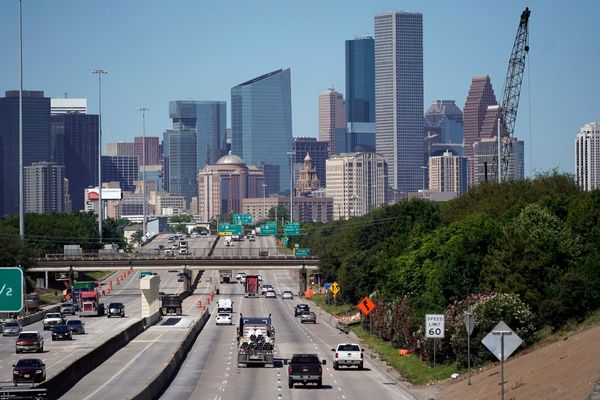
The credits had hardly finished rolling on Monday’s BBC Panorama, showcasing Gove’s summer study tour to Texas to see how they are cutting their burgeoning prison population, before fresh details of his cabinet battle over a Saudi prison contract emerged.
Unexpectedly, for those who have been following the affair, it seems to have been successful: the controversial contract with the Saudis has been cancelled, it emerged just before lunch.
The debate is now over, but my colleague – who was in the chamber – said that Conservative MP Daniel Kawczynski was handed a note part-way through (from a whip telling him not to speak in the debate?) which he then slung to the ground shouting “disgraceful”.
He is the former chair of the all-party parliamentary group on Saudi Arabia and has strongly-held views on critiques of the country’s human rights record. See below.
Updated
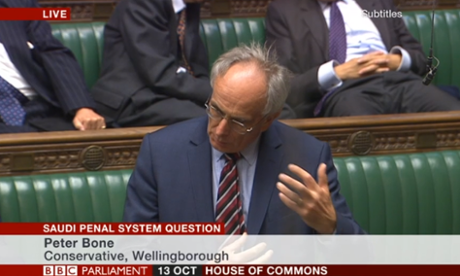
Conservative MP Peter Bone asks how the “difficult balancing act” between human rights and national interest works in practice.
Gove says the UK engages with the Saudi government on every level. The balancing act is guided by Britain’s national interest and keeping British citizens safe, but also by promoting the values that the British hold.
Kate Higham, caseworker at human rights organization Reprieve, said the decision to drop the prisons bid could not have come soon enough.
This deal, if it had gone ahead, would have meant the UK was complicit in the same system that is threatening to execute juveniles Ali al-Nimr and Dawoud al-Marhoon for the ‘crime’ of protesting. Britain’s alliance with Saudi Arabia, however, remains extremely strong. Cancelling the bid has sent a clear message that the UK does not support Saudi Arabia’s gross violations of human rights, and David Cameron must now use this moment of opportunity to prevent the brutal executions of Ali and Dawoud.
Labour MP Ann Clywd asks about the training courses the UK College of Policing provides to the Saudi police. “What training is being given and at what price?” she asks.
Gove says that he is not a Foreign Office minister but that he knows from his dealings with the Foreign Office that they put human rights first and foremost.
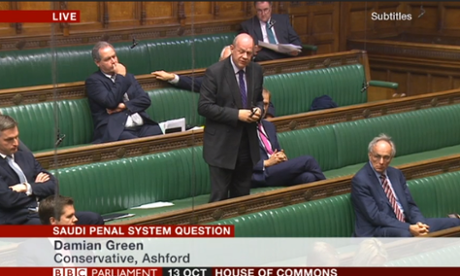
Minister of State for Policing and Criminal Justice, Damian Green says he wants to congratulate Gove for making a decision because “quite simply, it’s the right thing to do.” He asks whether, when weighing up security considerations and human rights, the consideration of human rights should be “slightly higher in the mix” than it has been under past governments of all colours.
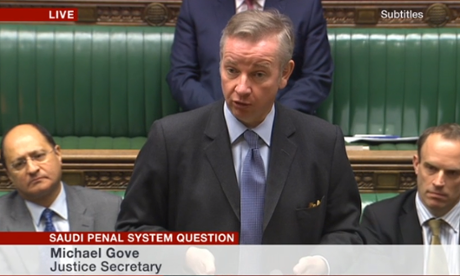
Gove stresses, in response to a question from Alistair Carmicheal, that it was a cross-government decision, reached after wide discussion.
Carmicheal asks whether Gove would consider publishing the documents behind the prisons deal. Gove says that it is necessary that conversations remain confidential in order to maintain confidence in future negotiations.
The SNP’s Stewart McDonald asks Gove about the decision to fly the Union jack at half mast when King Abdullah of Saudi Arabia died in February. Gove says that it is standard practice to fly the flag at half mast when any monarch dies.
Gove repeats, in response to a question from Alan Duncan MP, that a balance needs to be struck between maintaining strong diplomatic relationships while opposing the death penalty and human rights abuses.
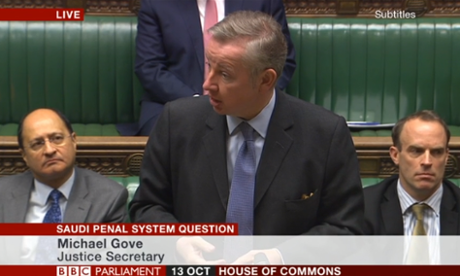
I can only apologise for any delay in responding to the leader of the opposition on the case of Ali Mohammed al-Nimr, says Michael Gove in response to Slaughter’s comments.
It in the interest of the most important human right of all – right to live in security and safety – that the government continues to cooperate with the Saudi government, says Gove.
He says he wants to reassure MPs that the whole focus of the ministry of justice will be to maintaining the rule of law, human rights and making sure that UK citizens are protected effectively with a justice system that all can have pride and confidence in.
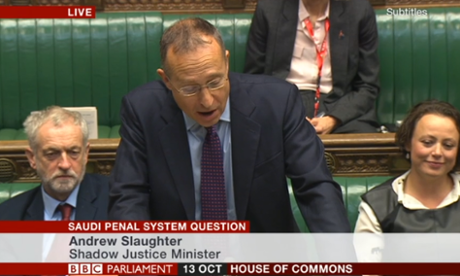
Michael Gove is formally announcing the decision to withdraw the bid for a prison’s contract with Saudi Arabia
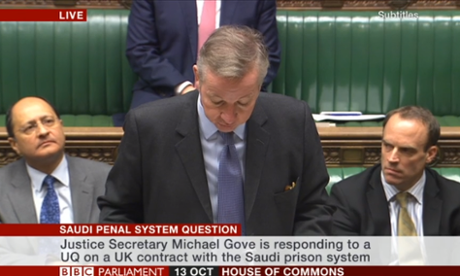
Andrew Slaughter, shadow justice secretary, opens his comments with: “Well Mr Speaker, the power of the urgent question”.
He says that, in September, Corbyn wrote to the prime minister about the fate of Ali Mohammed al-Nimr and is yet to receive a response. Sitting next to Corbyn, he asks: Why did the government ever contemplate such a prisons contract? And why hasn’t Corbyn received a response?
Jeremy Corbyn: the prime minister has been shamed into a U-turn
Jeremy Corbyn has issued a statement on Cameron’s decision to scrap the Saudi prisons contract:
David Cameron has been shamed into a u-turn on this terrible contract, but why on earth was it set up in the first place? We should be sending a strong message to repressive regimes that the UK is a beacon for human rights and that this contract bid is unacceptable in the 21st century, and would damage Britain’s standing in the world.
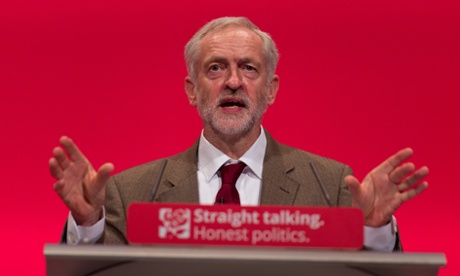
This is the first major victory for Corbyn as leader of the opposition (though much of the credit should also go to Michael Gove and the Times). Here is an extract from the Labour leader’s speech to the party’s autumn conference on 29th September, in which he challenged Cameron to scrap the deal.
So to David Cameron I say: Intervene personally with the Saudi Arabian regime to stop the beheading and crucifixion of Ali Mohammed al-Nimr for taking part in a demonstration when just 17 years old.
And start by terminating the Ministry of Justice’s bid to provide services to the Saudi prisons service - the very body which would be responsible for carrying out this barbaric sentence.
This is the kind of thing that really damages Britain’s standing in the world.
Here is the Guardian’s chief political correspondent, Nick Watt, on the cancellation of the Saudi prisons contract.
Downing Street has announced that the government is to cancel a £5.9m contract to provide a training programme for prisons in Saudi Arabia.
In a significant victory for Michael Gove, whose attempts to cancel the project had been resisted by David Cameron and the foreign secretary, Philip Hammond, the prime minister’s spokeswoman said the contract has been cancelled after a review.
The spokeswoman said: “This bid to provide the additional training to Saudi Arabia has been reviewed and the government has decided that it won’t be proceeding with the bid. The review has been ongoing following the decision that was announced earlier in September to close down the Just Solutions International branch of the Ministry of Justice that was providing some of these services.”
In another significant development, Downing Street also announced that the prime minister is to write to the Saudi authorities to raise his concerns about the case of Karl Andree, the 74-year-old grandfather who is due to face 360 lashes for transporting homemade wine in his car.
The No 10 spokeswoman said: “This is an extremely concerning case. We have been providing consular assistance to Mr Andree and to his family since he was first arrested. We have raised the case repeatedly in recent weeks.
“Given the ongoing concerns and the fact we would like too see more progress the PM is writing today to the Saudis to further raise the case on the back of action that was already being taken by the foreign office and by ministers there.”
Updated
While I’m waiting for more information on the news that Cameron has cancelled the controversial prisons deal with Saudi Arabia, here’s a recap of the story. I’ve taken the points from the article my colleague Nadia Khomami wrote this morning.
- The Times reported this morning that the UK foreign secretary, Philip Hammond, has accused the justice secretary, Michael Gove, of naivety over his demand that a controversial £5.9m prisons deal with Saudi Arabia be scrapped.
- The issue of British officials providing a “training-needs analysis” for the Saudi penal system was brought to public attention by Jeremy Corbyn at the Labour party conference last month. The Labour leader called on the Ministry of Justice to drop its bid for a contract, citing the case of pro-democracy protester, Ali Mohammed al-Nimr, who was sentenced to crucifixion when he was 17.
- The bid for a prisons deal was put in by Just Solutions International (JSI), the commercial arm of the MoJ that was set up by the last justice secretary, Chris Grayling.
- Gove wanted to pull out of the deal, saying the British government should not be assisting a regime that uses beheadings, stoning, crucifixions and lashings as forms of punishment.
- The row between Gove and Hammond was so serious that it was even raised at a meeting of the National Security Council. Gove’s demand was agreed by his predecessor and won the support of the business secretary, Sajid Javid, but in the end the prime minister insisted the deal should go ahead.
Cameron cancels prison contract with Saudi Arabia
My colleagues Nick Watt and Patrick Wintour are reporting that David Cameron has decided to cancel the controversial £5.9m prisons deal with Saudi Arabia.
David Cameron has cancelled the Ministry of Justice contract to supply prison services to Saudi Arabia, No 10 reveals.
— Patrick Wintour (@patrickwintour) October 13, 2015
Victory for Michael Gove. No 10: govt has decided not to go ahead with contract to advise Saudi penal authorities. Riyadh informed 1/2
— Nicholas Watt (@nicholaswatt) October 13, 2015
No 10: @David_Cameron writing today to Saudi authorities to raise 'extremely concerning case' of Karl Andree 2/2
— Nicholas Watt (@nicholaswatt) October 13, 2015
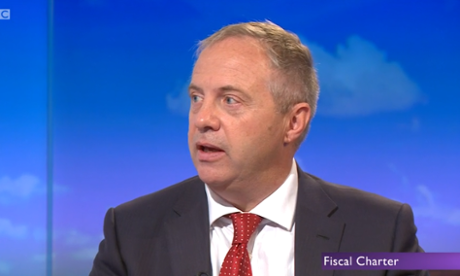
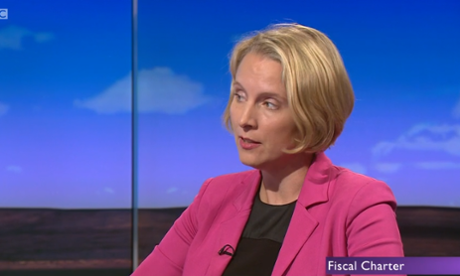
Labour MPs John Mann and Emma Reynolds – who was shadow communities secretary before Corbyn’s reshuffle – are on the Daily Politics.
Mann says that Labour members discussed Osborne’s fiscal charter in July and felt it was a dangerous gimmick. Mann is asked why McDonnell decided to support it in the first instance. “Haven’t got a clue,” he says.
Mann says McDonnell U-turned because the party’s new leadership realised that it would be hard for people to get their heads around the fact that MPs like Mann and Wes Streeting – self-styled moderates – would be voting against Osborne and Corbyn and McDonnell would be voting with him.
“Let’s be generous to John McDonnell,” says Mann. “He’s very ill experienced and he’s had his fingers burnt.”
Emma Reynolds says that she always intended to vote against the charter because it is anti-democratic to tie the hands of future chancellors. “I think we need to be clear and consistent on the economy,” she says. “We still have a window of opportunity... we have to clear [our position on the economy] up pretty quickly.”
Reynolds says she might abstain, as Chris Leslie called on Labour MPs to do in his interview on the Today programme this morning, but she is undecided.
Hello, Frances Perraudin here. I’ll be covering for Andrew for the rest of the day.
Stewart Hosie, the deputy leader of the Scottish National Party, has been on the BBC. He said he was “absolutely aghast at the shambles the Labour party are in” and that it was “pretty shallow” for the party to change its position to gain ground on the SNP. “It simply won’t wash – people expect consistency from a political party, not this kind of cheap shot,” he said.
No one could have been in any doubt from the moment the budget was published in July and the fiscal charter update was published – also in July – that George Osborne was planning to run a surplus in the economy, in this parliament and in the future, cutting far more than he needed to in order to run a balanced economy. The fact it has taken Labour 24 hours before the vote to get to a good place, with all the mayhem that has ensued, is a ridiculous place for them to be in.
There’s an urgent question on the Ministry of Justice Saudi prison contract at about 1.15pm.
UQ granted circa 1.15pm to @hammersmithandy to ask Gove whether he'll withdraw from Saudi penal systems contract pic.twitter.com/6fAI0P0Wrb
— Labour Whips (@labourwhips) October 13, 2015
I’ve got to head off to pick up a sick child from school. My colleague Frances Perraudin will be taking over the blog, and covering the UQ in detail.
Here’s the Guardian audio of Chris Leslie’s interview on the Today programme about the fiscal charter U-turn.
The shadow cabinet has been meeting this morning. According to Diane Abbott, it went well.
Diane Abbott emerges from Shadow Cabinet to say the mood in the meeting was "very positive".
— Kevin Schofield (@PolhomeEditor) October 13, 2015
John Mann has also set out his critique of John McDonnell in an article for PoliticsHome, in which he also modestly claims that “it has been the consistent stubbornness of me and others that has saved the day.”
John Mann says McDonnell has been left looking 'a bit of a fool'
John Mann, the Labour MP, told BBC News a few minutes ago that the fiscal charter U-turn had left John McDonnell looking “a bit of a fool”. Mann said it was clear to him all along that the fiscal charter did not make sense economically, and that it was just a political trap, and he did not understand why McDonnell originally said he would back it. He also criticised the way McDonnell first announced he would back it, and then announced he would not, without proper consultation.
I don’t understand why [McDonnell] was backing George Osborne’s austerity lock-in through legislation. It’s quite peculiar. One thing Jeremy Corbyn was elected on more than anything was let’s do more about tackling austerity, and that seems to resonate very popularly. And yet McDonnell was backing Osborne’s lock-in which would have worsened things for everybody ...
Let’s have proper debate and discussion. This is not the way to do business. John McDonnell looks a bit of a fool because of that. But the policy, and the way that we will vote on Wednesday, is the right way, not falling into George Osborne’s trap.
Mann said that Corbyn should also abandon plans for people’s quantitative easing because of the potential inflationary impact on pensioners. He claimed it was a monetarist proposal, although Richard Murphy, the tax campaigner who helped to inspire Corbyn to adopt people’s QE as a plan, would dispute this. Mann said:
I hope Jeremy will reign in John McDonnell. McDonnell’s other policy is more quantitative easing which is a policy that has come from straight monetarism, a chap called Milton Friedman from Chicago, the most rightwing of economist who created the policy. It’s been a George Osborne policy. I hope Jeremy will rein in John McDonnell and get rid of that policy because that will have a very detrimental effect on pensions, including mine workers, teachers, local government workers in my area and across the country.

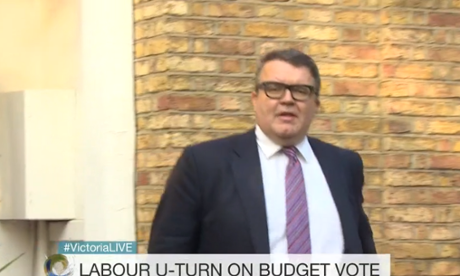
Tom Watson, the Labour deputy leader, was doorstepped as he left home this morning and asked about Labour’s fiscal charter U-turn. Asked if he was happy about it, he said: “Yes, absolutely.” Asked why John McDonnell changed his mind, he replied:
He’s a very wise and judicious shadow chancellor.
Karim Palant, who was head of policy for Ed Balls when Balls was shadow chancellor, has written an article for Comment is Free saying that Labour is right to be opposing the charter for budget responsibility, and that John McDonnell should never have said he would back it in the first place. Palant suggests McDonnell only did this because he misunderstood what it actually said.
Here’s an extract.
The last charter in January was for a current, not absolute surplus, and it had no specific date attached, so Labour was able to vote for it.
This current charter enacts a fiscal policy far tougher than that contained in Labour’s 2015 manifesto. Voting for it was not consistent with a slowing of fiscal consolidation ....
In announcing his initial decision McDonnell made two revealing arguments. He claimed the charter did not define the “normal times” when borrowing was forbidden. And that unlike Osborne he would achieve a surplus by “investing” to grow. But the charter does define “normal times” and prevents borrowing for investment.
It is quite a claim to say that McDonnell announced that he would vote for something that he had not read or perhaps misunderstood. But when his conference speech just two days later failed to explain how he could ever meet this surplus rule, I and others feared he hadn’t realised the hole he had dug himself.
It seems that at some point in the last two weeks this became clear to him. The result is that he has been forced to backtrack on the first major decision he has ever taken.
And here is Palant’s conclusion.
A shadow chancellor’s fiscal stance is fundamental to credibility and trust. This kind of chaos less than a month into the job is the kind of blow even significant political figures struggle to recover from.
Here is the final text of the government’s 20-page charter for budget responsibility (pdf) that Labour MPs will vote against tomorrow following John McDonnell’s U-turn.
And here is a blog by Richard Murphy, the tax campaigner whose ideas are being picked up by Jeremy Corbyn, explaining why he thinks the charter (which commits the government to running a budget surplus in normal times) is a mistake. Here’s an extract.
Saving takes money out of circulation in our economy: it effectively destroys it. That is because money is only created be lending and since saving is the opposite of lending ( loan repayment having the same net effect as saving in economic terms) than a worldwide glut of savings leaves a shortage of something that we all need, which is money. UK money supply has fallen since the end of the quantitative easing programme in 2012. If this shortfall is to be made good then the only party capable of delivering the money we need to keep the economy going when the private sector insists, overall, on saving is the government and the only way in which it can create this new money is by running a deficit. This is the role of quantitative easing when the economy gets really tight: I would of course prefer people’s quantitative easing to any other form because this does, of course, direct the funds to productive investment for all the positive reasons noted in the previous section.
Here’s the Labour MP Mike Gapes on the state of the Labour party today.
There is now no collective Shadow cabinet responsibility in our Party, no clarity on economic policy and no credible leadership. @BBCr4today
— Mike Gapes (@MikeGapes) October 13, 2015
His whole Twitterfeed is well worth reading this morning. He seems to have spent the last hour or so in robust debate with Corbynites.
Osborne says negative inflation is 'a real boost for budgets for working families'
George Osborne, the chancellor, has welcomed the inflation figures.
Inflation at -0.1% while wages rising at fastest rate in over a decade is a real boost for budgets of working families
— George Osborne (@George_Osborne) October 13, 2015
We shouldn't mistake this for damaging deflation: we remain vigilant and our system is designed to deal with such risks
— George Osborne (@George_Osborne) October 13, 2015
Inflation has gone negative and is at -0.1%
Inflation has gone negative, according to figures just out today.
On Twitter this morning the Labour MP John Mann says that John McDonnell decided to execute his fiscal charter U-turn partly because he learnt that Mann and other Labour MPs were determined to vote against it.
Whips discovered on Sunday that I and others were voting against Osborne's austerity charter. That is why McDonnell did his U-turn.
— John Mann (@JohnMannMP) October 13, 2015
Labour Treasury Cttee members took Osborne's budget charter apart in July. All were voting against it. And still are.
— John Mann (@JohnMannMP) October 13, 2015
Last night's PLP meeting - A round-up of the coverage
Last night’s PLP meeting seems to have been remarkable. Here is a round-up of the best and most colourful accounts around this morning.
After a short speech by Jeremy Corbyn, shadow chancellor John McDonnell sought to explain his decision to oppose Osborne’s fiscal charter (having supported it just two weeks ago). He cited the change in global economic conditions and the refusal to allow Labour to table an amendment. McDonnell also vowed to assist colleagues in Scotland in challenging the SNP anti-austerity claims. But MPs were left unimpressed. “I don’t think I’ve ever heard a weaker round of applause at the PLP than the one John McDonnell just got,” one told me. MPs believe that McDonnell’s U-turn was due to his failure to realise that the fiscal charter mandated an absolute budget surplus (leaving no room to borrow to invest), rather than merely a current budget surplus. “A huge joke” was how a furious John Mann described it. He and others were outraged by the lack of consultation over the move. “At 1:45pm he [McDonnell] said he was considering our position and would consult with the PLP and the shadow cabinet,” one MP told me. “Then he announces it before 6pm PLP and tomorow’s shadow cabinet.”
The U-turn sparked furious scenes at the weekly meeting of the Parliamentary Labour Party in the Commons which one long-serving MP said afterwards was ‘the worst PLP meeting I have ever attended’, including the dark days of Iraq when the party was deeply split.
Angry shouting could be heard as Mr McDonnell outlined his thinking to MPs behind closed doors.
Former Labour Cabinet minister Ben Bradshaw said the party’s economic policy was now ‘a total f****** shambles’.
Another former minister told Mr McDonnell: ‘You are right to say we need a serious message on the economy but this is an embarrassing shambles’.
“It was absolutely mental,” one senior Labour MP reflected when Guido asked how Monday night’s PLP meeting went. “It was feral,” reveals a second backbencher: “Shambolic“. A relative newcomer comments: “People who have been around for a lot longer said it was the worst PLP meeting they have ever been to.” This is what happened at this extraordinary meeting of Labour MPs, told by the people in the room ...
Moderate MP Ian Austin “stood up and said Jeremy should start acting like the Leader of the Opposition and not like a student union president”, reports a colleague. Grimsby MP Melanie Onn launched a thinly-veiled attack on Diane Abbott over her “online trolling”: “She didn’t name Diane but everyone knew who she meant”. Emily Thornberry angrily told off her fellow MPs for texting journalists details of what was being said.
John Mann, the MP for Bassetlaw, led the attack over the apparent change of stance on a key economic policy. Describing the U-turn as a “huge joke”, he accused the leadership of “shambolic politics” and making a decision that “does not have any aspect of democratic politics”. Leaving early, Ben Bradshaw, the former culture secretary, described it as a “total f***ing shambles”.
Ben Bradshaw left the meeting early, reportedly describing the scene as a “total f*cking shambles”, while inside John Mann had described the move as a “huge joke”. Former Shadow Chancellor Chris Leslie also criticised the decision, and appeared on this morning’s Today programme to advocate Labour MPs abstaining from the vote.
From the Guardian’s Patrick Wintour
Corbyn blasted at PLP on fiscal rules, privy council, trolling front benchers, fixing NEC seats, Syria & Momentum. Otherwise routine.
— Patrick Wintour (@patrickwintour) October 12, 2015
From Mark Ferguson, the former LabourList editor
Texts from MPs about the PLP meeting tonight are X-rated. Bloody hell
— Mark Ferguson (@Markfergusonuk) October 12, 2015
Updated
Diane Abbott says Corbyn's critics will soon come to terms with his victory
Diane Abbott, the shadow international development secretary and an ally of Jeremy Corbyn, told the Today programme this morning that the U-turn row was “a process story” and that most Labour MPs now supported the policy.
We are in the right position now, it is a position that most of the PLP is comfortable with and, I think, all party members. John McDonnell takes the deficit very seriously and the party as a whole takes the deficit very seriously.
She also played down claims that last night’s PLP meeting was chaotic. “At any given time there were will be a group of MPs in parliament, of whatever party, who are unhappy,” she said, when asked about it. And she Labour MPs unhappy about Corbyn being leader would come to terms with the situation.
Some people in the party are only slowly coming to terms with the fact that Jeremy won. Once they have come to terms with that, they will be happy.
Asked how long this would take, she said “weeks rather than months”.
UPDATE: Here’s the interview.
Watch John Humphrys press @HackneyAbbott on Labour's budget surplus vote U-turn: http://t.co/5zNbvnDJHc
— BBC Radio 4 Today (@BBCr4today) October 13, 2015
Updated
Jeremy Corbyn, the new Labour leader, has already had a series of uncomfortable policy disputes with MPs and shadow ministers - over Europe, the benefits cap, and Trident, for example - but today he is embroiled in what could be the biggest row yet. Yesterday John McDonnell, the shadow chancellor and Corbyn’s close ally, announced that he was abandoning the stance he took just last month and that he was now committing Labour to voting against the government’s charter for budget responsibility. At last night’s meeting of the parliamentary Labour party (PLP) there was a mighty backlash, leading to it being described as shambolic.
Parliamentary Labour Party meeting described by one MP - not a Blairite - as one of the worst he has ever seen - "an incompetent shambles".
— Patrick Wintour (@patrickwintour) October 12, 2015
And this morning the backlash continues. On the Today programme Chris Leslie, who was shadow chancellor for a brief period after the election until Corbyn’s election as leader, said the U-tun was sending out “the wrong message” to the public. He said:
To go from one extreme to the other is wrong in economic terms but also it sends the wrong message to the general public as well. So, to be fair to John McDonnell, this is a very difficult balancing act, it’s a very difficult topic, but it’s incredibly important that his is clear and consistent and explains fully not just what Labour’s position is but why he backed George Osborne’s surplus a couple of weeks ago and is now against it, apparently ...
I can’t explain why John went in favour of supporting and voting for George Osborne’s strategy. I personally think it would have been better to say, in principle, we support the concept of a surplus but if certain conditions, certain tests are passed. For example, can we be certain that the viability of public services - our NHS, our national security - would be safe.
I will be covering more reaction to the U-turn as the day goes on.
Here is the agenda for the day.
9.30am: The Home Office releases hate crime statistics.
11am: David Cameron chairs a meeting of the community engagement forum.
Around 12.40pm: MPs start debating the second reading of the immigration bill.
2.30pm: Chris Grayling, the leader of the Commons, gives evidence to the Scottish affairs committee about English voters for English laws.
2.45pm: Richard Harrington, the minister for refugees, gives evidence to the Commons home affairs committee.
As usual, I will also be covering breaking political news as it happens, as well as bringing you the best reaction, comment and analysis from the web. I will post a summary at lunchtime and another in the afternoon.
If you want to follow me or contact me on Twitter, I’m on@AndrewSparrow.
.jpg?w=600)