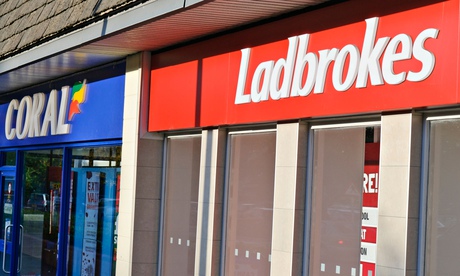
The obvious place to start when considering the news that Ladbrokes and Coral, two of Britain’s biggest bookmaking businesses, are in merger talks is the form book. And at first glance, even if the two sides can thrash out a deal, the chance that it will get past the competition regulators appears to be about 33-1 against.
It is 17 years since Peter Mandelson, then the secretary of state for trade and industry, accepted the “unanimous conclusions” of the Monopolies and Mergers Commission that Ladbrokes’ proposed takeover over of Coral “would damage competition and disadvantage punters”. Then, Ladbrokes had around 1,900 betting shops, while Coral had about 830, though the deal would also have resulted in 130 shops sold to what was then the state-owned Tote. When the smoke cleared, Ladbrokes, with 2,600 shops, and William Hill, with 1,500, would have controlled about 52% of Britain’s cash-betting market between them and that, Mandelson decided, to general approval from racing and punters alike, was much too much.
Now, the idea is back in the starting stalls, with one obvious difference being that a merged company would control nearly 4,000 shops out of a UK total of 9,000. William Hill, meanwhile, has about 2,300. If 52% of the market was going to damage competition and disadvantage punters in 1998, how could a duopoly with 69% of all shops possibly get through the competition regulators now?
And yet, there seems to be optimism on both sides that this time around, a deal would negotiate the final fence. The City took a view on Tuesday morning, too, as Ladbrokes’ share price rose nearly 20% by lunchtime, even though the bare form suggests it should be a non-runner. So what has changed since 1998?
The simple answer, of course, is everything, and the reason why is the internet. The retail landscape has been profoundly and permanently transformed over the last decade-and-a-half, and the gambling sector has not been immune. The language used to describe the proposed deal between Ladbrokes and Coral is a symptom of this change. Then, it was a takeover, the betting behemoth that was Ladbrokes swallowing a less significant rival. Now, it is being seen as a “merger” between two businesses of broadly similar size, or even a “reverse takeover” of Ladbrokes by Coral.
This could be seen as final confirmation that Ladbrokes has, in business terms, missed one of the most gaping open goals in corporate history. It arrived at the dawn of the online age neck and neck with William Hill in terms of its size and brand-awareness. Both in Britain and around the world, punters recognised and trusted the Ladbrokes name. Yet while its old adversary seized the opportunity and kicked clear, Ladbrokes stumbled horribly, and was then overtaken too by younger, slicker rivals such as Paddy Power and Bet365.
The internet also opened up new ways to bet, as the Betfair betting exchange not only took a share of the market but further reduced margins that were slim in the first place. But the change that arguably hurt Ladbrokes most of all was not in the shape or structure of the gambling market. It was in the nature of its customers.
Put simply, there is no loyalty in gambling any more. Twenty years ago, the overwhelming majority of punters, whether they were betting on horses, football, greyhound or anything else, placed most of their bets in a single shop. The handful that could bet on credit via telephone – a throwback to the days before betting shops were legalised – might have accounts with a couple of firms at most.
For some punters, this brand loyalty was rooted in superstition - they had a “lucky” bookie – but for most, it was born of necessity. The “demand” rule in local planning regulations – which required bookies who wanted to open a new shop to prove that there was sufficient local demand – meant that betting shops were spread out. The competition was often several blocks away. Now, with shops clustered in areas of high population density to exploit the arrival of high-stakes gaming machines, the nearest alternative is often next door.
Online, meanwhile, there is no need for brand loyalty at all. Aggregator sites offer real-time prices with one-click access to the best odds available. Bookies new and old face the same problem: they attract money only when a price is at, or near, the top of the market and thus has very little margin attached. How long would a supermarket stay in business if its customers bought only the loss-leaders and ignored everything else?
Ladbrokes recently appointed Jim Mullen, formerly of William Hill, as its new chief executive, and his first decision seems to have been that it is time to do something dramatic. A possible merger with Coral also hints at a belief – or hope – that cash gambling on the high street is not quite the doomed dinosaur that many suppose it to be.
If so, he might be right. Gambling shares many of the characteristics of coffee as a quick-fix, in-out product that doesn’t need to cost too much. A credit to an online account, meanwhile, will never match the excitement that comes from pocketing a roll of tenners. For as long as there is a high street, there will also be a market for gambling with cash, and it is one that an immense 4,000-shop estate may now be allowed to service because the internet has brought so much competition to the market as a whole. But what might it mean for punters, beyond the likely disappearance of a familiar name from the retail landscape? A little less choice, obviously, and so, perhaps, slightly higher margins for the bookie, but not to an extent that many customers are likely to notice. Those who are hugely price-sensitive, after all, are already betting online, where most firms offer bonuses and price-boosts that their bricks-and-mortar colleagues cannot hope to match.
And what about the number one complaint of the modern backer, that bookies have turned into risk-averse accountants who will not lay a proper bet? Might a new mega-bookie be more willing to take three figures on a 10-1 chance without a reduction in either the price, the stake, or both? The short answer, sadly but almost certainly, is no, because wherever in the modern betting world there is a decent price and bookie willing to stand it to serious money, there will also be an “arber” trying to take as much as they can before laying back for a small, guaranteed profit on Betfair. They take most of the juice from the orange and force everyone else to suck on the peel, and whether it is offline or online, sifting the arbers from the genuine punters who just want a chunky bet is difficult and expensive. There is no obvious reason why a merged firm would be more willing to do it than its constituent parts beforehand.
Ladbrokes dates back to the late 19th century while Joe Coral founded his bookmaking business in 1927. It is a racing certainty that a merger between two such well-established companies would result in job losses, not just at head office but in the shop estate too, as the most marginal shops are weeded out. Beyond the loss of another familiar name from the high street, though, the general public would be unlikely to notice much difference.
It may not happen in any case, but even if the merger talk turns out to be hot air, it will not mark the end of change in gambling and betting, or even the end of the beginning. A multibillion pound industry is adjusting to the digital age, and the adapt-or-die phase still has a long way to run.