Afternoon summary
- Ministers have lost a vote on pubs after Lib Dem and Tory rebels united with Labour to back a proposal to loosen the control of pub companies over pub landlords. (See 4.26pm.)
-
Alex Salmond has used his resignation statement as first minister to hint that he will stand for parliament at the general election. (See 4.53pm.)
Updated
Duncan Hames was one of the Lib Dem MPs voting against the government.
Among the Lib Dem rebels to Jo Swinson's pub bill... her husband Duncan Hames! #awkward
— John Stevens (@johnestevens) November 18, 2014
That’s awkward. His wife, Jo Swinson, was the minister putting the government’s case in the debate.
My colleague Nicholas Watt says Brian Binley, one of the Tory rebels supporting Greg Mulholland, sent an email to Tory colleagues telling them to ignore a note they had received from the whips.
How rebels confront whips. Brian Binley 'dear colleague' email: whips message which gave impression minister has done deal...simply untrue
— Nicholas Watt (@nicholaswatt) November 18, 2014
Nick has sent me the text of Binley’s email. Here it is.
Dear Colleague,
The Whips message which gave the impression that the Minister has done a deal with the prime movers of the New Clause 2 is simply untrue. No such deal has been done and New Clause 2 will therefore still be put to the vote. I and its other prime movers would be most grateful if you could support or abstain as you had originally decided.
Regards
Brian
Here’s Toby Perkins, the shadow business minister, on the pubs vote.
Labour has led calls for a proper statutory code with teeth on pub companies, giving tenants the protection they need and putting an end to the unfair treatment they’ve received from large pub companies. Our plans have won support from a broad coalition of campaigners including Camra, the Federation of Small Business, trade unions and the cross-party BIS select committee.
Over the past three years ministers have been dragged kicking and screaming every step of the way on this issue, and now they have been dealt a resounding and humiliating defeat in the House of Commons. Ministers must now act immediately to ensure there is a proper statutory code with a free-of-tie option to protect local pubs, and must not ignore the will of the House of Commons, after their desperate and shambolic attempts to stave off defeat have failed.
Sam Coates from the Times says Matthew Hancock, the business minister, has been apologising to David Cameron for the vote.
Matt Hancock reportedly seen grovelling to the PM after he oversaw the first loss of a vote on a government bill since 2010
— Sam Coates Times (@SamCoatesTimes) November 18, 2014
The pubs vote does represent an incident of “yellow on yellow” friendly fire.
Greg Mulholland, the MP who tabled the amendment, is a Liberal Democrat. The department in charge of the bill is business, which is run by Vince Cable, and the minister handling the bill when MPs debated pubs was Jo Swinson, a third Lib Dem.
In an attempt to avert the rebellion, Swinson offered to amend the bill in the Lords to ensure the MRO option (Mulholland’s option - see 4.42pm) started coming in after two years if a review showed that the reforms in the bill were not working. But MPs rejected that.
Here’s more from the pubs debate.
Adrian Bailey, the Labour chair of the Commons business committee, explained why he was backing the Mulholland amendment.
We know that behind every closure there is a personal story, often heart rending of people investing their life savings, and working all hours, and then having to close their businesses because the imbalance and the fundamental economic relationship between them and the pub company was so unfair that they just couldn’t keep going.
I believe that this new clause is not only vital for the future of thousands of pub tenants who will be watching this debate knowing that their future could depend on the outcome of it, but it is also actually potentially a milestone in our democracy.
Back to the pub vote.
It marks the first government defeat on legislation in the Commons where collective responsibility was not suspended.
Pubs vote is 1st time since 2010 Govt defeated on its own bill (where collective resp not suspended).
— Paul Waugh (@paulwaugh) November 18, 2014
@paulwaugh On a bill, yes, but somewhat less significant than the European budget vote or Syria (where collective responsibility held).
— Philip Cowley (@philipjcowley) November 18, 2014
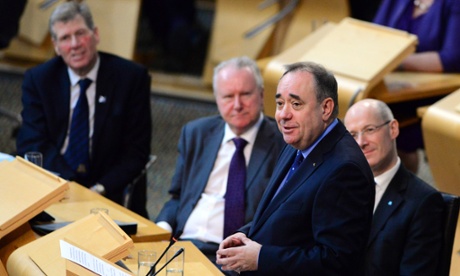
Alex Salmond's resignation statement - Summary
Alex Salmond’s resignation statement was rather gracious, and the exchanges overall were polite and generous. Of the responses, Ruth Davidson and Patrick Harvie’s were the best, and Jackie Baillie’s was poor. There was not much politics in it all, but there were a few sharp moments.
Here are the main points.
-
Salmond used his resignation statement as first minister in the Scottish parliament to say that devolution, and the independence referendum, has given Scotland “the most energised, empowered and informed electorate of any country in Europe”.
This Parliament was reborn out of the realisation that we could no longer afford to have our domestic politics dictated by governments without democratic legitimacy.
We progressed because people became impatient with politicians who wanted to administer rather than to govern.
And we will grow further yet because people wish to shape the circumstances around them and are demanding a Parliament fully equipped for that task ...
Scotland now has the most energised, empowered and informed electorate of any country in Europe.
We have a new generation of citizens who understand that their opinion matters, who believe that their voice will be heard, and who know that their vote can shape the society they live in.
-
He hinted that he intends to stand for parliament at the general election, so that he can use SNP votes to put maximum pressure on the government to offer concessions to Scotland in the event of a hung parliament.
I have led a minority administration and a majority one. Minority government requires negotiation – to recognise honest disagreement, and then compromise in the public interest.
And Presiding Officer, I have no idea if that experience of minority government in this place will ever again come in handy in another place.
-
Ruth Davidson, the Scottish Conservative leader, said implied that Salmond was being hypocritical in criticising Labour and the Lib Dems for siding with the Tories over independence. Mocking his attack on Alistair Darling for standing “shoulder to shoulder” with the Tories, Davidson said that Salmond relied on Tory support when he ran a minority government.
On Thursday the first minister joked that working with the Conservatives [in the referendum] was electoral suicide, despite the small matter of us having defeated him in the referendum, despite also one of the reasons for his administration gaining a reputation for confidence and stability during those first four years being because he needed, he sought and he received support from the Scottish Conservativese to pass his budgets and to keep his government on the rails. One might say that the first minister and Annable Goldie [the then Conservative leader] stood shoulder to shoulder to make the government work. I would not go so far as to say that they were Better Together, but such a close working relationship was no drag his electoral prospects in 2011.
-
Willie Rennie, the Scottish Lib Dem leader, said Salmond had left a divisive legacy.
For too many families, friends and communities, the referendum was divisive. [Salmond] may not wish to accept it, but that will be as much his legacy as all the positive attributes that he would describe. It will take many years for those wounds to heal and the unity we once enjoyed to return.
Updated
Greg Mulholland's speech in the pubs debate
Here are some extracts from Greg Mulholland’s speech in the debate. Mulholland is chair of the Save the Pub campaign.
I’ve taken this from the Press Association.
Mulholland said:
At the moment the bill and the code [of conduct] doesn’t deliver what the government has set out courageously to deliver.
Don’t take my word for it - take the word actually of one of the two companies who is particularly vociferously lobbying against it - Punch Taverns.
In their own prospectus for potential investors, dated October 6 2014, they say ‘Punch does not believe that the reforms currently proposed would materially adversely affect the Punch group’.
In other words it would be business as usual, they would continue to charge excessive beer prices, often 70% more than actually MPs could get from the brewery as well as entirely unregulated rents.
Mulholland stressed that his plan to allow pubs a “market rent only” (MRO) option from their parent company would come in gradually over five years and only be triggered at key points in the cycle of a lease or tenancy, such as rent reviews, lease renewals or on the sale of the title of a property, or if there was a substantial change in prices or change in circumstances such as a cheaper pub opening next door.
This period would then be followed by two potential periods of negotiation between the pub and the larger owning company with an independent surveyor to adjudicate over any differences in opinion, he said.
This is a reasonable gradual process that will simply bring back market forces into a sector that frankly has become grotesquely anti-competitive, it’s closed to many smaller breweries and it is not working for publicans, it’s not working for those communities losing pubs, and actually frankly it’s not working for those large companies themselves.
Mulholland also launched a stinging attack on large pub companies and the British Beer and Pub Association for scaremongering about his proposals with “utterly baseless comments”.
There has been a shameful campaign of misinformation against (my amendment) and the market rent only option.
The usual suspects, the large pub companies and their mouthpiece the so-called British Beer and Pub Association, in reality the big brewers and pubco association, and they have been lobbying vociferously with a whole stream of utterly baseless comments, simply scaremongering to suggest that somehow the idea of these companies simply offering a fair commercial rent to their would somehow cause collapse, chaos and closures and all the rest of it.
If you do believe in competition then you should not be afraid of allowing brewers of all sizes to compete.
My colleague Patrick Wintour points out that this was a victory for a campaign run on a shoestring. They were up against the large pub companies.
Govt defeat in the Commons 284 to 269 on curbing PubCos. Extraordinary victory for @GregMulholland1 and a campaign funded with £1,500.
— Patrick Wintour (@patrickwintour) November 18, 2014
This is what the Press Association has filed on the defeat.
The government has been defeated over proposals to allow pub tenants tied to big companies to demand a market rent only (MRO) agreement from their parent company.
A broadly-backed amendment to the small business, enterprise and employment bill, signed by MPs from all three main parties, was approved by 284 votes to 269, majority 15.
Liberal Democrat Greg Mulholland (Leeds North West), who proposed the amendment, said his option had been broadly backed in a consultation run by the Department for Business, Innovation and Skills (BIS).
It is thought to be the government’s first defeat on one of its own bills since the 2010 election.
The government’s majority is usually around 60.
Loud cheers from the Labour benches greeted the result while shouts of “resign” were also heard. A shout of “well done chief whip” was aimed at Conservative Michael Gove.
Senior Liberal Democrat Tim Farron patted a smiling Mr Mulholland on the back.
Greg Mulholland, the Lib Dem who tabled the amendment, had the support of 28 Lib Dem MPs and 15 Tories.
But he would not have won had it not been for Labour also backing the measure.
Government loses vote on pubs
Labour have won a vote in the Commons on the small business bill.
They were backing an amendment tabled by Greg Mulholland, a Lib Dem MP, saying pubs should be free to buy beer from anywhere, not just from the chain that owns the premises.
Mulholland, the rebel MPs and Labour won by 284 votes to 269 - a majority of 15.
Labour would stop EU migrants claiming out-of-work benefits for two years, says Reeves
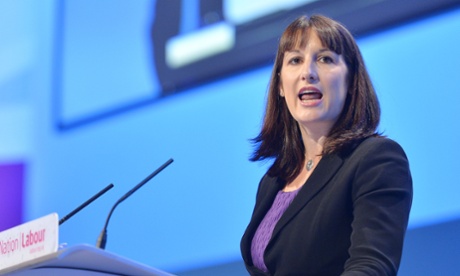
Rachel Reeves, the shadow work and pensions secretary, has announced that Labour would seek to stop EU migrants claiming out-of-work benefits for two years.
Labour would also look at restricting their access to in-work benefits such as tax credits, she said. And it would seek to stop child benefit and child tax credit being paid for children living abroad.
Reeves announced this in an article for Mail Online. Here’s the story about it, and it contains Reeves’s article at the bottom.
Here are three extracts.
On out-of-work benefits
Other countries, like Germany, have already gone further than us on this issue. So we believe that it is right to extend the period that EU jobseekers need to live and support themselves in the UK before claiming out-of-work benefits from three months to two years.
On tax credits
There are 252,000 working households from the EU now receiving tax credits, including 12 per cent of all single, childless people receiving Working Tax Credit.
Some may have been working for several years, but others may be recent arrivals on short-term contracts.
The House of Commons library estimates total spending on in-work tax credits for EU migrant households amounts to £1.6bn a year.
Our country’s social security system was never intended to subsidise and perpetuate low-paid and insecure work.
The European single market should not be about a race to the bottom on working conditions.
So while some have said that we cannot negotiate changes to benefits paid to people in work, I am determined to look at how we can deliver reform in this area too.
On child benefit and child tax credit
We will work with European countries to end the absurdity of child benefit and child tax credits being claimed for children living in other countries.
Here are some of twitter comments on the exchanges.
From David Torrance, Salmond’s biographer
FM on much better rhetorical form in his resignation statement at Holyrood: good historical sweep, ecumenical in tone & well delivered.
— David Torrance (@davidtorrance) November 18, 2014
From the journalist Euan McColm
ruth davidson points out that the snp was happy to work with the tories from 2007-11. says salmond stood "shoulder to shoulder" with goldie.
— euan mccolm (@euanmccolm) November 18, 2014
that's a pint scottish labour owes ruth davidson for pointing out alex salmond was happy to cooperate with the tories.
— euan mccolm (@euanmccolm) November 18, 2014
From Jim Murphy, favourite in the contest to be Labour’s next Scottish leader
No matter our differences, Alex Salmond has served Scotland with real commitment. I wish him all the best in whatever he chooses to do next.
— Jim Murphy (@jimmurphymp) November 18, 2014
And here’s me replying to Murphy
@jimmurphymp You sure? Holding a minority Labour government to ransom seems to be top of his list at the moment
— AndrewSparrow (@AndrewSparrow) November 18, 2014
The exchanges are now over, and the sitting is suspended.
I’ll post a summary shortly.
Alex Salmond is replying now.
He says Jackie Baillie was wrong. Salmond did not walk out of the SNP. He was flung out. You should never go until you are expelled, he says.
Addressing Davidson, he says he had no idea she came close to voting yes. If only they had found the right arguments to persuade her.
And he says he did not realise all the achievements of the 2007-11 SNP government were down to the Tories.
As for Willie Rennie, he says when he met him and told him the SNP were going to win at the Dunfermline byelection, he thought Rennie was a voter.
He says he regards Harvie as a “critical friend”. He thanks him for his comments.
And, as for Stevenson’s “black bitch” comment, he says that reflects what his opponents think of him.
He wishes everyone in the parliament well. Goodbye and good luck, he says.
MSPs applaud him again.
Stewart Stevenson, the SNP MSP, is speaking now.
He says Salmond is a “black bitch”. That’s a phrase for people born in Linlithgow, he explains.
The most telling moment during the referendum was when Salmond met a young man who was voting no. Salmond did not try to belittle him. He listened as the man explained his reasons, he says.
Stevenson says this is a transition. It does not mark an ending.
Salmond can take away “our thanks and our love”, he says.
Updated
Patrick Harvie, the co-convenor of the Scottish Green party, is speaking now.
He will start with a low point, so he can end with a high point, he says.
Salmond may regret falling into the orbit of Donald Trump, he says. Trump embodies the values of greed and over-consumption, the values of the Tea party.
Will Salmond “sever all links with this delusional bully”, he asks.
As for a high point, people might expect Harvie to mention the Climate Change Act.
But Harvie says that was only a half measure.
Instead, he pays tribute to Salmond for putting his weight behind the idea of climate justice. This is an idea that will grow in importance, he says.
Harvie says the case for independence was advanced during the referendum. And, if there is another referendum, support for it will rise from 45%.
The experience of the campaign has been transformational, he says.
Willie Rennie, the Lib Dem leader, is speaking now.
He says he first met Samond at the Dunfermline byelection. Salmond was predicting an SNP win, but Rennie won.
For too many families and communities, the referendum was divisive. That will be Salmond’s legacy, he says. He hopes Salmond reflects on that.
Rennie says he is now the longest-serving party leader in the Scottish parliament. It is not much of a accolade, but he will take anything these days, he says.
Rennie says he is recovering from a back operation. He hopes Salmond takes care of his health.
Davidson says Salmond’s record in his second term was less good.
He had the democratic right to demand a referendum. But he should take some responsibility for his side losing, she says.
She says his leadership has been marked by a remarkable instinct for power. That kept him at the top for so long.
Davidson says she is a rare breed: an opposition party leader who has outlasted Salmond.
Davidson finishes. And here’s David Torrance’s verdict.
SNP MSPs are rolling their eyes at @RuthDavidsonMSP's speech, but it's actually a pretty good analysis of Salmond's strengths & weaknesses.
— David Torrance (@davidtorrance) November 18, 2014
Davidson says Salmond said last week working with the Conservatives was electoral suicide. But it was our side that won the referendum, she says.
And you could even say Salmond and Annabel Goldie, the former Conservative leader in the parliament, stood “shoulder to shoulder”.
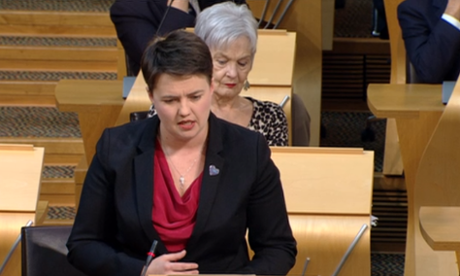
Ruth Davidson, the Conservative leader, is speaking now.
It is traditional to make some comments about how nice it will be for him to be on the golf course. But Salmond shows no sign of wanting to retire, she says.
It is said all political careers end in failure, she says. But that is not true of Salmond. He is “a political Lazarus”. He may well return to Wesminster for a third time.
She says Salmond’s longevity is quite remarkable.
She says he phoned her when she became leader, and asked her how old she was. He told her he was 35 when he first led his party.
To lead his party for so long is a feat of stamina, she says. There are very few people capable of that.
Salmond may appear like a stuck record. But, because he has stuck to the same tune, like an ear worm, it has stuck in people’s mind.
She says his record as first minister is mixed.
It’s a game of two halfs. When he was running a minority administration, he had to tone things down.
Davidson says the Tories even worked with the SNP one some things, like extra police officers.
It was a government that looked as if it knew what it was doing.
No party tried to bring it down, she says.
Jackie Baillie, the acting Labour leader, says she has enjoyed her jousts with Salmond in the chamber. But it would be wrong not to recognise his commitment to the parliament, and to the country.
The Scottish parliament and Scottish politics need people of talent. And Salmond’s considerable talents will be missed.
But Salmond might be back, she says.
She hopes he has more time to spend more time with his family.
And he will have more time to play golf. But he found time to play golf as first minister anyway, she says.
She says that Salmond was once expelled from the SNP. You can watch it on YouTube, she says.
He took the SNP from relative political wilderness to minority government. How it became a majority government is something that still has John Curtice scratching his heads, she says.
Salmond said he single-handed could have saved RBS. So, if only the first minister had been running the yes campaign.
Baillie says Salmond has started a trend with the 45-ers. Not the people who think yes won, but the supporters of Keith Brown (who got 45% in the SNP deputy leadership campaign.)
Baillie says Salmond is writing a book. It might reveal where the SNP’s missing legal advice about the EU and independence went.
Salmond says it has been the privilege of his life to have been first minister.
Any departing is twinged with sorrow. But it is balanced by confidence and optimism, in the new first minister and in the ability of the parliament.
I can say with certainty more change and better days lie ahead for this parliament, he says.
MSPs are now applauding.
Salmond says the parliament will grow because people want to shape the circumstances around them.
The referendum was hailed around the world as a model of truly participatory democracy, he says.
He says he wants to end on this point of political engagement.
Fifteen years after MSPs were applauded into the Mound, that applause has turned into proper engagement.
Scotland has the most informed electorate of any country in Europe, he says.
.@AlexSalmond: "Scotland now has the most energised, empowered and informed electorate of any country in Europe."
— The SNP (@theSNP) November 18, 2014
Salmond says they have all just lived through one of the most invigorating debates of the modern era.
It was kind of the Daily Record to show 50% SNP support on the day he’s leaving, he says.
Maybe it was because he was leaving, he says.
Salmond says he has led a minority government and a majority government.
He does not know if his experience of minority government will come in handy in another place, he says.
(That’s another hint he will stand for the Westminster parliament next year.)
Salmond says more than 400 organisations held events in the building last year.
And more than 4m people have visited the parliament.
That kind of accessibility is not unique in the democratic world. But it is rare, he says.
Salmond says this is because of the work of MSPs. He pays tribute to some of those who have died.
.@AlexSalmond: "I think in particular of some of the MSPs who are no longer with us–Donald Dewar, Margaret Ewing, Bashir Ahmed, Phil Gallie"
— The SNP (@theSNP) November 18, 2014
.@AlexSalmond:"Donald Gorrie, David McLetchie, Brian Adam, Helen Eadie, John Farquhar Munro, Margo Macdonald & most recently Sam Galbraith"
— The SNP (@theSNP) November 18, 2014
The parliament has great strengths, he says.
Updated
Only a minority of MSPs attended the opening ceremony of the parliament, he says.
It was a great day, he says.
When the MSPs entered the building on the Mound, they were cheered in by the public.
He had never seen that much enthusiasm before. And he did not see it again until this summer’s referendum.
He quotes from a poem by Edwin Morgan.
This parliament has accepted the mandate to be bold, he says. And it reflects the diversity of modern Scotland. It is the chamber that reflects people’s values and hopes.
Alex Salmond's resignation statement
Alex Salmond is making his resignation statement now.
He will resign from the start of parliamentary business tomorrow, he says.
My colleague Severin Carrell reveals what Salmond got as a leaving present from his cabinet colleagues.
.@AlexSalmond got a personalised golf bag, in blue and white with small saltire, as a leaving present after Cabinet whip-round.
— Severin Carrell (@severincarrell) November 18, 2014
Alex Salmond is making his resignation statement in the Scottish parliament shortly.
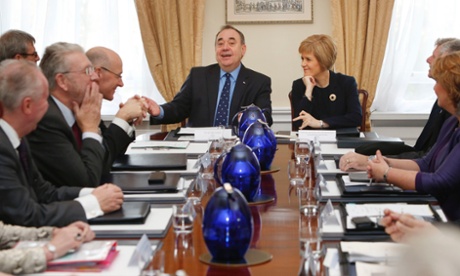
Here he is earlier chairing his last cabinet meeting as first minister.
Lunchtime summary
- Theresa May, the home secretary, has announced plans to hold police disciplinary hearings in public. (See 10.43am.) She also said that getting rid of police commisioners would be “a grave mistake”. (See 12.42pm.)
- Yvette Cooper, the shadow home secretary, announced that Labour would pay for 1,000 extra border guards by imposing a charge on visitors from the US and 55 other countries. (See 12.57am.)
- David Cameron has been briefed by intelligence chiefs on the hunt for Islamic State (IS) militants responsible for the murders of Western hostages held in Syria. As the Press Association reports, Cameron chaired a 40-minute session of the Government’s Cobra contingencies committee called in the wake of the killing of US hostage Peter Kassig. “The security agencies gave the prime minister an update on all aspects of the situation,” Cameron’s official spokesman said. “The prime minister reiterated his condemnation of Mr Kassig’s murder. The Prime Minister will continue to be briefed on a regular basis.”
- A new poll has given the SNP record leads in both Westminster and Holyrood voting intentions. As the Press Association reports, the Survation survey for the Daily Record put support for the SNP for the coming general election at 45.8%, compared with 23.9% support for Labour. (See 9.34am.) SNP Westminster leader Angus Robertson said:
This new opinion poll giving the SNP our biggest ever lead in a Survation poll for both Holyrood and Westminster elections is enormously encouraging. It reflects all recent surveys in underlining the strength of the SNP vote, and is a further demonstration that Labour and the other Westminster parties are facing a major backlash in Scotland. With a majority of people in Scotland saying that they distrust Ed Miliband, David Cameron and Nick Clegg, this poll is a disaster for all three Westminster parties.
-
Campaigners have held a rally ahead of a vote this afternoon on an amendment to the small business bill that would allow pub landlords to buy beer from anywhere, not just from the pub chain that owns the premises.
Huge crowd outside @UKParliament earlier for #voteforpubs rally! Thanks all for coming, vote on #NewClause2 at 4pm! pic.twitter.com/hs28v18ifE
— FairDealforYourLocal (@FairDeal4Locals) November 18, 2014
Ed Miliband has (finally) got round to responding to Myleene Klass on Twitter.
Here’s why our NHS needs a mansion tax. It’s Pure and Simple. http://t.co/ol6eRj5aAW
— Ed Miliband (@Ed_Miliband) November 18, 2014
You can read all today’s Guardian politics stories here. And all the politics stories filed yesterday, including some in today’s paper, are here.
As for the rest of the papers, here’s the PoliticsHome list of top 10 political must-reads, and here is the ConservativeHome round-up of all today’s political stories.
And here are six articles I found particularly interesting.
The role of human agency is overrated in politics. Not every development in public opinion is a reaction to something a politician has said or done. Ukip’s success is a mysterious thing. It might be a backlash against the copious European immigration of the last decade but, if so, it took a long time to materialise. It could be a howl at globalisation; similar parties are rampant in countries where Mr Cameron is not prime minister. But again there is that question of chronology: why, in 2010, under the same leader, when globalisation was no less a force, did this insurrection perform so feebly?
The only certainty is that voters will decide the future of Ukip independently of anything said by the mainstream parties, or even by Ukip itself. Britain is experiencing either a great structural turn towards populism, or a transient fit of pique. The general election in May next year will tell us which. Either way, nothing Mr Cameron does will have much effect. If we are living through a tectonic rupture and the emergence of a durable political movement – and such things do happen, albeit once in an eternity – no speech or policy will stop it. A century ago, the Liberals tried to stymie Labour’s ascent after the enfranchisement of the industrial working class. They redistributed wealth and constructed an alpha version of the welfare state. Labour still usurped them as the principal non-Tory force in the land, driving them almost to extinction.
The individual policy wrangles are symptomatic of a wider culture war. Like Labour, which finds itself forced back to its comfort zone by economic crisis and electoral defeat, the Tories are now facing an existential crisis. As one Conservative moderniser puts it: “We are in danger of targeting angry old men and writing off the younger voters, women, ethnic minorities, gay people and city dwellers who we need to create a winning coalition.”
There is a disconnect between the Tories’ desire to maximise their traditional vote between now and May to avoid immediate electoral defeat, and the need to attract new supporters to avert annihilation in the longer term. “The big strategic question for the Conservatives is: which election do we want to win?” says one senior figure. “We can try and limp over the line in 2015 by echoing Ukip but that will damage us five years down the line.”
Ed Miliband has seized control of the selection process for Labour MPs, boosting hopes of those in his inner circle who want a seat and allowing him greater scope to do deals with unions.
The party’s ruling national executive committee (NEC) has agreed that from today a “special selection panel” will determine what happens in plum seats where sitting MPs announce they are standing down.
The panel wields huge power, deciding which seats must field all-women shortlists and determining the entire composition of shortlists in others. It is usually set up closer to polling day. One senior Labour source said that candidate selections which go through this process are “usually fixed” ...
Although a special panel seizes control of the selection process before every election, Labour sources were stunned that it was being set up in November. “It’s very early for this to be happening,” said one close the NEC.
Letters containing the detailed conclusions of the public inquiry into the Iraq War have been sent to the main participants, the Daily Mail understands.
The revelation will increase speculation that the conclusions of the long-delayed inquiry could be made public in the coming months.
Tony Blair and Jack Straw are among those thought to have received letters in recent weeks warning them of any criticisms to be made by Sir John Chilcot.
Whitehall sources have told the Mail the letters were sent out ‘some time ago’.
Yvette Cooper's speech - Summary
The main news announcement in Yvette Cooper’s speech, the proposal to hire 1,000 extra border guards by imposing a charge on visitors from the US and 55 other countries, was released overnight. You can read the details in the story here.
But the politics and the arguments in the speech were interesting too. Here’s a summary.
-
Cooper claimed the national debate on immigration was polarised.
On the one hand we now have an arms race of rhetoric involving the Tories and UKIP over immigration. Ukip are exploiting peoples’ fears, fuelling anxiety and division, and David Cameron is racing to catch up. Between them they promote the idea that immigration is all and always bad, and should always be stopped.
On the other hand some liberal commentators seem to think talking about immigration at all is reactionary, and concern about immigration is irrational. They give the impression that immigration is all and always good, and should all be encouraged.
Both sides shout at each other. Neither are right. And most people don’t agree with either of them.
-
She said there was more consensus on immigration than people realised.
I’ve held public meetings, discussions and debates on immigration right across the country. And there is more consensus than you’d think. Most people think immigration is important for Britain but it needs to be properly controlled. Most people think there are benefits from immigration, but they also think there are problems – and they don’t think the problems are being dealt with. And they are right.
- She said Labour needed to talk more about immigration so that the country can have “a practical, sensible debate”.
-
She said that wanting stronger immigration controls was not rightwing.
It is the reactionary right who want to build a wall to keep the world out. But it is the free market right who want a wide open border – in the interests of cheap labour. On the one hand the right wing politics of division, on the other the right wing politics of exploitation. Neither will ever be right for Britain, for working people, or for Labour.
-
She set out five principles for a “progressive” approach to immigration.
It is because immigration is important to Britain that it needs to be controlled and managed so the system is fair.That means we need five things:
1. An honest debate; challenging the politics of division and misinformation, but honest about the problems and the need for reform
2. Stronger enforcement and border controls to build confidence in the system and tackle abuse
3. Smarter controls on different kinds of immigration to make sure we get the migration we need that benefits Britain, and can control migration that causes problems
4.Action to tackle the unequal impact of migration on jobs and wages so we get a fairer deal for local people and a better deal for our economy
5. Fairer rules when people come to Britain to make sure people contribute, promote integration, address the impact on communities and prevent division.
-
She said Labour favoured “fair movement, rather than free movement” in the EU. And she said reform in the EU was possible “if we negotiate in the right way rather than the megaphone diplomacy the prime minister has been pursuing that seems designed instead to drive us towards the exit door.”
Theresa May says getting rid of police commissioners would be 'a grave mistake'
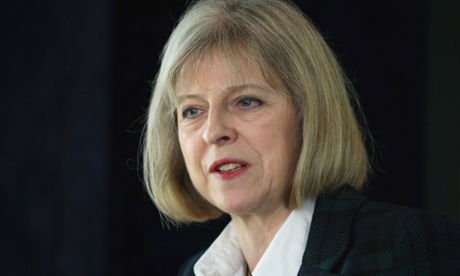
In her speech to the Association of Police and Crime Commissioners Theresa May, the home secretary, said getting rid of police commissioners would be a “grave mistake”.
When I hear that the Labour party want a ‘new political settlement’ for policing, which would replace police and crime commissioners with a ‘policing board’ made up of local council leaders, or when I hear that the Liberal Democrats - who failed to even put up a candidate in South Yorkshire - propose a similar ‘board’ of appointed councillors, I am reminded of those dark days of invisible, unaccountable committees.
We should call these policing boards for what they really are - police authorities by another name.
And when we look at the positives that police and crime commissioners are bringing, we can see just why returning to a committee model would be a grave mistake.
She also said that, even though the turnout in the first PCC elections was disappointing, that was still a big improvement on the previous system.
Under this government, more than 5.8m votes have been cast for police and crime commissioners in total. That’s 5.8m more votes than were ever received by any police authority. We have every reason to believe that turnout at the next election in 2016 will be higher than before.
Here’s the full text of Yvette Cooper’s immigration speech.
I’ll post a summary soon.
Nick Clegg is taking questions in the Commons. Asked by Sir Edward Leigh, a Conservative, if there would be a vote on English votes for English laws before the election, he did not rule it out. In reply, he just said that this was being considered by a cabinet committee and that its proposals would be published soon.
Yvette Cooper is delivering her immigration speech now.
I’ll post a summary when I’ve seen the full text.
On Twitter this morning there are claims Myleene Klass demolished Ed Miliband on the subject of the mansion tax.
Quite why is a mystery. Having watched the exchange, she just sounded like a shouty celeb not engaging very well with Miliband’s argument. If this counts as a political win, God help us all.
You can watch it here and decide for yourself.
Bloomberg’s Rob Hutton makes the point that, actually, this is probably just what Labour needs.
I can't think of anything so likely to drive support for a mansion tax as a bunch of celebrities complaining about it.
— Robert Hutton (@RobDotHutton) November 18, 2014
The General Boles spoof account puts this rather well.
At this festive time of the year, please spare a thought for the truly needy. pic.twitter.com/hY10ohuXu8
— General Boles (@GeneralBoles) November 18, 2014
And Sean Kemp, a former adviser to Nick Clegg, points out that Klass also has a poor understanding of how tax actually works. Actually, you can just tax a glass of water, he says. HM Revenue & Customs do just that.
@RobDotHutton @stephenkb Bottled water subject to VAT I think, so unless ITV used tapwater both glass and contents had been taxed
— Sean Kemp (@Sean_Kemp) November 18, 2014
Alex Salmond is formally resigning as Scotland’s first minister this afternoon.
Before he goes, he has been unveiling an engraving at Heriot Watt University with one of his favourite soundbites.
Alex Salmonds legacy stone at Heriot Watt Uni pic.twitter.com/deImnp05KF
— Claire Stewart (@stvclaire) November 18, 2014
Yvette Cooper has not delivered her immigration speech yet (see 9.10am), but the Lib Dems have already issued a statement criticising her. This is from Andrew Stunell MP, chair of the Lib Dem immigration working group.
Labour in office crashed the economy and left the immigration system in a complete shambles.
Yvette Cooper needs to explain her party’s ludicrous decision to axe exit checks - which left us with no idea if people left the country when they were supposed to.
Labour need to admit scrapping these checks has been a disaster and apologise.
Liberal Democrats will clean up their mess and bring back border controls, so we can track who is leaving Britain and identify visa over-stayers.
May announces plans to hold police disciplinary proceedings in public
Theresa May, the home secretary, has now issued a written ministerial statement with details of the consultation she has announced today on police disciplinary procedures (pdf).
It is quite a significant package. She is proposing:
- Holding police disciplinary proceedings in public.
- Giving disciplinary panels the power to cut pay-offs for chief officers.
- Getting legally-qualified chairs to conduct disciplinary proceedings.
- Giving extra protection for whistleblowers.
May says she wants to introduce these measures before the general election.
She also says she will announce another consultation soon proposing further reforms to the police complaints system and further protections for police whistleblowers.
Here’s the key section from her statement.
To improve justice, I am consulting on a power for disciplinary hearing panels to remove or adjust the compensation payments due to chief officers on termination of their appointment where a disciplinary finding is made against them.
To introduce greater independence into the way police disciplinary hearings are conducted and ensure judgements are legally sound, I am consulting on the introduction of legally-qualified chairs to conduct police disciplinary hearings.
To strengthen protections for police whistleblowers and ensure they can come forward with confidence, I am consulting on proposals to ensure whistleblowers will not be subject to disciplinary action for taking the necessary steps to report a concern and that any reprisals against them will be taken seriously.
Finally, to improve transparency and accountability to the public and ensure that the robust response that the police take to misconduct is both visible and open to public scrutiny, I am consulting on holding police disciplinary hearings and appeals in public.

Theresa May, the home secretary, is publishing plans for police misconduct hearings to be held in public.
Theresa May publishes consultation plans for police misconduct hearings to be held in public & for independent legal experts to chair them
— Danny Shaw (@DannyShawBBC) November 18, 2014
I’ll post more details when I get them.
The Lib Dem MP Greg Mulholland says on Twitter that he expects a parliamentary private secretary (PPS) to resign this afternoon over his freedom for pub landlords amendment (see 9.10am) which the government is opposing.
BREAKING NEWS: at least one #PPS expected to #resign tomorrow over #voteforpubs NC2, huge Govt whipping operation underway! @FairDeal4Locals
— Greg Mulholland MP (@GregMulholland1) November 17, 2014
David Cameron has put out a statement on Twitter condemning the attack on worshippers at a synagogue in Jerusalem.
I'm appalled by today's horrific attack on worshippers at a Jerusalem synagogue. My thoughts are with the victims' families.
— David Cameron (@David_Cameron) November 18, 2014
We are covering emerging news about the attack on a separate live blog.
UK house prices increasing by 12.1% a year, and by 18.8% a year in London
And the ONS has also publishes house price figures. Here’s its summary.
- UK house prices increased by 12.1% in the year to September 2014, up from 11.7% in the year to August 2014.
- House price annual inflation was 12.5% in England, 5.8% in Wales, 7.6% in Scotland and 10.9% in Northern Ireland.
- House prices continue to increase strongly across the UK, with prices in London again showing the highest growth.
- Annual house price increases in England were driven by an annual increase in London of 18.8% and to a lesser extent increases in the East (13.4%) and the South East (11.6%).
- Excluding London and the South East, UK house prices increased by 9.1% in the 12 months to September 2014.
- On a seasonally adjusted basis, average house prices increased by 0.5% between August and September 2014.
- In September 2014, prices paid by first-time buyers were 13.3% higher on average than in September 2013. For owner-occupiers (existing owners), prices increased by 11.5% for the same period.
And here’s the statistical bulletin with the full details (pdf).
CPI inflation up to 1.3%, from 1.2%
Here are the headline inflation figures.
- The rate of consumer price index inflation rose to 1.3% in October from 1.2% in September.
- The rate of consumer price index inflation rose to 1.3% in October from 1.2% in September.
Here’s the Office for National Statistics news release. And here’s the statistical bulletin with the full details (pdf).
For the record, here are today’s YouGov GB polling figures.
Conservatives: 33% (up 2 points from YouGov in the Sunday Times)
Labour: 32% (down 1)
Ukip: 15% (down 3)
Greens: 8% (up 3)
Lib Dems: 7% (no change)
Conservative lead: -18
Here are the latest figures from Populus (pdf).
Labour: 36%
Conservatives: 35%
Ukip: 11%
Lib Dems: 7%
Greens: 5%
According to Electoral Calculus, this would give Labour a majority of 4.
And here is a Survation poll on voting intention in Scotland, commissioned for the Daily Record. The actual figures are here (pdf). These are the figures for Westminster voting intention.
SNP: 45.8%
Labour: 23.9%
Conservatives: 16.7%
Lib Dems: 6.1%
Ukip: 4.8%
Greens: 1.5%
Theresa May, the home secretary, and her Labour shadow, Yvette Cooper, are both giving speeches this morning. May’s is on policing but Cooper’s, on immigration, is the one attracting the headlines at the moment. Overnight Labour released some details, and Cooper is saying Labour would hire an extra 1,000 border and enforcement staff. Here’s an extract from the briefing note.
· Labour will introduce US-style visa reforms to fund 1,000 more border and enforcement staff
· The additional border staff will improve visitors’ experience at the border with swifter passport controls, but also crucially bolster the strength of the border and enforcement of fair rules in the UK.
· They will be funded through the introduction of a small charge (approximately £10) to process electronic visa waivers for those coming to the country.
· This means those travelling from countries with whom the UK has visa waiver agreement (e.g. the USA, Oman, UAE, New Zealand) will pay a small fee in their own country when they submit the information required to enter the UK
· The fee would be set at a similar level to the US (approx. £10) – which a fraction of 1% of the average expenditure of a tourist coming to the UK.
· The current Government has already increased the cost of General Visitor Visas – for countries without UK visa-waiver arrangements – every year since 2010, from £68 to £83 without a material impact on visitor numbers.
I’ll cover both speeches and the reaction to them.
9.30am: Inflation figures are released.
11am: Yvette Cooper delivers her immigration speech.
11am: Theresa May speaks to the Association of Police and Crime Commissioners.
11.30am: Nick Clegg takes questions in the Commons.
Around 12.40pm: MPs start debating the small business bill. At around 4pm there will be a vote on an amendment tabled by the Lib Dem MP Greg Mulholland proposing that pubs should be able to buy beer on the open market, not just from the chain that owns the establishment.
2.20pm: Alex Salmond makes his resignation statement as first minster in the Scottish parliament.
3.30pm: James Brokenshire, the immigration minister, gives evidence to the Commons home affairs committee. It is also taking evidence from transport officials.
As usual, I will be also covering all the breaking political news from Westminster, as well as bringing you the most interesting political comment and analysis from the web and from Twitter. I will post a summary at lunchtime and another in the afternoon.
If you want to follow me on Twitter, I’m on @AndrewSparrow.