Call it a survival strategy or a way to manoeuvre the current chaotic landscape, the smart Indian kitchen is getting more attention than ever as LPG shortages take centre stage in the country. What is unfolding in the process is an opportunity to move towards cooking solutions that are smarter, technologically sound, and more self-sufficient for the future.
Bengaluru-based Beyond Appliances is among the few kitchen appliance brands driving this shift by introducing hybrid configurations that combine traditional gas cooking with electric heat technologies in a single platform.
India’s smart kitchen appliances market, valued at over $1 billion in 2022, is estimated to reach between $2.99 billion and $4.85 billion by 2030-2032, according to Grand View Research. The market intelligence firm anticipates that increasing IoT adoption, higher disposable incomes, and a growing demand for automation, among other things, will drive future growth.
Hybrid as the future
Amid the LPG shortage triggered by the West Asia conflict, hybrid cooking solutions can be a practical alternative for consumers. “Every crisis compels people to think of something innovative and solve the problem,” Rakesh Patil, Co-Founder and Chief Technology Officer of Beyond Appliances, told The Economic Times Digital at the company’s Bengaluru factory. He added that Beyond Appliances has developed a hybrid system that operates on both LPG and electricity, providing better flexibility to the consumer. “Hybrid solutions are the future,” he said.
Acknowledging uncertainty surrounding the crisis, he said that any hybrid unit can solve the purpose of the industry efficiently. “For consumers, this will change the way cooktops and hobs are perceived while creating a new category in the kitchen space,” he added.

Within 8-10 days of the launch in the first week of March, the company sold 350 units. For the next batch, they plan to scale up after the regulations are in place. Patil said that currently there is no government regulation or law for selling such hybrid appliances. “We are working closely with LPG Equipment Research Centre (LERC) and Bureau of Indian Standards (BIS) to set up this preliminary function. So, we are working with a system to build that and understand the guidelines we should follow. It will take us close to six months to close it completely and get the regulation,” he said.
After regulations are in place, the brand wants to scale up this category to 1,500 pieces and take it up to 5,000 pieces in a month. “The potential is good, and we are investing in it for the long term. Once habits change, hybrid solutions are bound to have better scalability in the next three-four years,” he added.
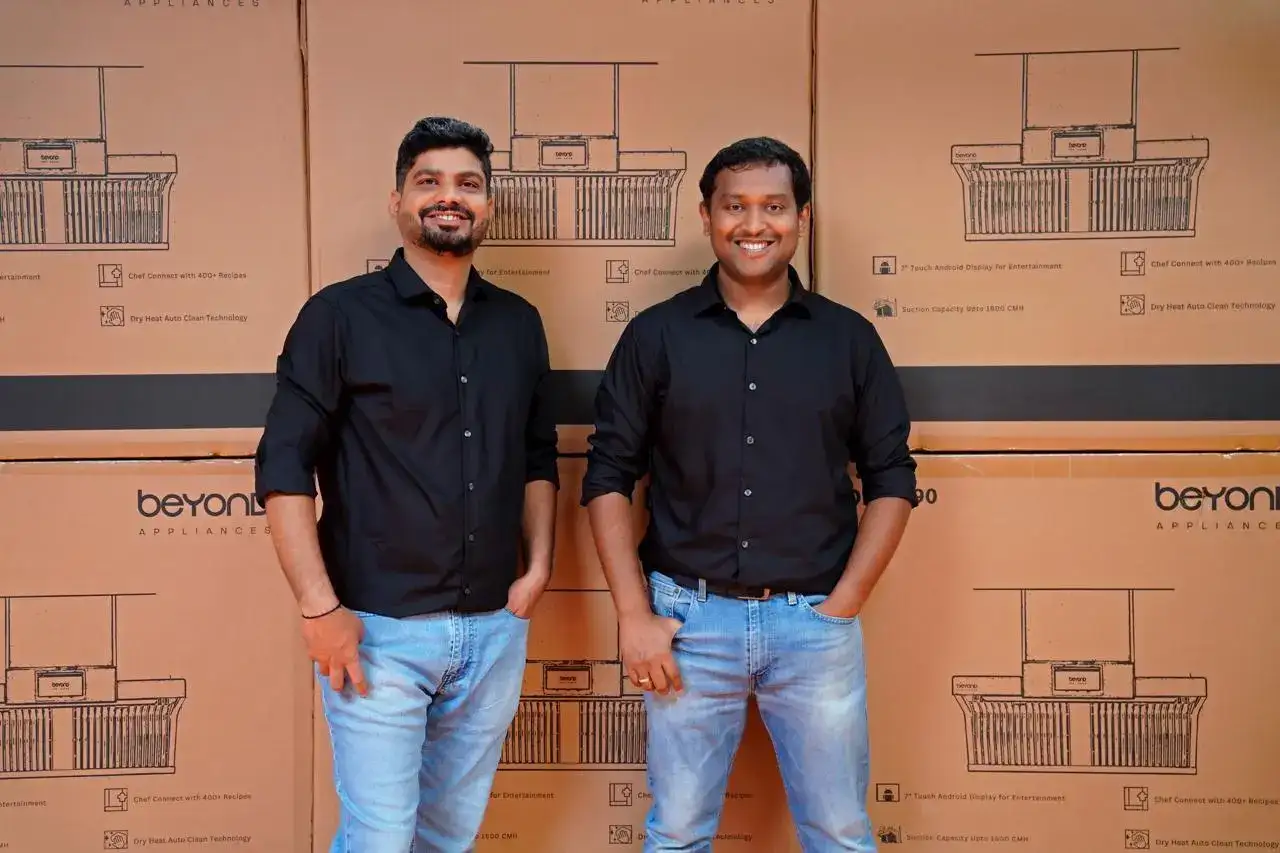
Founded in 2024 by Eshwar K Vikas and Rakesh Patil, Beyond Appliances offers multiple cooking options in one unit. Its design combines traditional flame-based cooking with ceramic electric heating zones, the company claims.
In FY 25, the company’s revenues increased to Rs 28.07 crore from Rs 21.08 crore in FY24, according to data from Tracxn. In August 2025, the company raised $4 million (about Rs 34 crore) in a funding round led by existing investor early-stage venture fund Fireside Ventures. “We have doubled down our investment since our first cheque in October 2024. The founders’ customer centricity, execution agility, and understanding of distribution gave us confidence in their ability to scale the business meaningfully,” said Shuchi Pandya, Principal, Fireside Ventures.
Based on evolving market demands and needs, the founders are pursuing a strategy of scaling. Patil said people have now started to understand how to use electrical appliances for day-to-day cooking, which wasn’t the case earlier. “They primarily used gas before and never tried electrical induction, which is now changing. Secondly, people have started understanding efficiency and why it is important. So, they understand that combining gas consumption and energy-efficient appliances in the house not only helps their pockets but also gives them ease of mind,” he said.
Long-term plans
Besides looking at this new category, the company currently specialises in two primary product categories: smart chimneys and smart hobs, all of which are manufactured in Bengaluru. The brand also boasts of its Android-powered chimney, its flagship innovation, which features a 7-inch display that doubles as a comprehensive kitchen management system. This smart device enables users to access OTT and music apps, set cooking reminders, and manage grocery lists via integrations with Zepto and Blinkit.
Devroop Dhar, Co-Founder & India CEO, Primus Partners, said that this transition to electric smart cooking emphasises the need to build domestic manufacturing scale in this segment, particularly as current supply chains remain dependent on imports for critical components. “Over time, improving self-sufficiency will be key to ensuring resilience and cost competitiveness,” he said.
Drawing a parallel with the trend of smart homes, Dhar adds that the trajectory of smart kitchens will be fundamentally different. “Unlike smart homes, smart kitchens are expected to endure, as they provide value like enhanced safety and efficient energy systems. Besides, they are also designed to withstand the external geopolitical shocks, such as the West Asia crisis, by combining the renewable energy-rich indigenous capabilities of India. When combined with increasing localisation of manufacturing and stronger domestic supply chains, this segment is better positioned for sustained growth,” he said.
Disclaimer: The reporter recently visited Beyond Appliances' Bengaluru factory at the company’s invitation.