Three major convenience store operators are trying to reduce the amount of unsold food, and as part of these efforts, Seven-Eleven Japan Co. and Lawson, Inc. have started reviewing the fixed price sales system that has become synonymous with convenience stores themselves, together with around-the-clock operations.
As their franchisees experience severe business conditions, mainly due to the saturation of stores and the industry's labor shortage, the business model that promoted their growth has reached a turning point.
Reducing food waste has been a challenge for the convenience store industry for a long time. The government set a goal of reducing food waste across all food-related industries, including convenience stores, to about 2.7 million tons by fiscal 2030. This is tantamount to half the amount of food waste in fiscal 2000.
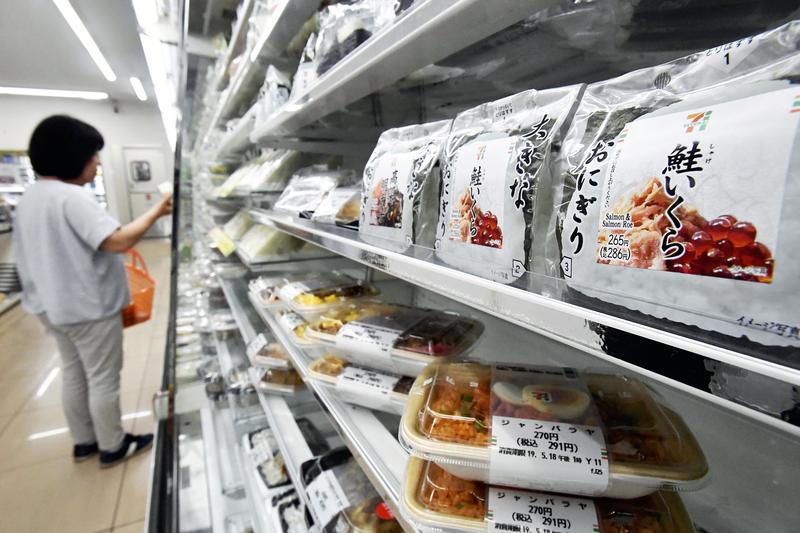
So, why on earth would Seven-Eleven Japan and Lawson choose this moment to start marking down products for the cause of reducing food waste? They made the move because they think that reducing food waste could lead to supporting franchisees if business conditions deteriorate further.
At a press conference on Friday, Lawson President Sadanobu Takemasu said: "If waste [of unsold products] is reduced, the profits of each store will also increase. It is a friendly approach to franchisees as well."
Franchisees place orders for onigiri rice balls and bento boxed meals with their headquarters at their own discretion. They take on a higher percentage of losses for unsold products than their headquarters do. In the case of Seven-Eleven Japan, the headquarters covers 15 percent of the loss, while a franchisee covers 85 percent. In addition, franchisees have to bear the cost of disposing of unsold products.
For that reason, some of Seven Eleven Japan's franchisees began to discount products on their own. The number of such stores is only a few percent of the 20,000 stores nationwide. However, the fact is that not a few stores are willing to offer discounts that lead to reducing the number of unsold products. They are just waiting to see what headquarters, which is reluctant to offer its own discounts, will do next.
Uniform system needed
Until now, each convenience store operator had believed that continuing to sell at fixed prices would maintain their high profitability and brand value. However, as the number of franchisees experiencing severe business conditions increases, it has become impossible to stick to the principle of fixed prices. In 2009, the Fair Trade Commission expressed its view that franchisees should be able to offer discounts at their own discretion.
If an increasing number of franchisees begin to offer discounts on their own, there is also a fear of a war of attrition among franchisees with the same company name.
A franchisee owner said, "If the headquarters managing chain stores creates a system to cover all stores nationwide, the number of stores that offer discounts in a sly manner would reduce, and brand value could be maintained."
Saturation, labor shortage
The number of convenience stores nationwide has increased to nearly 60,000. Franchisees face fierce competition to survive alongside rival stores of other operators as well as other franchisees with the same company name. With the population decreasing, the number of stores is about to reach saturation point. The sales of each store remain at almost the same level.
Operators have until now been opening up new stores in one area to prevent rivals from setting up their stores in the same area. This is called a "dominant" strategy in the industry.
However, they have begun to review this strategy that aims to increase sales by opening up more stores. Lawson announced that the net increase in its number of stores will be zero in fiscal 2019, while Seven-Eleven Japan plans to set the number of new stores in the same fiscal year at 900, about 500 fewer than in the previous fiscal year.
It is difficult to secure even part-time staff for late-night shifts due to the serious labor shortage.
Following a request from the Economy, Trade and Industry Ministry in April, each operator has compiled its own action program to solve the labor shortage.
Seven-Eleven Japan took a stance of coping by being flexible with store owners who want shortened operating hours. FamilyMart Co. stipulated that it will increase incentive pay to franchisees that continue around-the-clock operations. Lawson will start running unmanned stores that operate without cashiers during late night hours on a test basis.
Operators are also putting effort into supporting existing stores. They have already shown their intentions to expand the introduction of self-checkout machines, stressing that they are making efforts to listen to the opinions of member stores.
Read more from The Japan News at https://japannews.yomiuri.co.jp/