Operators of convenience store chains are working to support franchise outlets that are suffering from labor shortages, prompted by increasing frustration among the franchises and the industry ministry's calls for help to be offered.
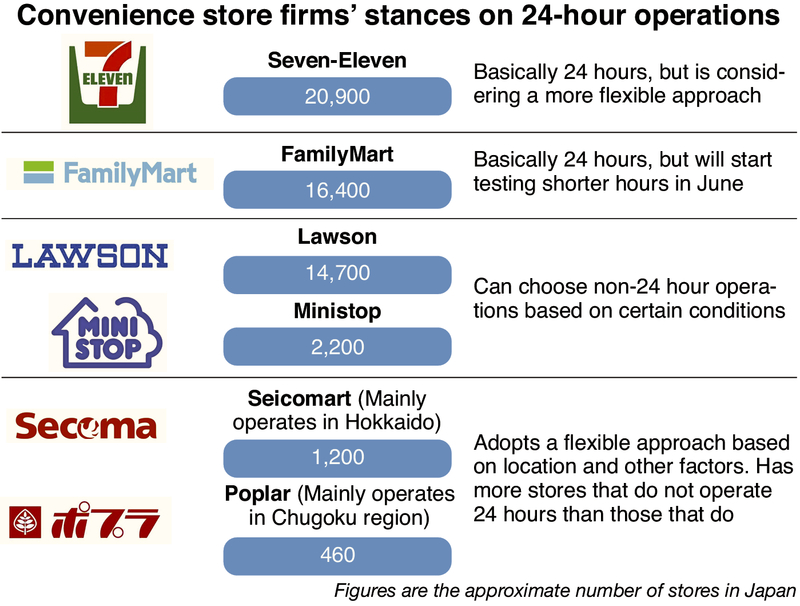
Along with its business results, FamilyMart Co. announced on Wednesday a key policy package titled "Four Challenges." The package starts with a plan to strengthen support for franchises, spending 133 billion yen over one year to help about 16,400 franchises and enhance profitability.
One key element is to start experimenting in June with shorter hours of operation at a maximum of about 270 stores. Another is the introduction of 4,000 self-checkout machines.
"We want to work closely with franchises to solve problems," FamilyMart President Takashi Sawada said.
The experiments with less-than-24-hour operations will be conducted at franchises, among stores that use the same trucking networks, and are seen as possible preparation for full-scale introduction of shorter hours of operation.
The introduction of self-checkout machines is a capital investment to deal with labor shortages.
FamilyMart will also tackle losses resulting from the discarding of food items that are nearing their best-before date. In many cases, losses from discarding such food items are shouldered by franchises, and this, along with labor shortages, is one of the most frequently voiced complaints to operators.
Poplar Co., which runs about 460 stores mainly in the Chugoku region, has started discount sales of such food items to lower related losses.
Sapporo-headquartered Secoma Co. which runs Seicomart convenience stores, has a policy of not opening a new franchise within 150 meters of an existing one, to avoid excessive competition.
These moves were prompted partly by the Economy, Trade and Industry Ministry's instructions for operators of convenience store chains to give due consideration to franchises that have been suffering labor shortages.
Eight convenience store operators plan to map out action plans that include support measures for franchises late this month. Reviews of their 24-hour operations, a key issue in helping franchises, differ from operator to operator.
In addition to carrying out widespread experiments with shorter hours, FamilyMart will also introduce a program to increase incentive payments to 24-hour franchises in accordance with the rate of increase in the minimum wage.
Seven-Eleven Japan Co. has been experimenting with less-than-24-hour operations since late March, but only at 10 of its direct outlets and some franchises. The company has said it will review around-the-clock operations across the board, but most in the company are cautious about introducing a system that lets franchises chose whether to have shorter hours of operation.
A Seven-Eleven franchise in Osaka Prefecture that has opted for shorter operational hours since February says it posted higher profits in February and March from a year before, because the decline in the costs, including labor, was higher than the drop in sales.
"It's much easier physically," owner Mitoshi Matsumoto said Wednesday. "A system has to be devised for both the company and franchises to grow. Otherwise we can't both keep going for long."
Read more from The Japan News at https://japannews.yomiuri.co.jp/