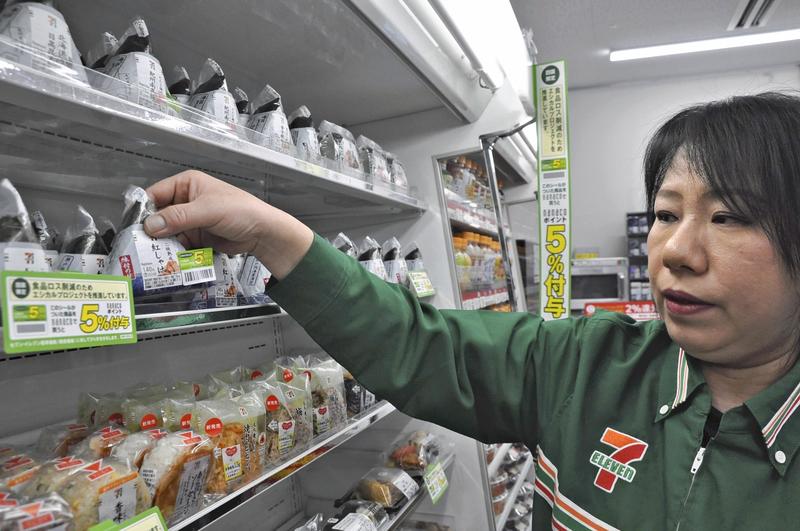
Major convenience store operators have been stepping up efforts to reduce food waste, not only to respond to growing consumer awareness, but also to shore up profits at franchised stores, though it may take some time to broaden the understanding of their initiatives.
FamilyMart Co. plans to start selling in January a pouch-packed oden that is heatable by a microwave oven. After receiving an order from a customer, a clerk will heat up the pouch, which contains several kinds of ingredients. FamilyMart expects the introduction of pouch-packed oden to reduce the number of unsold oden ingredients.
FamilyMart sold kabayaki-style broiled eel this summer only to customers who ordered them in advance. Though some customers did not come to pick them up, the rate of discarded unsalable products significantly declined, according to the convenience store operator.
FamilyMart plans to introduce a similar advance reservation system for the sale of Christmas cakes and ehomaki sushi rolls this winter.
In late November, Seven-Eleven Japan Co. started a feasibility test in Yamaguchi Prefecture in which customers who purchased food such as fried chicken or croquettes with its nanaco e-money from 9 p.m. to midnight could receive reward points equivalent to 20% of the sales price, excluding tax.
"We prepare fried foods in advance for the evening, but many are left unsold," said a Seven-Eleven convenience store staffer in charge.
Convenience stores have based their profits on selling products at uniform prices recommended by the headquarters. However, they now have to review this system with the mass disposal of unsold ehomaki sushi rolls and other products becoming an issue of public criticism.
Yet their efforts to reduce food waste have not always worked well.
Lawson Inc. conducted a feasibility test this summer, providing customers with reward points of 5% of the sales price when they buy onigiri rice balls whose expiry dates are approaching. However, the number of customers who used the system was below expectations, said a Lawson official in charge.
Manufacturers and retailers also have a long-standing practice of delivering food produced on the day as late as possible. While there have been some recent moves to stock shelves with older food items, the practice is still limited as there still are many freshness-minded consumers who prefer the newest products.
"Convenience stores have lagged behind supermarkets in terms of reducing food waste. It is also essential for them to improve the accuracy of orders and prevent unsold orders," said Tomohiro Ishikawa, a senior researcher at the Distribution Economics Institute of Japan.
Read more from The Japan News at https://japannews.yomiuri.co.jp/




.jpg?w=600)