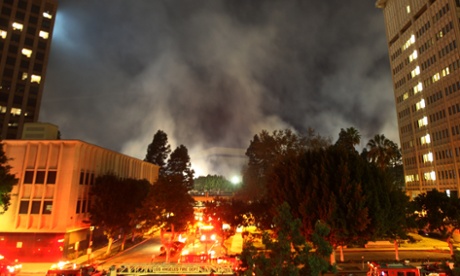
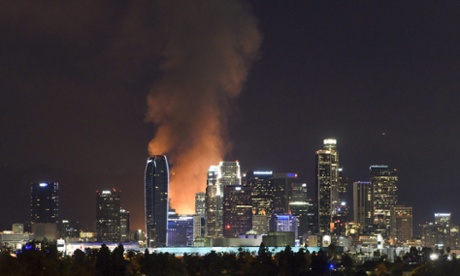
A controversial new high-rise apartment building on the edge of Los Angeles’s rapidly transforming downtown was destroyed overnight by an explosive fire that reduced the almost complete seven-story complex to little more than bare concrete stairwells and smouldering, twisted metal.
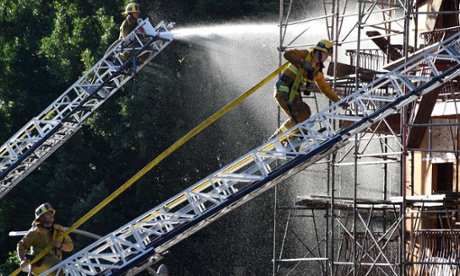
The fire spread so rapidly that by the time firefighters reached the scene – from a station less than 100 yards away – it had already engulfed the entire city block where the Da Vinci complex was hoping to offer mid-priced living, plus a gym, swimming pool, basketball court, cinema and business centre, starting early next year.
The blaze was fierce enough to melt signs on the approach to two nearby freeways, force road closures that played havoc with the Monday morning commute, and blow out windows and set off sprinklers in nearby public buildings.
Within hours, arson investigators were on scene with accelerant-sniffing dogs, although the fire department said this was standard and did not indicate any determination about the cause of the fire.
No injuries or deaths were reported. The fire started shortly after1am local time, in an area with no residents. Police managed to close the freeways before scaffolding crashing down from the building site could cause any accidents. A second building in the Da Vinci complex, on the other side of Temple Street, escaped without serious damage.
The Da Vinci is one of a number of faux-Italianate housing complexes developed along the western edge of downtown LA by Geoffrey Palmer, a local construction magnate frequently lambasted by architects, urban planners and media critics for building unimaginative fortresses that they say strangle city life instead of enhancing it.
The Los Angeles Times’ leading columnist, Steve Lopez, has called them “Death Star monstrosities”. Another local architecture critic, Adrian Glick Kubler, dubbed them “vacuums designed to suck the life out of a neighborhood that has worked so hard to become lively in the past decade”.
The Da Vinci was a target of particular fury this year when Palmer’s company petitioned the Los Angeles city council for the right to build a pedestrian footbridge linking one half of the complex to the other so residents would not have to encounter homeless people on the streets.
The council twice rejected the proposal before allowing it to go ahead, at the behest of one councilman who has received campaign contributions from Palmer and argued in council chambers that the bridge had nothing to do with the homeless population after all.
Palmer’s supporters in the business community argue that he should be congratulated for building in places nobody else dares – along the 110 freeway, which was previously a wasteland of tenements, flophouses and homeless shelters. Palmer himself has not spoken publicly in years, preferring not to answer charges that he is destroying downtown LA’s revival instead of contributing to it.
Over the past 15 years, downtown has slowly shed its reputation as a collection of sterile office buildings, shuttered art deco palaces from a bygone era and homeless shelters. Artists’ studios, restaurants and cultural landmarks like the Frank Gehry-designed Walt Disney concert hall have brought in tens of thousands of new residents who have occupied and repurposed industrial warehouses and lofts.
The community has been less kind, however, about Palmer’s buildings and about an arts and sports complex on the southern end of downtown called LA Live.
Conservationists have never forgiven developers for destroying the once vibrant downtown community of Bunker Hill – vividly described in Raymond Chandler’s novels – and replacing it with corporate offices. Palmer was blamed in the late 1980s for destroying the last historic building on Bunker Hill – he claimed that one of his bulldozers had accidentally backed into it.