Dining out and travel-related consumption have picked up rapidly in these industries hit hard by the government's states of emergency amid the COVID-19 pandemic.
Alongside new infections with the novel coronavirus subsiding, eateries are again allowed to operate at normal hours, so more people are going out.
Pandemic-related changes in people's behavioral patterns, however, have taken hold firmly. The prevailing view is that it will take some time for relevant businesses to regain the state of briskness of the days before COVID-19.
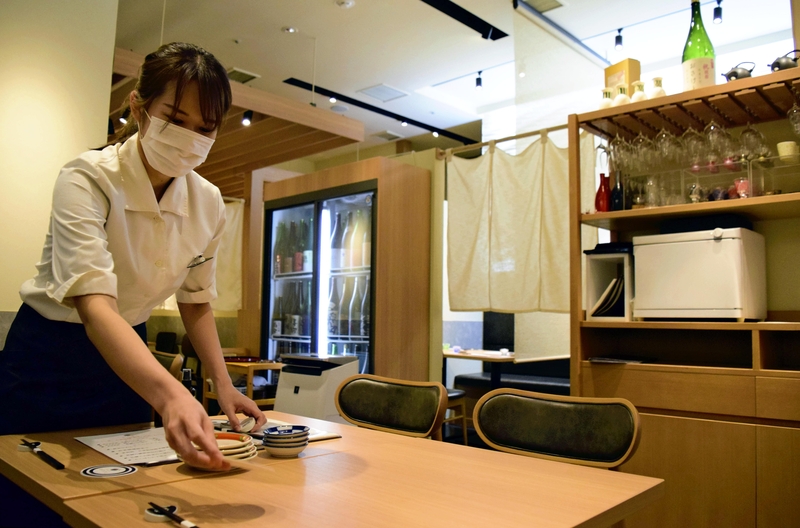
"As many companies lifted the restrictions on their employees from dining out at the end of October, the tables have been filled almost every day, mainly by parties entertaining business contacts," said Naoki Yamaguchi, the 40-year-old president of izakaya pub chain Washoku Biyori Osaketo in the Nihombashi area of Tokyo. The outlet is one of his five establishments in central Tokyo.
Once the request from the Tokyo metropolitan government for operating shorter hours was lifted, he changed the closing time of his izakaya pubs from 9 p.m. to 10:30 p.m., starting on Oct. 25.
"We are able to make use of the advantage of our business style, having a large number of private rooms catering to small groups of people," Yamaguchi said.
The recovery in consumption has had a positive effect on employment.
According to DIP Corp., which operates an online job-information site, the number of job offering, including part-time positions, being sought by businesses operating restaurants, izakaya pubs and the like has increased by nearly 80% in the fifth week of October, compared to the first week of August, when a state of emergency was declared in many parts of the country.
There has also been a ray of hope seen by tourism-related businesses, which have been impacted by the requests to refrain from crossing prefectural borders.
According to JR East (East Japan Railway Co.), the number of passengers using Shinkansen bullet trains and super-express trains on regional lines up until the end of September hovered around 30% of what it was in the pre-coronavirus days. Since October when the state of emergency ended across the board, however, the number of individuals and companies that resumed their trips for sightseeing or business increased, bringing the number of passengers using these long-distance train services to around 50-60% of what it was before the pandemic hit the nation. JR East and other JR companies have gradually resumed their operation of special Shinkansen trains, which had been suspended during the pandemic.
Yuji Fukasawa, president of JR East, said at a regular press conference on Nov. 9, "Since the emergency ended, the use of trains by passengers has been on a recovery track."
-- Harsh times remain
Yet the road to a full-scale recovery in businesses remains harsh.
"Because of the change in people's lifestyle [under the COVID-19 pandemic] and their awareness of preventing infections, their visits to our restaurants and izakaya pubs after 9 p.m. have been weak," Miki Watanabe, chairman and president of Watami Co., said at a press conference on Nov. 12 to report the company's financial results for its second quarter ending Sept. 30.
Colowide Co., which operates izakaya chain Amataro and other eatery chains, has had almost all its restaurants and izakaya pubs, which had been closed under states of emergency, resume operation. As the company still has some of its eateries closed earlier than normal, an official in charge said, "It will be difficult for some of our eateries, depending on their location, to return to the level of business as seen in the pre-coronavirus days."
According to TableCheck Inc., which offers restaurant reservation services, the daily average of diners per restaurant during the week up to Nov. 7 soared by about 30%, both for lunches and dinners, from one week earlier. Yet, when compared with the corresponding week in 2019, the daily average of diners was down 10% for lunch and 30% for dinner.
An official in charge of public relations said, "As there is a lasting effect of the protracted period of business closures and shorter business hours, there are many restaurants that cannot get their operating hours back to normal."
Travel agency JTB Corp. said that as of Nov. 7 the number of people making reservations with its outlets for domestic travel for December was only at the 50% level when compared with the same period last year, and at a 40% level for January 2022 when compared with a year earlier.
"People may be taking a wait-and-see posture until the resumption of the 'Go To Travel campaign' to support the tourism industry," said Hiroyuki Takahashi, chairperson of JTB.
Read more from The Japan News at https://japannews.yomiuri.co.jp/