The English votes for English laws debate - Summary and analysis
Opposition MPs aren’t always the most reliable guide to the significance of an event in the House of Commons. Labour is describing the vote, which it “won” with the SNP by a majority of 289, as a “shambles” for the government, and a defeat. The SNP has gone much further, with a full raid on the Westminster hyperbole cupboard and a press notice laden with words like “humiliated” and “meltdown”.
In truth, the vote itself doesn’t really matter, because Labour forced a vote on a procedural matter which would never normally merit a proper division anyway.
But the debate itself was revealing, because it showed that, while some Tories are merrily embracing the government’s English votes for English laws (Evel) plans, others are expressing quite serious reservations about them. One of the most telling moments came when the debate was over, and David Davis rose to make a point of order about how more time needed to be set aside for these matters to be debated. It sounded relatively innocuous, but Davis is one of Westminster’s inveterate plotters, and he doesn’t do innocuous. MPs are due to approve the changes after a debate a week tomorrow, but today’s proceedings suggest Chris Grayling, the leader of the Commons, may have difficulty getting them through without a bit of give.
Whether he has to give way on substance, though, is another matter. Some of the critical Tories were simply asking for more time. But the more time MPs get to debate the changes, and the more opportunities they get to vote on amendments to the bill (see 2.32pm), the more chance there is that the government will be defeated, or forced to compromise, on aspects of its plans.
Here are the key points.
-
Several Tory MPs complained that the government was trying to rush its Evel plans through the Commons. Sir Edward Leigh said that the UK “hangs by a thread” and that the future of the union was “at stake” and that the government had “o be seen to be doing this in a very fair way”. Like David Davis, Leigh appealed for extra time, and Peter Bone even floated that idea of letting the Commons sit through the night to ensure the plans got proper scrutiny. Dominic Grieve, the former attorney general, made a similar point.
We certainly shouldn’t seek to underestimate the enormity of that change, it is a very profound change and it needs to be properly debated. I have to say that at the moment I have serious anxieties that there is time available to carry out that scrutiny.
Grieve even suggested Britain might now need a written constitution. With all the changes taken place, the unwritten constitution was being stretched too far, he suggested.
- Leigh said he would like to amend the plans to ensure that Scottish MPs could vote on any devolved matter relating to England with “Barnett consequentials” (ie, spending implications for Scotland). The SNP hinted they would back Evel on this basis.
- The DUP’s Jeffrey Donaldson criticised the government’s plans. The DUP sometimes supports the Conservative party, but Donaldson said this initiative was “muddled”. He went on: “It is incoherent, it is going to lead to many problems and a very fractious House of Commons which really ought to be the forum in which we bind this UK together.” He also complained about how the government was trying to implement its changes.
-
Grayling said that MPs would be able to vote on more than one amendment to the plans. Pressed on this by Angela Eagle, he said:
There will be an opportunity to debate and vote on more than one amendment to standing orders. I give that undertaking. There’s absolutely no intention of limiting the debate.
-
Eagle, the shadow leader of the Commons, accused the government of using an “outrageous procedural fix” to increase its majority. She said:
It’s the case that the government’s changes will turn their slim majority of 12 into something over three figures if both Scottish and Welsh MPs are to be prevented from voting. I believe this is the real driver behind these changes and it makes the outrageous procedural fix of using standing orders rather than legislation to produce the change even more unacceptable.
-
Ed Miliband accused the government of “an act of constitutional vandalism”. Speaking from the backbenches, the former Labour leader said:
I think doing this procedure, in the way it’s being proposed, is frankly an act of constitutional vandalism. It really, really is. It’s not true to the traditions, the great traditions of the Conservative and Unionist Party and that’s why I urge members on the opposite side to vote against this next week.
-
Pete Wishart, the SNP spokesman, said the Tory tactics were helping the cause of Scottish independence. He told MPs:
This is quite extraordinary - we have never done anything like this for centuries. This is of historic significance. If this is their attempt to save the union, then God help them. It almost seems like they are absolutely determined to push us out.
That’s all from me for today.
Thanks for the comments.
Updated
Pete Wishart, the SNP shadow leader of the Commons, has put out a statement saying the Conservative Evel policy is “in meltdown”.
The Tories’ policy is in meltdown - the Government themselves didn’t even vote in favour of their own handling of English Votes for English Laws. The only conclusion that can be drawn is that the Tories knew they were staring defeat in the face.
In a blog for Coffee House, Alex Massie has responded to Ed Miliband’s speech. Massie says Evel is a modest change, and perfectly justifiable.
As my old friend Angus Robertson asked the Prime Minister in 2007: Is it not “completely iniquitous” that English MPs “are not able to decide on matters in Scotland but Scottish MPs from the UK parties can vote on matters which only impact on England. Why does he not join the SNP in abstaining on these issues?”
Will these vile Tories stop at nothing? Why, they stoop so low they will even agree with us. This must be an anti-Scottish plot. Because obviously.
Here’s the BBC’s James Landale on the significance of this afternoon’s vote.
Significance of government "defeat" over English votes? It shows Labour and SNP are beginning to work together... #evel
— James Landale (@BBCJLandale) July 7, 2015
I posted a tweet with a link to the last post.
The #Evel vote - Was it a gvt defeat, and did it mean anything? http://t.co/wPwL7YVeg7 - In short, no and not much
— AndrewSparrow (@AndrewSparrow) July 7, 2015
And got this reply from Labour Whips.
@AndrewSparrow debate & Davis Point of Order shows Tory Whips weren't confident of winning EVEL vote so ordered Tory MPs to abandon Grayling
— Labour Whips (@labourwhips) July 7, 2015
And this reply from a DUP account.
@AndrewSparrow wait and see Andrew. This is shaping up to be a very telling vote indeed.
— Westminster Unionist (@WestminsterDUP) July 7, 2015
I’ll post a summary soon.
Isabel Hardman’s blog on the Evel debate for Coffee House is well worth reading. Here’s her take on the significance of the result.
The result was 2 Ayes and 291 Noes. But as a motion, it doesn’t mean anything.
David Davis then raised a point of order in which he too said there hadn’t been enough time for debate and asked the Speaker for advice on ‘how we communicate that to the government?’. As a statement, that does mean something, more in fact than the motion. That’ll go down well with Number 10: and shows that anyone who thought governing with a majority of just 12 was going to be easy simply because the Tories had pulled off an election win was suffering from severe hubris.
The Labour Whips twitter feed is describing this as the first defeat of this parliament.
Tory govt suffer first defeat of parliament on procedural EVEL motion. Govt abstained because they couldn't get the votes, as lost argument
— Labour Whips (@labourwhips) July 7, 2015
By govt abstaining on motion, shows 1. Govt know they've lost the argument & 2. that they themselves think more time is required to discuss
— Labour Whips (@labourwhips) July 7, 2015
Actually, this is over-stating it. At best you could call this a symbolic defeat, but even that’s not really accurate; a government cannot get defeated on a matter on which it decides not to vote. And it was not a motion of any consequences; MPs were just voting on whether or not they had had a debate.
But it certainly is true to say that the debate revealed serious concerns about the government’s plans from MPs, including from Conservative ones.
I’ll post a summary shortly.
Alex Salmond, the former SNP leader, says Chris Grayling has not just abstained, but “fled the field entirely”. Many MPs feel more time needs to be set aside for the debate on this matter. Isn’t that what the vote means?
John Bercow says it is not for him to rule on that.
Dennis Skinner, the Labour MP, says the government has failed to persuade its own MPs. That is why the government abstained.
A decent government would have resigned.
Bercow says there is no need to reply to that point of order.
John Bercow, the Speaker, says a point has been made, but nothing has been decided.
David Davis, the Conservative MP, says some Tories abstained because they also thought that more time should be set aside for this to be debated.
Bercow says he thinks the government will get the message.
The motion was been defeated by 291 votes to 2 - a majority of 289.
Angela Eagle, the shadow leader of the Commons, says the government abstained because it knew it was going to lose.
Now I've seen them together I'm less convinced Ed Miliband could fit in to Alex Salmond's top pocket. pic.twitter.com/21BQopHpa5
— Jamie Ross (@JamieRoss7) July 7, 2015
The tellers on both sides - aye and no - are Labour MPs, suggesting that the government is abstaining. Labour, I presume, is putting up tellers for the motion, even though it is voting against, to ensure that there is a division. (If there are no tellers on one side, no division takes place.)
Updated
The Evel debate is now over. The motion is a very bland one - “that this House has considered the means by which the government seeks to deliver the objectives outlined by the leader of the House in his statement on English Votes on English Laws” - but Labour MPs have forced a vote to make a point.
Ed Miliband’s speech has been praised by Calum Kerr, an SNP MP.
2nd time I've heard @Ed_Miliband in chamber. 2nd time he's been excellent "the cause of unionism has been going badly since 19th Sept 2014"
— Calum Kerr MP (@CalumKerrSNP) July 7, 2015
Here is some Tory Twitter comment on the debate.
From Ramsay Jones, a Number 10 adviser dealing with Scotland
Today a libdem complains about something in their manifesto and SNP MPs moan about getting more votes than they used to allow themselves.
— Ramsay Jones (@Ramsay59) July 7, 2015
From Adam Tomkins, a law professor and adviser to David Mundell, the Scottish secretary
The "Barnett consequentials" line about #EVEL is complete guff, by the way. Decisions as to supply will continue to be for the whole House.
— Adam Tomkins (@ProfTomkins) July 7, 2015
Dominic Grieve, the Conservative former attorney general, says it was implicit in the devolution legislation in 1999 that these issues would have to be addressed. They have been ducked for too long, he says.
He says Britain is moving towards a written constitution. The unwritten constitution is being stretched, and asked to deal with more and more problems for which it is not suited, he says.
He says not enough time is being set aside to debate these changes. He says, before the end of today’s debate, he hopes to get an assurance that enough time will be set aside.
Jeffrey Donaldson, the DUP MP, says he is a unionist. But he does not support these plans. They are going to lead to confusion. The plans are “a recipe for divisiveness”, and play to the separatist agenda.
He says parades are a big issue in Northern Ireland. They are non-devolved. But should only Northern Ireland MPs be able to vote on parading legislation?
He says he recognises that this matter needs to be addressed. But this is the wrong way to do it. He says he agrees with Ed Miliband; there should have been a constitutional convention.
DuP's Jeffrey Donaldson: "We want the best for the United Kingdom and frankly this is not it" #evel
— Tim Reid (@TimReidBBC) July 7, 2015
Updated
Sir Edward Leigh, a Conservative, is speaking now. He says the United Kingdom “hangs by a thread”.
People need to know that these plans were debated properly, he says.
He says Grayling should allow more time for debate.
In the 1922 committee, before the election, Leigh said he said it would be a mistake to exclude the Scots. He was told that the Scots would not care about being excluded from English business.
Sir Bill Cash, a Conservative, says the SNP want independence.
Leigh replies:
Of course they want independence. But why are we making it easier for them?
He says he will try to amend the standing orders so that, on matters where there are Barnett consequentials, Evel will not apply.
Leigh says the Conservative party is at its best when it recognises that the constitution is asymmetrical. He says, unlike the Lib Dems, they do not believe in neat, constitutional solutions. The English should be generous, he says, and tolerate anomalies.
Miliband says Evel is 'act of constitutional vandalism'
Grayling asks Miliband why, if he feels that this matter should be addressed, Labour did not respond to an invitation to cross-party talks on this.
Miliband says the Tories were using this an an election weapon. It turns out it was quite an effective election weapon, he says.
He says Conservatives should not be trying to change rules like this with amendments to standing orders just before the summer recess.
The cause of unionism has been going “pretty badly” since the independence referendum, he says.
He says he will not start laying blame. But the question for the Conservatives is how they serve the cause of unionism.
Doing this is an “act of constitutional vandalism”, he says.
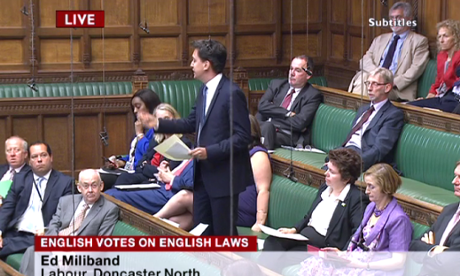
Miliband says Jacob Rees-Mogg said this issue had been around for 130 years.
But there is a reason for this, Miliband says. That’s because it is a hard issue to address.
He quotes Gladstone saying, with relation to Ireland, that trying to resolve this problem defies the wit of man.
Ed Miliband's speech
Ed Miliband is speaking now.
He says the Conservative party has a right to take action on this. And they have the power to take action too.
But what is the right way to do it?
They are the Conservative and Unionist party. But the way they are acting is not true to either the Conservative or the Unionist tradition, he says.
Sir Edward Leigh, a Conservative, says the SNP has been good about not voting on England-only matters. If the plans were amended so matters with Barnett consequentials did not count as England-only, would the SNP support them, he asks. He says he is minded to support this idea, because it would strengthen the union.
Wishart says the SNP would be tempted to back that idea.
Pete Wishart, the SNP’s shadow leader of the Commons, is speaking now.
He says the last time a government tried to create two classes of MPs like this was under Gladstone, when there were calls for the voting rights of Irish MPs to be curbed. That approach was not successful, he says.
He complains that, under these plans, the Speaker will be dragged into political controversy, because he will have to decide what is England-only.
John Redwood, a Conservative, says the SNP never had any trouble identifying England-only bills when they were deciding not to vote on them.
MPs debate English votes for English laws - Summary so far
Here are the main points from the opening of the debate.
- Chris Grayling, the leader of the Commons, has indicated that MPs will be allowed to vote on specific aspects of the English votes for English laws plan when they debate it next week, instead of simply having to accept or reject the whole passage. He made this apparent concession when Angela Eagle, his Labour opposite number, complained that MPs would not be able to vote on amendments to the plan. Grayling indicated that he would allow votes on multiple amendments. This increases the chances of the government being defeated on some aspect of the plans. Peter Bone, a Conservative, said the matter was so important that MPs should debate through the night, but there seemed little support for that idea.
-
Grayling warned Labour that, if they opposed these plans, they would be angering their English constituents. Eagle said that Labour was in favour of giving English MPs a greater say, but was opposed to the partisan way the government was introducing this. Another Tory MP, Gavin Barwell, made a similar point on Twitter.
Labour MP after Labour MP queuing up to oppose principle that laws that only affect England should have support of a majority of English MPs
— Gavin Barwell MP (@GavinBarwellMP) July 7, 2015
- Grayling said that he was introducing Evel through changes to Commons standing orders, not through primary legislation, partly because he wanted to minimise the risk of the plans being challenged in the courts.
- Grayling said that, under Evel, England-only matters would be defined as those that were devolved. SNP MPs complained that this ignored the fact that “Barnett consequentials” (the knock-on effect on spending in Scotland under the Barnett formula) meant these matters affected Scotland. Pete Wishart, the SNP MP, said this was not just English votes for English laws, but “English votes for Scottish laws”.
-
Alistair Carmichael, the Lib Dem former Scottish secretary, accused the government of “English nationalism” and accused the government of putting the union at risk. He told MPs:
The threat [to the union] does come from English nationalism. What pains me to say today though is that English nationalism is to be found on the Treasury bench.
The leader of the House [Grayling], when he came to the despatch box last week, made great pains of saying he was speaking as a Conservative and a unionist. I hate to say it but what he has brought forward is something that no unionist actually should be bringing forward.
-
Charles Walker, the Conservative chair of the Commons procedure committee, said in a speech that more time would have to be allowed for bills to be debated under these plans because a bill could have up to four more stages. He also warned that the government might limit the scope of some bills to make them England-only.
Tory ch of procedure comm Charles Walker suggesting there may be temptation to narrow scope of bills to "enhance their Englishness" #evel
— Tim Reid (@TimReidBBC) July 7, 2015
Alex Salmond, the former SNP leader, rises to make a point of order. Under these rules, John Bercow, the Speaker, would have to certify whether a bill was England-only, even if it had Barnett consequentials (ie, spending implications for Scotland). Would not be that too much a burden for one person to bear?
Bercow says Salmond is quoting Gladstone.
He says, in those circumstances, the Speaker would due his duty.
Jacob Rees-Mogg, a Conservative, says a government can easily vote to set aside standing orders. So Labour should not worry about these changes stopping a Labour government getting its business through the Commons, he says.
Eagle says she does not find that reassuring.
Eagle says the normal rules only allow one or two votes on changes to standing orders.
She says the government should ensure that many votes are allowed, so that MPs can vote on specific aspects of the plan.
Peter Bone intervenes again. The plans run to 22 pages. There will not be enough time to debate them, he says. Surely they should sit through the night?
Eagle says she has an alternative solution.
Peter Bone, a Conservative, asks Angela Eagle if she has asked the government for a suspension of standing orders so that next week’s debate can go through the night.
Eagle says that she hasn’t, but that she might consider it.
Sir Gerald Howarth, the Conservative MP, says Labour bears a heavy responsibility for this. It tried to appease the Scots with devolution in 1999, but then did nothing to address the West Lothian question. The government is coming up with a simple solution, he says.
Eagle says these plans are not simple.
She says only one chamber of parliament will vote on the new plans. The government is using a “procedural fix”, she says. And there will be virtually no chance of judicial oversight.
Angela Eagle, the shadow leader of the Commons, is speaking now. She says the government’s plans are “divisive” and that they way they are being introduced is “a constitutional outrage”.
She says Labour supports the idea of giving English MPs a greater voice, but it thinks that changes should be brought in on a cross-party basis, following a constitutional convention.
She says the government is playing “narrow party politics” when it should be acting in the national interest.
Antoinette Sandbach, a Conservative, says these problems were evident when Labour introduced devolution for Scotland. So why did the party not hold a referendum then?
Eagle says the devolution settlement took some time to evolve.
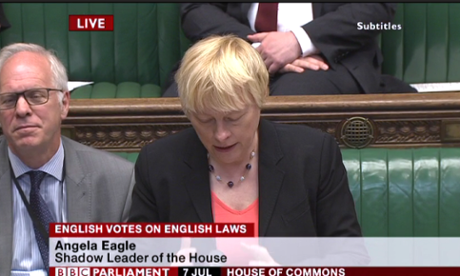
Ed Miliband intervenes to ask how it will be decided whether a matter is an England-only one. Is there a definition?
Grayling says it will be a simple matter of whether an issue is devolved.
This generates a lot of jeering. (SNP MPs believe that votes on matters like English health would have an impact on Scotland, even though it is a devolved matter.)
Alex Salmond says he thought it would be for the Speaker to certify what was an English-only matter.
Grayling says the Speaker would certify bills as English-only, but he would apply the test set out in the standing orders.
Grayling says Labour has a challenge. It must decide whether to back these plans or not. If Labour MPs want to tell their English constituents they are opposed to Evel, that is up to them. He would be happy about that, he indicates.
Grayling says the “double majority” idea in his plan is designed to stop MPs having to vote twice on certain matters.
Labour’s Ian Lucas asks Grayling to confirm that these plans will increase the Conservatives’ majority from 12 to over 100 for England.
Grayling says the Conservatives have a UK majority. And this is not about majorities, he says.
Grayling says he is reluctant to introduce English votes for English laws through primary legislation because that could open it up to scrutiny by the courts.
But the courts do not interfere with the Commons when it is just setting its own internal rules, he says.
Eagle says Grayling did not give her a clear answer. Will MPs be able to amend the proposed new standing orders?
Grayling says there will be a chance to vote on more than one amendment. If amendments are called, they will be put to a vote.
Eagle says it depends on how the government tables the motion. Will Grayling promise to do it in such a way as to allow amendments to be put to a vote.
Grayling says the government will allow votes on more than one amendment.
Sir Edward Leigh, a Conservative, says the government is entitled to introduce its manifesto proposals. But the union is at stake. This has to be introduced in a way that is seen to be fair, he says.
Grayling accepts this. If there is a case for more time being allowed for the debate, he will consider it, he says.
Grayling says that experts are all agreed that it is best to introduce these changes via standing orders (rather than through a government bill).
But when the government reviews the process next year, it will be open to the idea of introducing proper legislation.
Angela Eagle, the shadow leader of the Commons, says that her understanding is that, when MPs vote on the new standing orders next week, MPs will just have to vote yes or no. The new standing orders run to 22 pages, but MPs won’t be able to amend them.
Grayling says he is happy to discuss the procedure for next week’s debate with Labour.
Updated
Labour’s Helen Goodman says the government should not be introducing these changes in such a rushed manner. There should be a proper consultation, she says.
Grayling says Labour were invited to all-party talks on this last year. But Labour did not participate. Harriet Harman, the then deputy leader, did not even respond to the letter invited Labour to take part, he says.
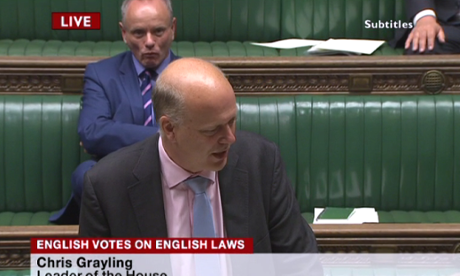
Chris Grayling, the leader of the Commons, is speaking now.
Alex Salmond, the former SNP leader, says that when Labour legislated for tuition fees in England, the Tories wanted the SNP to vote against the plan.
Grayling says the Labour increase in tuition fees was only passed because of the votes of Scottish MPs.
UPDATE: This is from Kevin Pringle, the SNP’s outgoing communications chief.
On English top-up fees even Tam Dalyell voted against because of the "adversarial effect on Scottish education" http://t.co/Bk85GJ9UPf #EVEL
— Kevin Pringle (@KevinJPringle) July 7, 2015
Updated
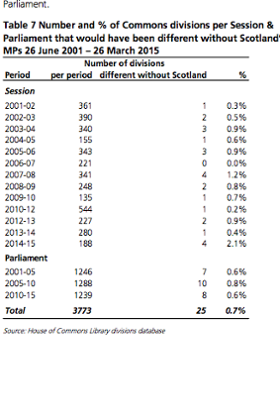
Here is a Commons library briefing note (pdf) looking at how the number of English, Scottish and Welsh MPs affects the outcome of votes.
This chart shows that, since 2001, only 25 votes would have had a different result without Scottish MPs taking part.
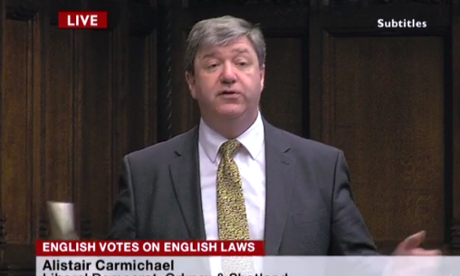
Alistair Carmichael says no proper unionist would support the government’s English votes for English laws plans. He accuses the government of English nationalism.
He says he would favour a federal solution to the problem raised by the West Lothian question.
Andrew Bridgen, a Conservative, asks what Carmichael would say to Bridgen’s constituents who object to Scottish MPs like Carmichael being able to vote on English education, when Bridgen cannot vote on Scottish education. Carmichael is trying to “have his porridge and eat it”, he says.
Carmichael says he understands this point of views. But his point is that the government is addressing this in the wrong way, he says.
MPs debate English votes for English laws
MPs have just started an emergency debate on the government’s plans for English votes for English laws (Evel). Alistair Carmichael, the Lib Dem former Scottish secretary, requested the debate using the rarely-used standing order 24, and he is opening.
And here is the live blog reporting what happened when Grayling announced his plans.
Lunchtime summary
-
Downing Street has rejected one of the key recommendations in a damning report from the Competition and Markets Authority saying that customers are paying too much £1.2bn a year too much for energy. The CMA said that simplifying tariffs, one of the measures introduced by the government in the last parliament to help consumers, had failed, and it suggested capping some prices. Here’s an extract from its news release.
Regulatory interventions designed to simplify prices, such as the ‘four-tariff rule’, are not having the desired effect of increasing engagement, and have limited discounting and reduced competition. Instead the CMA proposes that the regulatory approach to the retail market should be based on clear principles that allow the benefits of competition to be gained and promote measures, such as smart meters, that will increase engagement, while specifically targeting disengaged consumers to prompt them to shop around. Alongside this, the CMA will also be considering whether safeguards such as a transitional price cap on the most expensive tariffs are needed to protect customers until other measures have led to a more competitive market.
The CMA said a cap would lead to price cuts.
Asked CMA if proposed price cap would be lower than current standard tariffs. Roger Witcomb: "You bet." So price cuts for 70% of pop? "Yep."
— Emily Gosden (@emilygosden) July 7, 2015
But Number 10 said that David Cameron remained opposed to introducing a price cap. (See 11.44am.)
- Anna Soubry, the small business minister, has defended plans to relax the laws on Sunday trading, saying Sundays used to be “miserable” before shops were allowed to open. (See 10.24am.)
-
Tony Hall, the BBC director general, has dismissed claims that forcing the BBC to bear the cost of free television licences for the over-75s turns the corporation into a branch of the Department for Work and Pensions. He insisted the £750m cost of the plan, agreed ahead of Wednesday’s budget after a week of secret talks, was more than matched by the deal he had struck with with the Treasury.
Here’s Ed Davey, the Lib Dem former energy secretary, on the CMA report.
CMA right to continue my push for more switching - Big Energy firms hate it! 24 hour switching always my goal & has to be put in place asap
— Edward Davey (@EdwardJDavey) July 7, 2015
Here is some more reaction to the CMA report.
From Richard Lloyd, executive director of the consumer group Which?
This is a damning indictment of how the energy market is failing consumers, with the biggest suppliers taking advantage of millions of households who have also been hit with the costs of government energy policy.
From Ann Robinson, director of consumer policy at uSwitch.com, the price comparison service
Proper competition is essential to make this market work and so additional regulation should be a last resort. In the interim, the idea of a transitional price cap could go some way to protect the majority of consumers languishing on expensive, standard plans, while reforms to boost competition are made. However, energy suppliers shouldn’t be waiting for regulators to tell them to cut prices when their own costs fall.
We agree with the CMA that Ofgem’s four core tariff cap, whilst simplifying the market, has actually gone too far and has restricted consumer choice. We welcome a review of this policy and believe that relaxing restrictions will help consumers by increasing innovation, choice and competition. In addition, it’s right that customers on pre-payment meters – who often pay the most – should be the first to receive new smart meters to help them save energy.
From Dale Vince, founder of Ecotricity, the green energy company
There is no mention of the non-energy part of the industry, which makes up for around half of a customer’s bill. Distribution companies, for example, are an example of a monopoly, making up to 30% profit margins – compare that to the maximum 5% profit margin that the CMA believe should apply to energy companies.
Ofgem have allowed these monopolies to continue for years and as a result I would have expected the CMA to have analysed the role of the regulator itself in their report – we need proper regulation in the industry to stop these kind of abuses.
The TUC says production figures out today show that manufacturing output is still below its pre-recession peak. This is from Frances O’Grady, the TUC general secretary.
The chancellor promised a ‘march of the makers’, but manufacturing is still five per cent below its pre-recession peak and is declining again. At least the Grand Old Duke of York marched them up to the top of the hill before he marched them down again.
The government has had over five years to strengthen manufacturing, and has failed. But it’s no surprise when so much of the investment that would have made a difference has been cut, such as funding for catapult centres for technology and innovation in manufacturing.
The GMB union says the CMA report confirms that the energy market is not working. It thinks the government should be investing more in generating capacity. This is from Gary Smith, the GMB’s national secretary for energy.
This CMA report confirms that there is no real market in the energy sector. The tinkering proposed by the CMA propose won’t work.
Whilst the heat on energy prices is off at the moment, the long term trend, as the demand for energy continues to increase, is upwards.
As we fiddle about trying to fix a market that doesn’t actually exist we are losing generating capacity and can’t get new powers stations built. The government’s energy policy amounts to handing over responsibility for our energy sector including nuclear reactors lock stock and barrel to the Chinese state.
Number 10 lobby briefing
Here are the main points from the Number 10 lobby briefing.
-
David Cameron has rejected the Competition and Markets Authority suggestion that a price cap should be imposed on the highest tariffs to protect energy customers. Asked if the government would back this recommendation, the prime minister’s spokeswoman said:
The prime minister has not changed his view. He does not think that price regulation across the market is the right approach.
On the report generally, which also said that a rule introduced by the government during the last parliament to limit the number of tariffs had not had the desired effect on competition, the spokeswoman said that the government had asked the CMA to report and that today’s provisional findings were an “important milestone” in its investigation. She said the government would need to look at its proposals. But she also said that government moves to encourage consumers to switch to a cheaper supplier were having an effect. Some 1.5m customers have already switched this year, she said.
- Cameron does not support Tony Blair’s suggestion that the West should commit ground troops to fight Islamic State (Isis), the spokeswoman indicated. Asked about Blair’s comments, she said Cameron has set out his own views on the “fully-fledged response” needed to tackle Isis. Cameron wants countries in the region to take the fight to Isis, she said.
-
Sir Mark Lyell Grant, currently the UK permanent representative to the UN, is taking over as the prime minister’s national security adviser, Number 10 has announced. He will replace Sir Kim Darroch, another career diplomat, who is due to move on to another posting.
Here is some reaction from energy companies to the CMA report.
From Alistair Phillips-Davies, chief executive of SSE
SSE has consistently maintained that whilst customers already benefit from healthy market competition, there is always room for improvement. We will now examine today’s publications in detail, along with the analysis that underpins them.
We will also continue to work constructively with the CMA as this process continues to help ensure that the opportunity presented by this investigation is fully grasped, and that the final result is an enduring outcome that gives customers confidence, allows regulators to regulate, and encourages investors to invest in the Great Britain energy market.
From Iain Conn, chief executive of Centrica
This looks to be a comprehensive and thorough assessment. We welcome the possibility that this review will have a constructive and positive influence on competition in the energy market. While we have questions and concerns about some of the proposals we look forward to engaging with the CMA in the next phase of this process.
I’m off to the lobby briefing. I’ll post again after 11.30am.
According to Emily Gosden, the Telegraph’s energy editor, Energy UK, the trade body that represents the energy industry, has had to re-write its response to the CMA report.
EnergyUK, which said everyone should back CMA outcome, responds: "Customers have not been over-charged." Er really?! pic.twitter.com/a0XMENT1F8
— Emily Gosden (@emilygosden) July 7, 2015
Hilarious. EnergyUK has just issued a new version of its CMA response. It's now deleted the line that "customers have not been over-charged"
— Emily Gosden (@emilygosden) July 7, 2015
Stewart Wood, one of Ed Miliband’s key policy advisers, has also been savouring the CMA report.
CMA recommends a price cap to protect consumers while the energy market is reformed to make it more competitive. Sounds very familiar.
— Stewart Wood (@StewartWood) July 7, 2015
Soubry says Sundays used to be miserable without shopping
In Who Governs Britain?, an astute and enjoyable guide to modern politics, and how it has changed over the post-war period, Anthony King identifies a problem with the way politicians speak.
Switch on the radio in the midst of an interview with a person or persons unknown and more often than not one can tell immediately whether or not it is a politician who is speaking. Politicians’ answers to questions often sound rehearsed, stilted and declamatory, they are often repetitive and replete with ‘on message catchphrases, and they are often answers to any number of questions except the ones that the interviewer has actually asked ... To a remarkable extent, national politicians, irrespective of party, sound and talk alike as well as looking alike.
I’m quoting this very sound assessment to help to explain why Anna Soubry, the small business minister, was unusually effective when she appeared on the Today programme earlier. She was there to defend George Osborne’s plans to liberalise the Sunday shopping laws and the highlight came when she advanced an argument that was far too risky and colloquial for any conventional line-to-take merchant of the kind King was describing. Liberalisation was good because Sundays used to be miserable, she said. When John Humphrys put it to her that Sundays were meant to be special, she replied:
I nearly said that you and I are old enough, but we are - we are of that generation, aren’t we, where Sundays, truthfully, was the most miserable day of the week. The only thing to look forward to was Sing Something Simple on the radio. I mean, goodness me, if that did not sum up a miserable Sunday ... I think the harking back to a world probably that didn’t exist [is a mistake] - you can still have family life, but you can still have shopping.
Soubry was following John Hannett, the general secretary of the shopworkers’ union Usdaw, who told the programme the plan would “put more pressure on existing employees”. As well as recalling the horror of Sundays in the 1970s, Soubry said that she would be concerned if workers were put under more pressure as a result of this move, but that she thought that would not be the case. She also stressed that the government wanted to devolve the decision whether to allow more Sunday opening to local authorities, and that different decisions would be right for different areas.

Here is more from the Press Association story about the CMA investigation into the energy market.
The CMA probe into the energy market was launched in the wake of a pledge by Labour in 2013 to freeze prices if it won this year’s general election, following years of sharp increases in electricity and gas prices.
Suppliers have eagerly been awaiting the outcome of the report, which had the potential to drastically change the shape of Britain’s energy market.
While the CMA did not find the need to break-up suppliers, its findings on pricing and competition in the supply market made for painful reading for the big six.
Its research found that while residential customers were being overcharged by around 5% between 2009 and 2013, small businesses were paying around 14% more.
This means residential households are paying around £1.2bn more a year for their energy, while small firms are forking out around £500m too much a year.
But it found smaller energy suppliers competing with the big six often offered cheaper prices.
While it said it did not have overall figures yet for the smaller energy firm prices, it found the cheapest tariff offered by these firms was 30 to 40 lower than the least expensive tariff offered by the big six.
It said results from its survey suggested customers of two of the small suppliers were paying around 8% less than those with the cheapest of the large suppliers in the final three months of last year.
Labour says CMA report justifies party's pre-election stance on energy companies
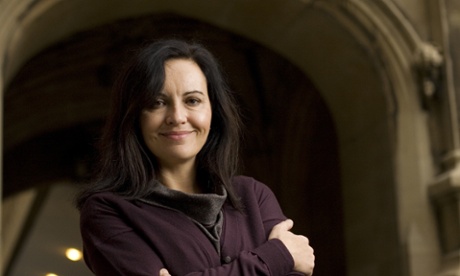
The Today programme did not manage to get Ed Miliband onto the programme to talk about the damning CMA report into the energy market, but they did get Caroline Flint, the shadow energy secretary, who came close to saying, ‘I told you so’. (See 8.49am.) Referring to the fact that there is mention of a price cap in the report, she said:
That says to me that myself and my Labour team were absolutely in the right ballpark in terms of thinking about how best we could protect these customers.
Here are the other points she made.
-
Flint accused the big six energy firms of being “incredibly complacent” about customers on their standard, variable tariffs. Those customers - 70% of the total - were paying too much, she said.
Because of the nature of the transition from this nationalised industry to the privatised industry, [customers] have actually behaved in a very similar way to the nationalised industry, which is we have have this big, sticky customer base, and what we know from the CMA report today is that those customers have seen their prices rise, even though the costs for the companies have gone down. And they are the people who are paying over the odds, which has resulted in what the CMA has said today.
- She said that the energy industry needed to be opened up, and that it was wrong that the big six dominated 90% of the market.
- She said there could be a case for energy firms having to put customers on the cheapest tariff by default.
-
She said that government efforts to encourage people to switch to cheaper tariffs had not worked.
Updated
Here is some more reaction to the CMA report
From Gillian Guy, chief executive of Citizens Advice
The energy market has failed the overwhelming majority of customers. Consumers don’t trust the relationship between prices and profits. Millions are locked out of the benefits of the competition that exists.
The CMA needs to provide a framework that gives customers confidence that they are not getting a raw deal and protects the interests of all consumers, including those who cannot or do not switch.
The remedies recommended by the CMA are encouraging but will take some time before they are finally agreed and implemented. In the meantime, we call on energy companies - who are benefiting from massive reductions in wholesale prices - to help customers and reduce bills.
From Ofgem, the energy regulator Ofgem
We welcome the CMA’s provisional findings on competition in the energy market. We will work with them, to develop and implement their final remedies, where they fall within our jurisdiction, to deliver a more competitive market for consumers.
Ofgem asked the CMA to investigate the energy market because of our concerns that competition in the market is not working for all consumers. We will respond to their consultation within the CMA’s timeframe.
Amber Rudd, the energy secretary, has issued this statement about the CMA report.
Our priority is to keep bills down for hardworking families and businesses across the country. We’ll consider the report and respond soon and we won’t hesitate to take further action where the market is not delivering a fair deal for consumers – including doing more to support switching, ensure the swift roll-out of smart meters and increase competition in energy markets.
At 7am this morning the Competition and Markets Authority released the provisional findings of a review it has conducted into the energy market. Ed Miliband could be forgiven for saying, ‘I told you so’. One of his big election messages was that the energy market is failing consumers, and the CMA has said much the same. It is even floating the idea of a price cap (on the highest tariffs).
Here is the CMA news release. And here is the full report (pdf).
Here is the start of the Press Association story about the report.
British households are overpaying for their energy by around £1.2bn a year and are failing to switch to get the best deals, the competition watchdog said today.
The Competition and Markets Authority (CMA) said its year-long inquiry into the energy sector found tariffs offered by the big six energy suppliers were around 5% higher than they should be between 2009 and 2013.
It outlined plans to encourage customers to switch, but stopped short of recommending a break-up of the energy giants, saying competition in wholesale markets was working well.
The CMA said it uncovered “widespread consumer disengagement”, with around 70% of customers on default standard variable rate tariffs despite better deals available.
More than 34% of 7,000 people polled for an extensive survey have never considered switching, according to the CMA.
It found dual fuel customers could save an average of £160 a year by switching to a cheaper tariff but often failed to do so because of a lack of awareness of which deals are available, “confusing and inaccurate” bills and worries over the difficulty of changing supplier.
The CMA said it plans to scrap recently introduced rules restricting suppliers to offering just four tariffs, saying they have in fact ended up reducing competition.
Instead, in its provisional findings, the CMA said it would look at measures to prompt customers to shop around, such as by using smart meters.
It will also look at introducing a price cap on the most expensive tariffs until competition is working as it should be in the market.
Roger Witcomb, chairman of the energy market investigation, said: “There are millions of customers paying too much for their energy bills - but they don’t have to.
“Whilst competition is delivering benefits to increasing numbers of customers, mainly through the growth of smaller suppliers with cheaper fixed-price deals, the majority of us are still on more expensive default tariffs.”
He added: “The confusing way energy is measured and billed can make comparing deals understandably daunting.
“The result is that some energy suppliers know they don’t have to work hard to keep these customers.”
I will be covering reaction to this as it comes in.
Here is the agenda for the day.
8.50am: David Cameron lays a wreath at the 7/7 memorial in Hyde Park. My colleague Jamie Grierson is covering all the events to commemorate today’s 10th anniversary of 7/7 on a separate live blog.
10.45am: David Gauke, the Treasury minister, gives evidence to a Lords committee on the EU budget.
11am: Number 10 lobby briefing.
11.30am: 7/7 memorial service at St Paul’s Cathedral.
Around 12.40pm: MPs begin an emergency debate on the government’s plans for English votes for English laws (Evel).
As usual I will be covering the breaking political news as it happens, as well as bringing you the best reaction, comment and analysis from the web. I will post a summary at lunchtime and another in the afternoon.
If you want to follow me on Twitter, I’m on @AndrewSparrow