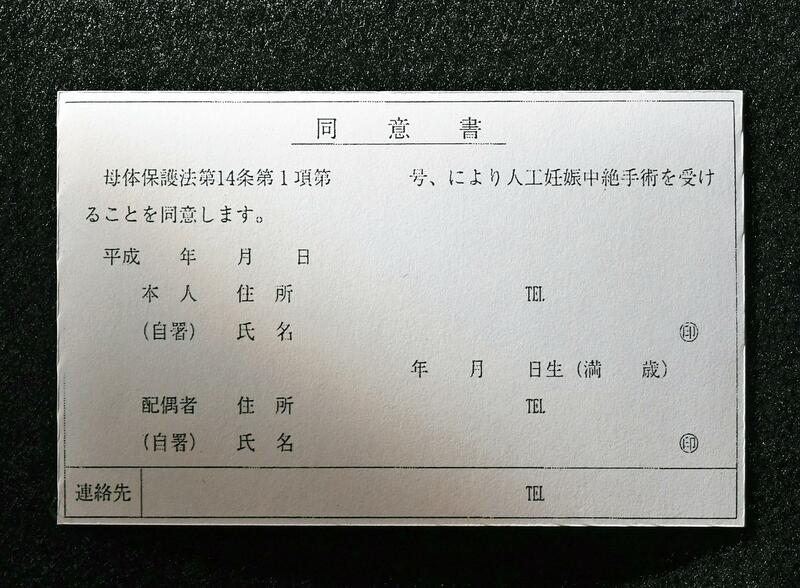
The Maternal Health Law stipulates that doctors must obtain the consent of a pregnant woman and her spouse to perform an abortion. In March, however, the Health, Labor and Welfare Ministry spelled out new guidelines to the law that would allow victims of domestic violence to terminate a pregnancy without their spouse's consent.
In addition to women being forced to bear a heavy mental and physical burden, this move was prompted by strong concern among medical staff who perform abortions at the risk of being sued by women's husbands.
"My husband forced me to have intercourse," a woman in her 30s told her obstetrician in a faint voice at a general hospital in the Kansai region about five years ago.
The woman, who lives in the Chubu region, was 10 weeks pregnant. She had been refused an abortion at a local hospital because her husband did not agree to the operation.
She married her husband about 10 years ago, but soon he began to berate her about housework and forced her to have sex with him. She was subjected to verbal and sexual domestic violence for many years and had an unwanted pregnancy.
The woman said it was painful to terminate a life through an abortion. But her fear of being unable to love the child was greater than the pain.
Asked by the obstetrician whether she could see her husband just once more to get his consent, the woman's face stiffened. "I can't do that anymore," she replied.
Believing that she might commit suicide if she had to have further contact with her husband, the hospital decided to perform the surgery after preparing medical records detailing the domestic violence.
The number of consultations on domestic violence has been increasing over the years, reaching a provisional figure of 190,000 in fiscal 2020, or about 2.5 times the level a decade earlier. According to a Cabinet Office survey conducted in the same year, 8.6% of 1,400 female respondents said they had been forced to have sex by their husbands.
However, according to women's support groups around the nation, domestic violence victims who become pregnant are often refused by doctors when they ask for an abortion, because the law stipulates that doctors must obtain the consent of both a woman and her spouse, in principle.
In 2017, the Okayama District Court ordered Ako City Hospital in Ako, Hyogo Prefecture, which had performed an abortion with only the woman's consent, to pay compensation to her husband.
Abortion can be performed with just the consent of the woman if her spouse is dead, missing or unable to express his will. In 2015, the Tokyo District Court interpreted this provision of the law broadly and ruled that it is virtually impossible for a domestic violence victim to confirm the will of her husband. The Japan Association of Obstetricians and Gynecologists has provided information on the ruling to doctors, but there have been no widespread changes.
Under these circumstances, women who have been refused an abortion at hospitals around the country visit the general hospital in the Kansai region, through the introduction of support groups or local governments. The hospital interprets the law in the same way as the Tokyo District Court decision. To prevent lawsuits, the hospital records the details of the domestic violence and sometimes encourages women to take out a restraining order against their husbands.
An obstetrician at the general hospital said, "What we've been doing is a legal operation, but we're always worried about being charged with illegal abortions under the law." Under the criminal law, those found guilty of performing illegal abortions may be sentenced to up to five years in prison.
The ministry's guidelines were announced in March. In response to an inquiry from the Japan Medical Association, which had consulted with the JAOG about operations on victims of domestic violence, the ministry said on March 10, "If a pregnant woman's marriage has essentially collapsed due to domestic violence by her husband or for other reasons, and it is difficult to obtain his consent for an abortion, only the woman's consent is needed."
A ministry official told The Yomiuri Shimbun it has clarified the interpretation of the law because doctors often face difficulties over the issue. The ministry informed women's consultation offices and spousal violence counseling and support centers, which are responsible for the temporary protection of domestic violence victims, of this policy on March 19.
Kyoko Tanebe, executive director of the JAOG, said: "This is a big step forward because it protects the precarious position of women and doctors. However, it is up to doctors to decide whether the cases they handle are domestic violence. We want to support them by providing training and other measures to ensure they make consistent decisions."
In 2016, the U.N. Committee on the Elimination of Discrimination against Women recommended that Japan abolish the need for spousal consent for abortion.
Tamie Kaino, a professor emeritus of gender law at Ochanomizu University, said: "There has been a male-dominated approach to decisions on childbirth and abortion, and women's health and safety have been neglected. In response to international pressure and problems such as domestic violence, the government has finally announced its guidelines, but it must continue to provide careful explanations to make it effective."
Read more from The Japan News at https://japannews.yomiuri.co.jp/