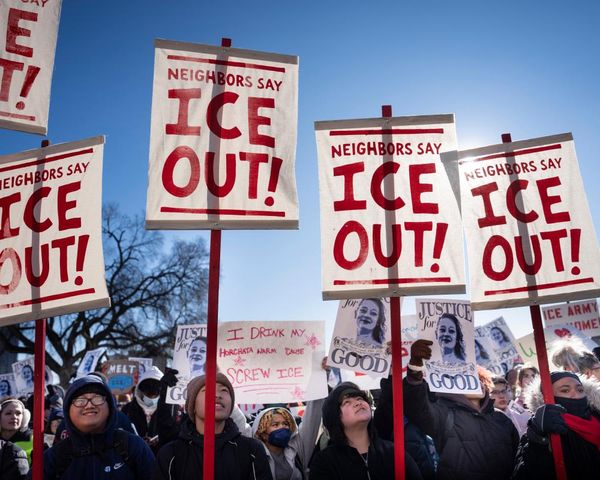
With other spending bills behind them, Congress now looks to find a way forward on a Homeland Security measure ensnared in controversies over the Trump administration’s aggressive enforcement push on immigration, an area where common ground historically has been hard to find.
Since the second fatal shooting of a U.S. citizen by a federal immigration agent during a crackdown in Minneapolis, Democratic lawmakers have advocated for a variety of policies they want to include in the bill to rein in what they say are the Department of Homeland Security’s abuses.
Most of those measures center on increasing accountability for officer actions and reinforcing the rights of Americans when it comes to searches, arrests, protests and the use of force during those interactions.
“If Republicans can’t come to the table on these very sensible changes, then the violence we see happening around the country is going to continue,” Senate Minority Leader Charles E. Schumer, D-N.Y., said on the floor Monday.
Republicans have been open to some ideas such as additional training, but they contend oversight measures should be paired with prevention of harassment of immigration agents and requirements that local governments cooperate with federal immigration authorities.
“I hope we can find consensus around these issues,” Senate Majority Leader John Thune, R-S.D., said on the floor Monday. “But one thing is clear. If the Democrats’ goal is simply to make it harder to detain and deport dangerous illegal aliens, then they will find no interest on this side of the aisle.”
Congressional leadership and the White House have an unusual legislative posture and a deadline of Feb. 13 to find a deal for a spending bill with $64.4 billion in discretionary funding for DHS along with other key public safety agencies, as well as $26.4 billion for disaster relief.
Congress stripped out that Homeland Security portion from a fiscal 2026 spending package and agreed to a short-term extension of current funding levels to negotiate.
It’s not clear exactly how a measure gets put together that will clear a House with a Republican majority that strongly backs Trump’s immigration push as well as a Senate where Republicans need at least seven members of the Democratic caucus to overcome procedural hurdles to pass the bill.
Rep. Tom Cole, R-Okla., the chairman of the House Appropriations Committee, said Monday he didn’t know if an agreement could be reached before the current continuing resolution for the Homeland Security portion of the federal government runs out.
“I think there’ll be a serious negotiation. My guess is there will probably be an extension. I don’t think it will be settled in 10 days,” Cole said. “I’d love to be wrong about that.”
DHS policies
The sides have found common ground when it comes to Democratic demands for immigration enforcement agents having body-worn cameras turned on during operations. The compromise spending bill already would require $20 million for the purchase and operation of the cameras.
Democrats want cameras to provide for accountability to document any lawless activity from officers, while Republicans see an opportunity to prove agent actions were justifiable in face of false accusations.
Homeland Security Secretary Kristi Noem announced in a social media post on Monday she had initiated a policy to deploy body cameras officers in Minneapolis with plans to expand that nationwide. Schumer, on the floor Tuesday, said Democrats “need it enshrined into law.”
Republicans and President Donald Trump have disagreed with a demand from Democrats for a policy that would require visible IDs and prohibit immigration officials from wearing masks hiding their faces, which is common with other law enforcement throughout the country.
Speaker Mike Johnson, R-La., has said that “would create further danger” for immigration enforcement agents by making them vulnerable to having their personal identities disclosed. “And when you have people doxxing them, and targeting them, of course we don’t want their personal identification out there in the street,” Johnson said.
Republicans have also disagreed with Democrats’ demands to end an Immigration and Customs Enforcement policy that allows agents to forcibly enter homes to conduct immigration arrests with a DHS-signed administrative warrant, rather than a judicial warrant from a court.
Johnson said that would be onerous because of the extent of illegal migration into the United States that occurred during the Biden administration, when agents know someone is here illegally.
“They want to add an entirely new layer of warrant requirement, OK?” Johnson said. “They want to have a judicial warrant on top of the immigration judge warrant. And we can’t do that.”
“Look, they are chasing people who are not going to stand out in the public on the street and say, ‘Come get me. I’m illegal,’” Rep. Ralph Norman, R-S.C., said when asked about judicial warrants.
Not even Democrats agree on what they want to see. Some are calling for radical changes to ICE that would amount to dismantling the agency, while others continued to call for the removal of Noem either by termination or impeachment.
The Congressional Hispanic Caucus, for example, included in “non-negotiable DHS funding conditions” the redirection of $75 billion in funding under the reconciliation law enacted in July “away from mass detention and quota driven arrests.”
House Homeland Security ranking member Bennie Thompson, D-Miss., hinted at even more demands from House Democrats that haven’t been unveiled yet. “Part of the discussion is, there are some things on the table, not everything,” he said. “And we’ve seen where the senators are, but the House is evolving.”
Democrats proposed a few amendments during Senate floor debate last week on training, oversight, warrants and hiring practices. The amendments also included language that would prohibit arrests at sensitive locations like schools and places of worship and affirm immigration officers can’t use the racial profile or the language spoken by an individual as a pretext for making an arrest.
Some Republicans, led by Sen. Lindsey Graham, R-S.C., have said they want to curtail jurisdictions known as sanctuary cities, which they criticize for refusing to cooperate with federal immigration enforcement activity, such as notifying immigration officials when an individual in local custody is in the country illegally.
Graham has signaled he would introduce an amendment that would impose criminal penalties on state and local officials who willfully interfere with the enforcement of federal immigration laws.
“I have publicly stated that some of the reforms to ICE and Border Patrol being advocated by Democrats make sense, like more training and body cameras,” Graham said in a statement. “However, in my view, the real problem leading to chaos is sanctuary city policies.”
White House deal
But negotiations seem to already be out of House Democrats’— and maybe even Johnson’s — hands. Cole said Tuesday the negotiations are already set to be “White House-driven.”
House Homeland Security Appropriations Subcommittee Chairman Mark Amodei, R-Nev., said Tuesday the discussions “are centered at the White House and Senator Schumer’s office.”
“I’m going to put this as nice as I can: We’re all nails, and Donald Trump’s the hammer,” Amodei said.
White House press secretary Karoline Leavitt on Tuesday said President Trump would be the “ultimate decider.”
“As for policy discussions that will take place, Congress will have those, the president will decide on those,” Leavitt said. “You saw yesterday, Secretary Noem announced that DHS agents on the ground in Minnesota will begin using and wearing body cams. … So that could be part of the discussion.”
Senate Democrats hold the most leverage, since Thune will need some Democratic support to avoid a filibuster and pass a DHS funding bill, said Matt Glassman, a Hill veteran and senior fellow at the Government Affairs Institute.
“If [Schumer] negotiates something with Trump, and if Trump is happy with it … and Schumer gets something he wants, you get your votes in the Senate, and then it’ll be Trump’s job to get the Republicans in line in the House,” Glassman said. “House Democrats can kick and scream all they want, but they’re probably not really relevant here under a lot of configurations of the outcome.”
House Minority Leader Hakeem Jeffries, D-N.Y., said Monday that Schumer has included him in previous DHS negotiations with the White House. But there’s still a sense among the caucus that House Democrats will be left out, Thompson said.
“There is concern about whether or not the House members will be left out of any agreement,” he said. “But we all just voted together on this issue — at least [House Democrats] have unity.”
Paul M. Krawzak, Aidan Quigley and John T. Bennett contributed to this report.
This report has been corrected to reflect that Thompson is the ranking member of the House Homeland Security Committee.
The post Congress turns to Homeland Security funding clash appeared first on Roll Call.