
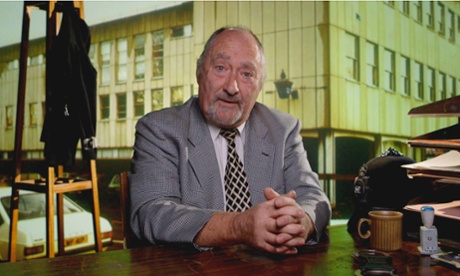
A few ex-police officers are reminiscing about the good old days, in Confessions of a Copper (Channel 4). The British bobby was a pillar of the community, respected by all who lived there. Well, nearly all; and those who didn’t respect the boys in blue were treated a bit differently. “They would be taken into a corner and told their fortune,” explains Ken German. Eh? Palmistry? At the end of the long arm of the law? Oh I see, it means a clip round the ear. Well, we are talking about the 1960s, and these were very bad people who didn’t respect the police; what did they expect?
Market traders certainly respected the police. So if a constable, like Stephen Hayes here, was walking through the market on patrol, they’d give him meat, a nice piece of bacon, perhaps, plus vegetables, to take back to the sergeant. And if they didn’t, Sergeant [Beep] would send Stephen out to remind them. With the van, if he was expecting something bulky, like a domestic appliance.
Well, a policeman needs to eat, like any other man. And he needs something to keep his food chilled, and something to cook it on. Fighting crime was hungry work, especially before the panda cars came in and they had to chase the villains on foot or by bicycle, while waving a truncheon and blowing a whistle.
That – fighting crime, the actual police work – was also done a bit differently, back in the day. They had more powers and flexibility, could use some of their own initiative. Well, that had to be a good thing, no? None of this liberal, PC (the other sort) nonsense. And if it meant bending the rules a little to get to the right place, then that’s not really so bad is it?
“There wasn’t really a line, it was only your own moral thinking, duty, ethics, whatever,” says Hayes. “It was quite common: someone arrested, say for an armed robbery, wearing a balaclava … you’d search a house, take hairs out of their comb or hairbrush, put them in the balaclava that was said to be found at the scene, that was quite a common practice.” And how did he know this person was guilty? “Well, you know they must be guilty; you know they’re at something, you just do. You wouldn’t be a police officer otherwise.”
Oh. I see. In a short space of time we’ve gone from a bit of fortune telling (know what I mean) in the corner, and the odd joint of bacon on the house officer, maybe a few white goods, to fabricating evidence. As well as – possibly even more seriously – some sense of inbuilt justice/moral superiority. The experience of watching this documentary has changed, too: from light-hearted mild outrage, to proper jaw-dropping scandal.
We haven’t even got to the torture yet. And the racism. And the sexism. Which ranges from not getting why women wanted to be called police officers, rather than women police officers – “Something I will never understand,” says Ken, “especially when you’ve got a PC Sandy Smith or something; you don’t know if you’re dealing with a fella or a woman” – to the “station stamp”. This was an initiation ceremony faced by female recruits, and which was more frightening than facing a riot, according to Carole Phillips, who did somehow make it to superintendent. “Skirt up, pants down, stamp on the backside,” explains Jean Wigmore. As in the station date stamp, having been dipped in the ink pad. Sexual assault, in other words. At least Ken never got involved in that: “I didn’t do, I certainly didn’t do it, well no I … no I didn’t do it … really.” Thanks for clearing that one up, Ken.
It’s not just about Ken and co; nor is it completely damning. A fair film, I imagine there were plenty watching who didn’t see anything wrong with any of it. I found that, although I was horrified, I wasn’t entirely unsympathetic. The ex-coppers featured are being honest; it’s just what went on. These are the pawns, and the mouthpieces, to the real villains: the institution, the culture, and most of all the age in which they worked. (Now they’re all angels, obviously; albeit angels buried under a mountain of paperwork, protocol and political correctness.)
Oh, and Gene Hunt, Life on Mars, Ashes to Ashes? No exaggeration, apparently; also documentaries. And I’m also beginning to understand why my mum told me some time around then that she’d disown me if I joined the police. Hey, it was only a brief idea, I was young …








.jpg?w=600)



