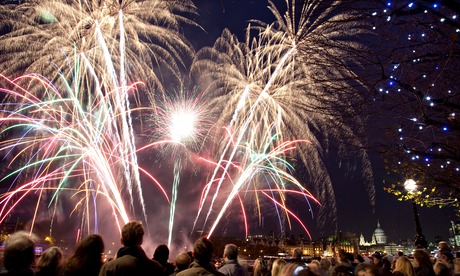
A growing trend for local authorities to impose admission charges for bonfire night displays could encourage fireworks fans to organise their own riskier back garden celebrations, firefighters are warning.
Some cash-strapped councils are saving money by forcing people to pay and limiting numbers on safety grounds, leading to fears from firefighters that more people will organise casual – and more hazardous – events.
Matt Wrack, general secretary of the Fire Brigades Union, said: “Charging for the public to attend firework displays over bonfire night will only encourage people to hold their own backyard displays which can be dangerous. Council firework events are, by far, a lot safer. They ought to be free.”
Gary Walsh, explosives and fireworks lead at the Chief Fire Officers Association, said: “We would always encourage people to attend a safely organised bonfire and firework display. Professionally organised displays are not only generally safer, they are usually more spectacular.”
In south London, Lambeth council has decided to charge adult residents £6 and non-residents £7 for its fireworks display in Brockwell Park.
It argues that too many people attended the free event last year – 100,000 came – and the £95,000 cost was too much. Only 48,000 people will be allowed into the venue this year where extra attractions include a giant mechanical firebird and a “disco turtle” that will roam the site.
Councillor Jane Edbrooke, Lambeth’s cabinet member for neighbourhoods, said the police and fire service had demanded changes after last year’s event. “We have listened, introducing tickets, while keeping the event free for under-16s. There is a lot of pressure on our finances.”
Local residents have complained that charging will dampen the community spirit that a good firework display can engender.
In east London, Hackney council has been praised for relaunching its display in Clissold Park after a gap of more than 10 years – but criticised for charging. Adult residents will pay £7.50 and children £2.50, while visitors must pay £1 more. Hackney argued it was working within difficult financial constraints and could not justify tens of thousands of pounds of taxpayers’ money going up in smoke.
It is not only London councils who are charging. An estimated 11,000 people gathered at West Park in the Yorkshire town of Goole for last year’s bonfire night celebrations and enjoyed a spectacular – and free – display. This time, the town council is charging entry fees and limiting the crowd to just 7,000.
“I think it’s a great shame,” said independent town councillor Shirley Marshall, who voted to keep the event free. “What will the people who can’t pay or won’t pay do? They’ll organise their own back garden displays, thousands of them.”
That could, Marshall argued, lead to more work for the fire service. “On top of that, it’s always been a great community event. Everyone loves a bonfire.”
In Peterlee, County Durham, the town council initially announced there would be no celebration, claiming traffic congestion caused health and safety problems last year. It changed its mind when Tom Simms, district fire manager for County Durham and Darlington, expressed concerns about private displays. He wrote: “If this event does not go ahead, there will be several thousand people that will potentially have their own fireworks displays and bonfires … I would urge you to rethink.”
Independent Peterlee councillor Andrew Watson said there had been an outcry at the prospect of the cancellation. “It has been going on for at least 40 years. We had 7,000 people there last year, it is a great event. It costs £10,000 to put on. One badly burned hand costs more than that.”
The question of whether or not to stage a bonfire show – and what it should feature – has become a burning political issue in town halls across the country.
In Portsmouth, there was controversy when the council decided that its fireworks display could go ahead but it could not afford a bonfire.
Conservative councillors blamed the former Lib Dem administration, which claimed the decision had been agreed by councillors of all political hues. A waste management company stepped in to save the bonfire by agreeing to pay for the wood and clean-up.
In Lewes, East Sussex, seen by many as the bonfire capital of the world, one of the groups that hold spectacular displays, the Waterloo Society, is charging admission for the first time in its 50-year history.
Its chairman, Paul Slot, said: “This is obviously a big decision but one that we have considered very carefully. We have an increasing number of spectators on the site each year and the costs associated with that have increased significantly.”
Liverpool, though, is staging two free displays, in Sefton and Newsham Parks.
Assistant mayor, Wendy Simon, said there were two main reasons for putting on free events. “The first one is the safety issue,” she said. “We want people to enjoy fireworks safely. The second is community spirit. It’s a great time to bring everyone together.”