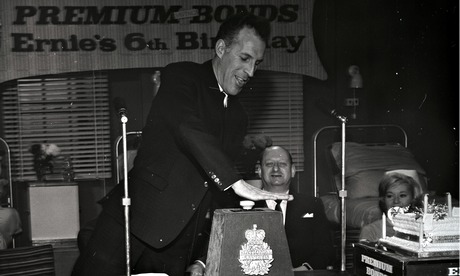
One of the first acronyms I ever learned was Ernie. This was the pet name given to the Electronic Random Number Indicator Equipment, which every week decided which holders of Premium Bonds were going to be made rich beyond dreams of avarice by winning as much as a thousand pounds, when that was almost enough to buy a house. Back in 1956 this was the first intrusion of computer-style machinery into most people’s lives. The story of Ernie and how its introduction as a means of boosting the national coffers had to sidestep Methodist qualms about gambling is told by Natasha Fry in the latest instalment of her series Computing Britain (Wednesday, 1.45pm, Radio 4). A similar theme appears in The Letters Of Ada Lovelace (Monday, 11am, Radio 4), where Sally Hawkins attempts the tricky feat of bringing to life the unusual times of the 19th-century pioneer of computing (and estranged daughter of Byron), who as a teenager would swap mathematical brain teasers in letters with her mother.
The geezers of rock still matter because they’re still box office, on the radio and elsewhere. Fifty years after Satisfaction, Keith Richards is the guest on The Huey Show (Saturday, 10am, BBC 6 Music). Forty-seven years since joining Pink Floyd, David Gilmour talks to Matt Everitt for The First Time (Sunday, 1pm, BBC 6Music). Forty-four years since Maggie May became his first UK hit, Rod Stewart headlines Radio 2 Live At Hyde Park (Sunday, 1pm, Radio 2) and promises a set peppered with fan favourites. “In football terms,” he says, “these are the impact players that often get left on the bench.” The supporting cast is led by Bryan Adams and includes Leona Lewis, Will Young, Kate Rusby, the Corrs and, in an unlikely choice for an open-air gig in London, Giorgio Moroder.
There’s a lovely bit in the situation comedy Shush! (Friday, 11.30am, Radio 4) where Rebecca Front’s slightly superior librarian says “Machu Picchu” in an accent which gently rebukes the rest of us for having said it with insufficient respect. She plays Alice, who has never quite got over winning a place at Oxford at the age of nine. She co-writes with Morwenna Banks, who plays Alice’s co-worker Snoo, whose affection for books has yet to extend to actually reading one.
I Was (Monday, 4pm, Radio 4), Andrew McGibbon’s series of interviews with people through whose lives the famous briefly wafted, returns with Geoffrey Stevens, who was taught by Eric Blair – AKA George Orwell – at a small private school in west London in 1932. Blair was very tall and, Steven remembers, lived wholly within himself. If you’re going to encounter a literary lion during your life, it’s probably best to have them as your teacher. All that time staring vacantly in their direction, taking in nothing of what they’re saying but everything of how they’re saying it is ideal preparation for a lifetime spent recalling them.
There’s a similar voice-from-the-past moment in Secrets And Spies: The Untold Story of Edith Cavell (Wednesday, 11am, Radio 4). “She had practically no sense of humour,” says a woman who joined Cavell’s hospital in Belgium in 1912, from an interview given in 1961. It’s a jolt to hear recollections about a person best known nowadays for their statue in Trafalgar Square. Cavell was the English nurse who was shot as a spy by the occupying Germans in Belgium in 1915, having been involved in helping Allied soldiers to get out of the country. This programme looks at whether her work went further.