Complexity of Belonging, a flagship show of the 2014 Melbourne festival, has an apt title given its origins.
This world premiere is a collaboration between German writer-director Falk Richter and Dutch choreographer Anouk Van Dijk, currently artistic director of Melbourne’s Chunky Move dance company. The cast combines five dancers and four actors, and the show is a co-production by Chunky Move, Melbourne Theatre Company, and the Melbourne and Brisbane festivals.
Perhaps unsurprisingly, Complexity of Belonging’s theme explores how intimate relationships are conducted across distances. As Richter and Van Dijk’s fourth collaboration, its key artists were located in different countries for much of its devising. All nine performers speak and dance, using their own names but performing as fictional characters. Dance takes place alongside, in parallel and sometimes within dramatic scenes and monologues.
A magnificent cyclorama of the Australian desert serves as a backdrop to the onstage action which is set, if not quite in Australia, in an Australian no man’s land created by remote communication. The design makes much of technologies like Skype and mobile phones in various digital projections and amplification.
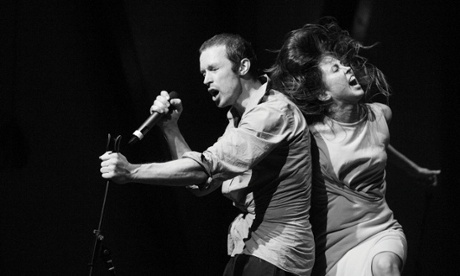
The actors dance beautifully, the dancers act with surprising skill, the excellent sound design contributes to an aesthetic in harmony with the theme. Placement is crucial in a work about the failure to connect, and there is no shortage of directorial and choreographic talent on display in the use of human bodies and simple stage furniture to build and destroy constantly shifting landscapes.
Yet it’s the triumph of Complexity of Belonging’s stagecraft and its superior production values that, perversely, expose the work’s inexcusable weakness – that it makes no original or complex contribution to the ideas it presents. The design complements the subject matter, but it’s in no way enhanced by the text.
A framing device places Eloise (Eloise Mignon) as a French researcher remotely interviewing random subjects about the nature of belonging, relationship and community. Some characters have a clear relationship to Eloise’s study, like Josh (Josh Price), who’s developing a serious romantic relationship with a man he originally met through Grindr for sex. Others, like James (James Vu Anh Pham) spontaneously emote, in his case discussing race, culture and identity in response to his memories of the film Romper Stomper.
Scenes, characters and dance routines overlap and overtake one another, and while the effect may be intentionally fragmentary, the result is inarticulate confusion. The central problem is that Van Dijk’s choreography abstracts movement, leaving long, often vacuous spoken scenes to describe people’s feelings. Like a choral sequence that begins every line with “I feel weird”, these don’t register emotional sincerity or philosophical truth, instead repeating themselves to theatrically deadening effect.
For this reason, a couple of isolated moments stand out: the scene where Lauren (Lauren Langlois) describes her dream man to her therapist and one in which Joel (Joel Bray) takes Eloise to task on Aboriginal identity in a Skype session. Concrete language and clear dramatic gestures allow the audience to pull out their own meaning from the choreography.
Anything resembling an emotional spine to the work is provided through the sheer determination of the extraordinary actor Karen Sibbing, whose focused performance as a lonely therapist grows and blooms with nuance and beauty despite receiving so little help from the script or arrangement of scenes.
Ultimately, the most complex thing about Complexity of Belonging is how it was made. As a dance work with speech, it’s an aesthetic pleasure, but as a 90-minutes plus exploration of how social globalisation has resulted in personal atomisation, the experience is thin.
Society’s been globalised for decades now; it’s not enough to bandy around the ideas of a 1980s postmodernist novel with a few mobile phones thrown in.
• Complexity of Belonging runs at the Southbank theatre until 26 October
See the full Melbourne festival program and look out for Guardian Australia’s live coverage