The reorganization of the Constitutional Democratic Party of Japan and the Democratic Party For the People is unlikely to be a "complete confluence" involving all the lawmakers of the two parties.
Party leaders Yukio Edano of the CDPJ and Yuichiro Tamaki of the DPFP have different intentions, and lawmakers under the Japanese Trade Union Confederation (Rengo), the power base of both parties, are yet to decide their future course. Creating a party to serve as an alternative to the ruling Liberal Democratic Party, with an eye on the next House of Representatives election, is unlikely to be easy.
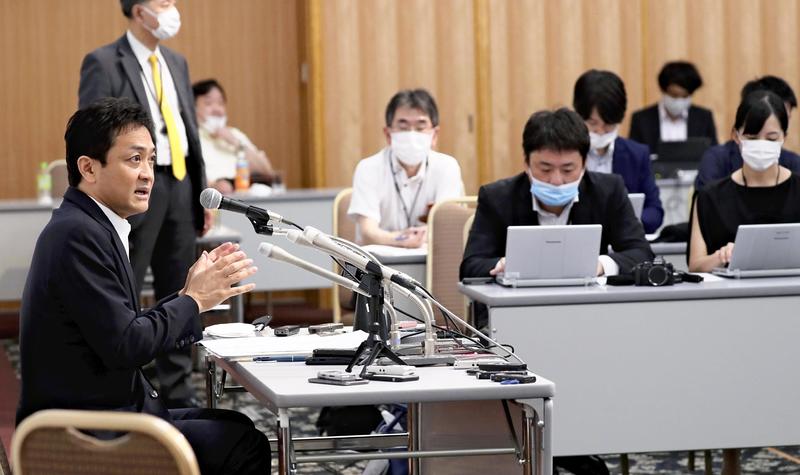
Regarding the reorganization, Tamaki of the DPFP agrees that "a big mass is needed" to counter the Abe administration. In Tamaki's eyes, however, the current CDPJ is seen as a "criticism-only" party. The DPFP was proud of the fact that it had been making policy proposals, such as advocating the provision of a universal 100,000 yen benefit as a measure against the novel coronavirus.
"Can the CDPJ change?"
When Tamaki received conditions for a reorganization from the CDPJ on July 15, he tried to determine if the CDPJ would be willing to compromise on issues on which it had been reluctant, namely reducing the consumption tax and discussing the Constitution.
Tamaki repeatedly called on Edano to hold party leader talks, but the CDPJ was dismissive toward the proposal and cold regarding the idea of a "reform-minded centrist party."
As a result, Tamaki announced that he would not participate in the new party formed with CDPJ. At the moment, however, less than 10 lawmakers are openly opposing the reorganization, including conservative former Foreign Minister Seiji Maehara.
At a CDPJ executive meeting on Wednesday, Edano said, "I want to fight to change the current political situation with as many of my peers as possible."
Edano wanted his party to lead the merger, and he approached Ichiro Ozawa, a member of the House of Representatives from the DPFP, whom he does not necessarily have a good relationship with.
"If we don't put this together now, the opposition parties will be wiped out in the next election," Ozawa said during numerous meetings with Edano. Ozawa advocates the idea that "there is strength in numbers." The route to a reorganization finally opened up after Edano made concessions to the DPFP, agreeing to dissolve both parties to form a new one, and to hold a vote to determine the party name.
Edano has long denied the possibility of a merger between political parties, saying, "I will not take part in the making and breaking of political alliances."
However, in the House of Councillors election last summer, few seats were won by the CDPJ in the proportional representation section, which is regarded as an indicator of party strength. Candidate selection did not go smoothly for the next House of Representatives election either. Late last year, Edano changed his stance to seek a reorganization.
When the reorganization talks on the premise of an absorption-based merger broke down in January, some CDPJ executives said this was the end of the reorganization. Since then, the party's approval rating has remained low at about 5%.
After the candidate supported by the CDPJ suffered a crushing defeat in the Tokyo gubernatorial election in July, Edano once again turned to the confluence route as a key for a breakthrough.
Read more from The Japan News at https://japannews.yomiuri.co.jp/