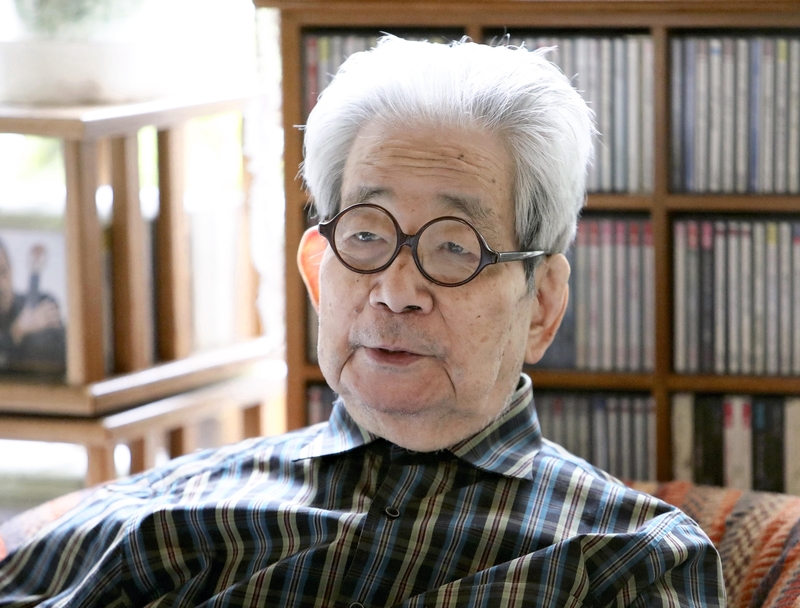
Kenzaburo Oe, the 1994 Nobel laureate in literature, continued writing novels for more than 20 years after receiving the prize. In a recent interview with The Yomiuri Shimbun, however, held before the July start of publication of a 15-volume collection of all his fiction, the 83-year-old author said that he would write no more stories. "I've finished writing everything I can write," Oe said.
The collection from Kodansha Ltd. contains 28 novels and 66 short and mid-length stories. Among them is "Seiji Shonen Shisu" (A political youth dies), in its first reprinting since it was originally published 57 years ago.
The following are excerpts of the interview with Oe.
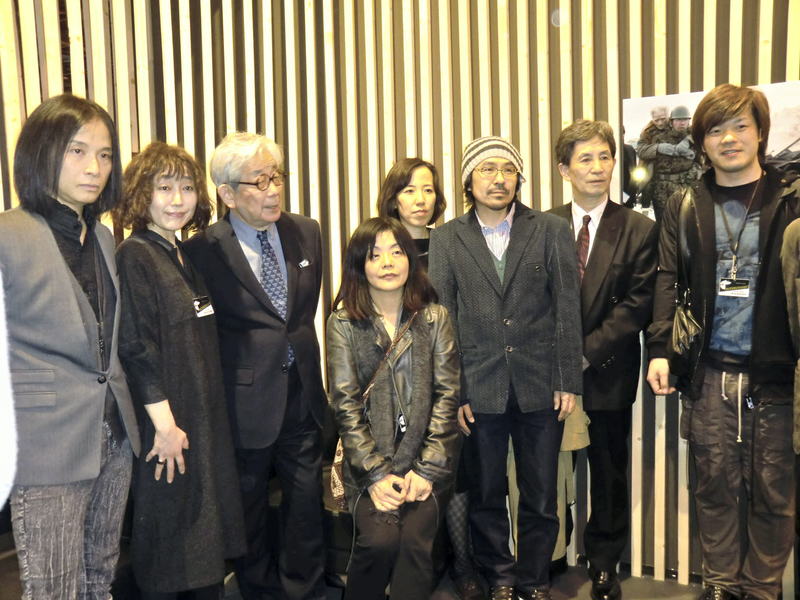
The Yomiuri Shimbun: Writer Yasutaka Tsutsui said this about the collection's publication: "It's been the era of Kenzaburo Oe all the time." I heard a similar comment from Hisashi Inoue before.
Kenzaburo Oe: We were fifthgraders at kokumin gakko (elementary schools) when Japan was defeated in World War II. We grew up in a time of poverty. But our generation was in luck because it was easy to work as professional writers. We've written with a fountain pen on genko yoshi (sheets of manuscript paper) marked off in 400 squares. This is a distinctive style developed by modern-day writers. Japan places great importance on such intellectual value and has many sophisticated readers. Thanks to them, the complete collection is to be published.
Yomiuri: There have been 1.14 million copies printed in 79 editions of "Shisha no Ogori" (Lavish are the Dead), your first collection of short stories, just in Shinchosha Publishing Co.'s paperback format. You had your first complete collection published as early as in 1966-1967, and a 10-volume collection of stories selected by yourself in 1996-1997.
However, some of your works haven't been available for a long time, such as "Seiji Shonen Shisu" and "Gisho no Toki" (Time of perjury), in which a female college student who holds someone captive is the narrator.
Oe: The publication of this latest collection will be my last task in life, so I'm now reading all the works again. It's made me realize that I knew what I wanted to write about from the beginning and have worked very hard to write about those things. I really feel I've done nothing other than writing stories.
If I were told, "This is the work that represents you," I would say: "That's right. Thank you for being interested [in my work]." I now have such a calm feeling, and there's no work that I want to take back.
Yomiuri: Even after receiving the Nobel Prize, you actively continued writing novels one after another for more than 20 years, which is exceptional for a Nobel laureate. There was longstanding, intense rivalry amid your generation, [among leading cultural figures] such as Shintaro Ishihara, Jun Eto, Keita Asari, Shuntaro Tanikawa, Toru Takemitsu, Shuji Terayama and Saburo Shiroyama. That "post-war generation" was the mightiest.
Oe: Ishihara was an excellent writer who used distinctive expressions from the beginning. As a poet, Shuntaro Tanikawa was distinctive. I'm grateful for these two, as they made their names known before I did, making it possible for me to start working as a writer when I was still a student.
Yomiuri: You had many one-on-one talks with Kobo Abe and Yukio Mishima. Both were about 10 years older than you. Weren't there any barriers between you and them?
Oe: Mr. Abe was my favorite writer of all. He was absolutely more creative than Mr. Mishima and a big talent. He lived close to my home and often invited me to go for a drive. But one day, Mr. Abe called me and said the two held talks.
He told me: "Oe, we want you to join us in a declaration of a shared view both culturally and politically. Since Mr. Mishima and you are quite different, why don't you create a base for having talks." But I declined. That was it.
Yomiuri: Both your "Seventeen" and Mishima's "Yukoku" (Patriotism) were published in December 1960. It was immediately after Inejiro Asanuma, the chairman of the Japan Socialist Party, was stabbed to death by a rightist youth in October that year. "Seiji Shonen Shisu," the sequel to "Seventeen," was considered to have been modeled after the culprit.
Oe: The story unfolds in a similar way but I didn't intend to model that work on him. I'd already depicted unstable boys who joined right-wing groups' propaganda campaigns and terrorists' activities in "Warera no Jidai" (Our age), published the previous year.
While an advocate of the postwar democracy, I had a contradictory, irresistible desire to write a story by immersing myself in the feelings of a right-wing boy who dedicated his life to the Emperor. I was severely criticized both by right and left groups for a decade or so.
Yomiuri: ["Seiji Shonen Shisu"] was already published in Germany in 2015, and is highly praised.
Oe: Whenever terrorist attacks in various forms occurred, I felt, "I've already written about what's happening now in my stories in the past." Why are young people driven to commit suicide bombing attacks? Political fanaticism and sexual impulses both have the same origin in human beings, and they turn into reality ... When I was still young, I wrote such works as "Sakebigoe" (Cry) based on an intuition I had, although I was immature.
Yomiuri: Many of your works have foretold dangerous signs of the times. "Kozui wa Waga Tamashii ni Oyobi" (The flood invades my spirit) has a conclusion that is similar to an incident caused by the Rengo Sekigun (United Red Army) terrorist group. The trilogy "Moeagaru Midori no Ki" (The flaming green tree), released in the early 1990s, was inseparable from incidents caused by the Aum Supreme Truth cult.
Oe: While studying [Jean-Paul] Sartre, I read new novels written in French and English, as well as Japanese and foreign newspapers, at a university library. I was inspired, and felt: "Similar incidents are taking place across the world. I can write about them in my stories!"
Activists became such different people as bureaucrats or politicians after graduating school. But I didn't join any organization. I just kept reading books and thinking all by myself. Then things happened in reality that overlapped what I had written in my stories after serious thought. I think this is how a writer's imagination works.
Yomiuri: Your works had strikingly new expressions of sensibilities, too. For example, the closed world of a boy and girl in an extreme situation depicted in "Memushiri Kouchi" (Nip the Buds, Shoot the Kids) has almost the same degree of transparency as a genre of works today called the "sekaikei" (world type). Now that these works are included in the complete collection, the enormous impact they had in later days can be felt.
Oe: When I was a student, I just traveled between the university and my boarding house. Some people teased me, asking why I became a novelist, because I didn't go out drinking or have a girlfriend. I've never felt I've been admired by young writers. However, having organized the Oe Kenzaburo Prize eight times and talked with such prize-winners as Yu Nagashima, Fuminori Nakamura and Risa Wataya, I feel like I'm treated well by them.
Yomiuri: Your novels such as "Manen Gannen no Football" (The Silent Cry), which was cited by the Nobel committee in awarding you the prize, and "Dojidai Game" (Contemporary game) effectively capture universal issues that modernization has brought to human beings. Researchers around the world have authored many papers on your work, and your writing is becoming more and more meaningful over time.
Oe: The village where I was born in the Shikoku region was really a periphery of a modern state. I myself am like a periphery, too. Due to major changes in the high-growth period, communal functions have been lost. Still, the settlements and forests depicted in my novels are special places, in that they have remained mythical since ancient times and, in this regard, they're connected with peripheries across the world. Each volume of the collection is to include theses written by overseas researchers. I look forward to finding out what perspectives they have shown.
Yomiuri: Protagonists in your works face challenges as they proceed with their lives, as if they are your alter egos. A young man who finds himself devoted to music in "Atarashii Hito yo Mezameyo" (Rouse Up O Young Men of the New Age!) is a reminder of your son, Hikari. Your late brother-in-law, Juzo Itami, is like a young actor in "Nichijo Seikatsu no Boken" (Adventure of everyday life) and a movie director in "Torikaeko" (The Changeling).
Oe: Itami never complained to me [about depicting characters similar to him], probably because he understood I'm ultimately a writer. I would have been a different type of writer if I hadn't met him. Anyway, for the past six decades, I've just devoted myself to writing stories and written everything in my stories. I may write short essays from now on, but seriously, I will never write a new story.
Read more from The Japan News at https://japannews.yomiuri.co.jp/