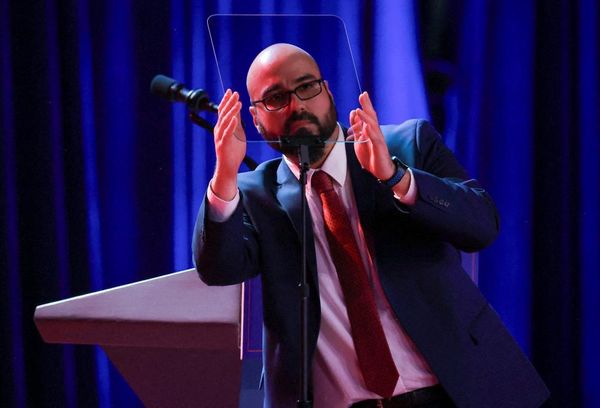
An alleged abuse victim at the centre of a complaint against Sarah Mullally, the incoming archbishop of Canterbury, has said she is not fit for the job after the church dismissed his case.
The alleged victim, known as N, told the Guardian he would exercise his right of appeal against a decision on Thursday to take no further action against Mullally, whom he accused of colluding with his alleged abuse.
Mullally is due to take up the post on 28 January, after Justin Welby was forced to resign over the way he dealt with a safeguarding scandal.
N had accused Mullally of mishandling a complaint against a serving vicar in London, where she serves as bishop. On Thursday the archbishop of York, Stephen Cottrell, who was asked to review Mullally’s handling of the complaint, said he had decided to take no further action against her.
In response, N said: “She’s not fit to be archbishop. This represents a betrayal of the Christian gospel. British public conscience will understand that while the crown may have appointed Sarah Mullally and Stephen Cottrell, Jesus Christ gave them their P45 years ago. They should both step down.”
The decision to appoint Cottrell to assess the complaint prompted criticism within the church because he had faced calls to resign last year over his handling of a separate sexual abuse case when he was Bishop of Chelmsford – allegations against the priest David Tudor.
Critics have said Cottrell’s dismissal of the complaint does not put a stop to questions of trust and accountability in the church.
N said the abuse started in 2005 and 2006 when he alleged the vicar “groped my bum, put his hand between my legs” and asked him to perform a sexual act.
Mullally became bishop of London in 2018.
N claimed that after he made a formal complaint in 2019 about the alleged abuse, Mullally breached a church disciplinary code by sending a confidential email about the allegation to the priest concerned.
N said: “That resulted in the course of absolute horrific harassment that drove me to suicide attempts. And that constituted the basis for my next CDM [church disciplinary measure] complaint in March 2020 against Mullally.”
The diocese of London said proper processes had been followed and that there was no outstanding complaint against Mullally.
N claimed it was wrong for the diocese to suggest his complaint had been dealt with. He said he had made CDM complaints against Mullally and Cottrell that were still in process.
Officials at Lambeth Palace, the official London residence of the archbishop of Canterbury, said N’s complaint was not followed up because of “administrative errors and an incorrect assumption about the individual’s wishes”.
On Thursday a statement from Cottrell’s office said: “On 7 January the archbishop of York issued his determination not to take any further action in relation to a CDM [church disciplinary measure] complaint originally filed against Bishop Sarah Mullally in 2020.”
N said: “Everyone knew he was going to dismiss the complaint, we just need to discuss the grounds under which we will be appealing.” He said there was a conflict of interest in Cottrell dealing with the issue given he was also the subject of a complaint from N on the same matter.
Robert Thompson, an Anglican vicar in the London diocese and a member of the General Synod, has called for a pause to Mullally becoming archbishop. He said it was not credible for Cottrell to adjudicate on the case.
In an email to the Guardian, Thompson said: “The dismissal of this CDM complaint by the archbishop of York may close a case on paper, but it does not close the trust deficit. It will inevitably deepen concern about whether the Church of England’s disciplinary processes are capable of commanding the confidence of survivors or the wider public.
“This decision does not resolve the serious questions that have been raised about safeguarding culture, accountability, and the handling of power at the highest levels of the church. It instead reinforces a longstanding perception that senior leaders are insulated from meaningful scrutiny by processes that are opaque, slow and internally controlled.”
In a statement last year, Mullally said it was clear that a complaint made against her in 2020 “was not properly dealt with”. She said she was “seeking assurance that processes have been strengthened to ensure any complaint that comes into Lambeth Palace is responded to in a timely and satisfactory manner”.
Michelle Burns, a former London diocesan safeguarding adviser, said: “For many survivors and safeguarding professionals this just reinforces the perception that the church disciplinary procedures just don’t work.
“Sarah is a good person. But it would be ill-judged of the Church of England to put her in place until these safeguarding issues are resolved.”