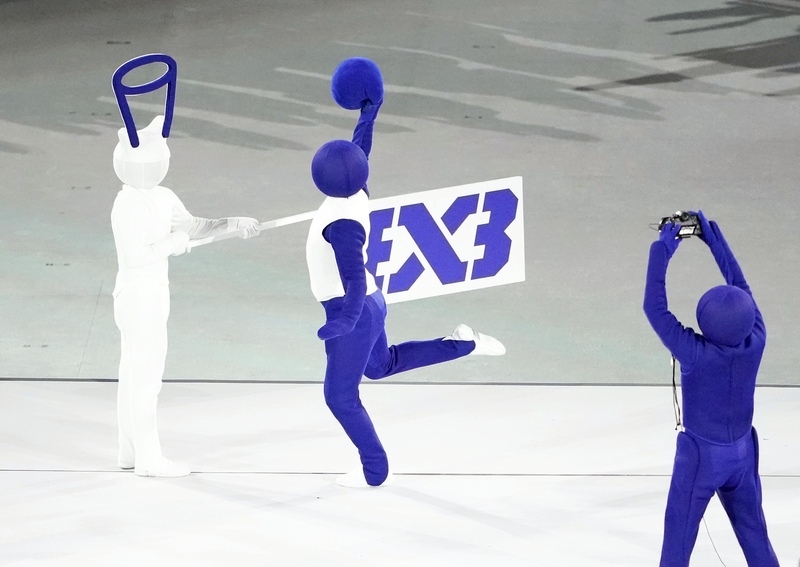
Olympic pictograms, one of the most talked-about performances of the Tokyo Games opening ceremony, are now generating quite a buzz on social media. Originally developed to communicate information to visitors from around the world, the icons are now being adapted by fans to comically convey universally-relatable events outside the sporting arena, from baby-hoisting to diaper-changing. The trend has become a modern showcase of the design sensibilities that are prided in Japan and led to its becoming the country that first introduced Olympic pictograms at the 1964 Tokyo Games.
-- Child-rearing Olympics
Tandem-shopping, baby-lifting, and competitive diaper-changing were among the interpretative pictograms posted to the Twitter account @aiuepo615. Run by a woman in Aichi Prefecture who goes by the handle "Epo," the account features cartoons and illustrations that offer a humorous take on the struggles of a working mom raising a one-year-old daughter.
Watching the Olympic pictogram performance on TV on July 23, Epo said a lightbulb flashed in her mind. "Hey, raising kids is kind of like an athletic sport," she thought, glancing at her arms that have been toned by carrying around her daughter. "It could be fun to make [pictograms] about childcare."
On July 27, Epo posted six pictograms, representing six events in the child-rearing gauntlet.
In one, a parent lifts a child overhead, as if playing airplane. In another, a harried parent appears to be sprinting with a baby tucked under one arm, a shopping bag wrapped around the other.
She devised the dynamic symbols over four days using illustration software.
Her creations struck a resounding chord on Twitter. The post has garnered over 110,000 likes with comments such as, "These are hilarious" and "Gold medals for all mothers."
Many comments also came from overseas users.
"It really made me realize the power of pictograms to transcend language and international borders," Epo said. "I just hope they let parents commiserate about the hardships of raising kids and provide a chance to look at the experience with a bit more optimism."
-- Abs or agriculture?
On July 27, the city of Fukuchiyama in Kyoto Prefecture also posted to its official Twitter account six different pictograms featuring Akechi Mitsuhide, a historical warlord associated with the area.
Created by Kozue Nishimura, a 23-year-old who started working in the city's secretarial and public relations division this spring, the series has received over 1,000 "likes" on Twitter.
In one illustration, Akechi can be seen preparing tea, sporting a samurai topknot. In another, the devoted husband is depicted handing his wife a heart bearing the Akechi clan's bellflower crest.
"I hope they will help convey the charms of Fukuchiyama, now that tourists won't be able to visit our city because of the COVID-19 pandemic," Nishimura said.
The enthusiasm for pictograms has even begun spilling over into some unexpected fields, with the JA Group logo being widely-shared by Twitter users, who point out the uncanny resemblance to a person doing sit-ups.
According to the JA-Zenchu (Central Union of Agricultural Co-operatives), the logo has been in use since 1992, with the circle on the bottom left representing a fertile harvest and an interconnected community, while the triangles on the right symbolize vast fields.
"We were surprised [the logo] trended overnight, but are glad the Tokyo Olympics has drawn attention," said a JA spokesperson. "We hope everyone will support the Olympics from their homes while enjoying meals made with domestically-produced agriculture and livestock products."
-- Seal of approval
Pictograms debuted at the Tokyo Olympics in 1964. In addition to representing Games events, they were also used to indicate general necessities such as restrooms and emergency exists, for the benefit of international visitors who could not read Japanese.
After the Games, the logos became widely adopted throughout cities, as clear symbols that made it easier for everyone to get around.
As Tsunao Harada, 82, a printmaker who was a member of the original production team, recalled: "The goal was to make symbols that people from different cultures all over the world could understand at a glance."
When the designs were completed, Harada and his colleagues on the 11-member production team were instructed to convene for a meeting. As they were also told to bring their personal seals, Harada assumed there was simply paperwork to sign in order to receive payment for the project.
Instead, art critic Masaru Katsumi said: "I would like to ask you all to relinquish your copyright on the designs so that they may be given to society."
There was no complaint from the team members, who all signed and sealed the agreement. Harada, who was the group's youngest member, aged 25 at the time, said: "I felt proud, like I was representing Japan."
When shown the new childcare and Akechi pictograms, Harada gave them high marks: "I think they capture the distinct characteristics [of the subjects] with an interesting dynamism."
"Even if we speak different languages, our bodies move in similar ways the world over," he said. "That's why I think people will continue to relate and respond to [these pictograms] even if the times change. I look forward to seeing what new pictograms will emerge in the future."
Read more from The Japan News at https://japannews.yomiuri.co.jp/