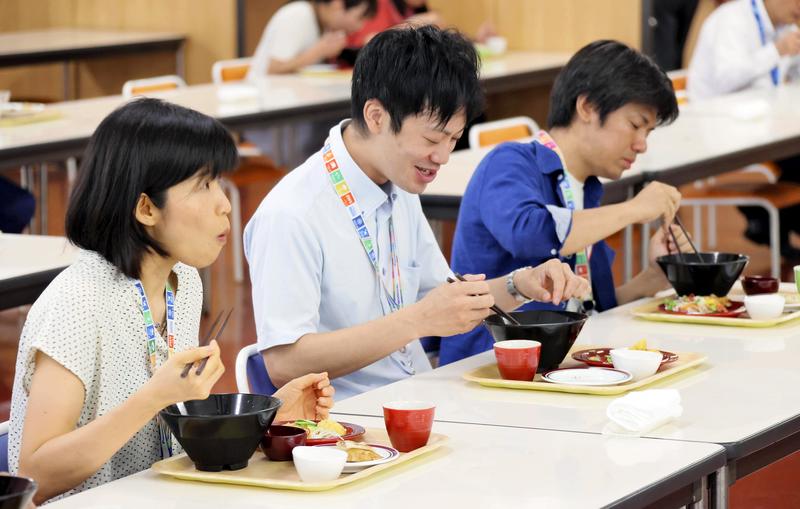
A growing number of Japanese companies are starting to adopt sustainably caught fishery products for their company cafeteria menus, in an effort to raise awareness of the need to protect the marine environment and its resources.
"Sustainable seafood" was first introduced as the company canteen of electronics giant Panasonic Corp. The concept has since spread to other major Japanese companies, such as banks and auto manufacturers.
In late July, a cold noodle dish using mackerel appeared on the cafeteria menu at Panasonic's headquarters in Kadoma City, Osaka Prefecture. The cafeteria had been serving this kind of set meal once a month since spring 2018.
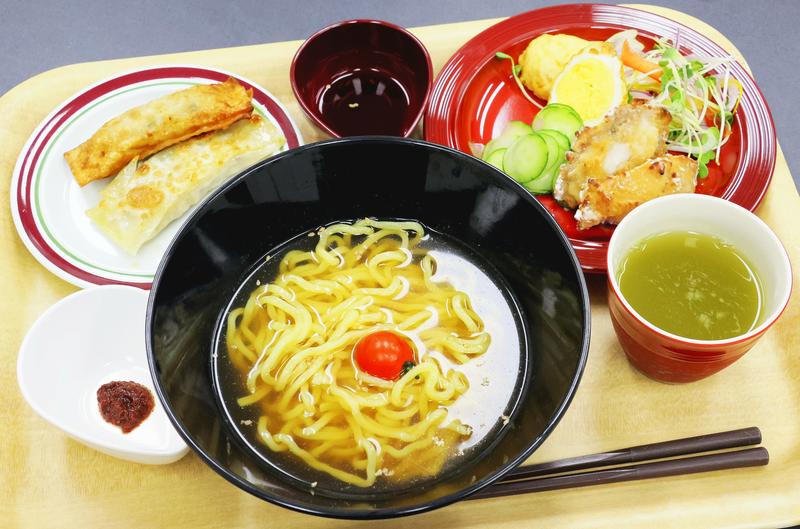
Many employees used to choose meat dishes such as pork cutlets and hamburger steaks, but now 30% of them choose the dish using sustainable seafood.
"We've devised ways to combine it with our curry, which is a favorite for many, or ethnic mixed, fried-rice nasi goreng," an official in charge of cafeteria said,
The mackerel used comes from Norway and was landed by fishermen who have been internationally certified as not overfishing, operating illegally or violating workers' rights.
International certification of sustainable seafood receives the Marine Eco Label. For wild marine products, there is a certification by the Marine Stewardship Council (MSC) in Britain, and for aquaculture products there is a certification by the Aquaculture Stewardship Council (ASC) in the Netherlands.
There is also a Chain of Custody (CoC) certification for processors and distributors, which indicates that MSC and ASC certified seafood is properly managed. McDonald's Holdings Co. (Japan) has been using certified products for its offerings since last year. Major supermarkets such as Aeon and Ito-Yokado have also adopted them.
The overfishing of natural fish is getting worse. According to the Food and Agriculture Organization (FAO) of the United Nations, the global catch of fish has risen from 34 million tons in 1960 to 92 million tons in 2016, although it has remained flat since around 1990.
Some reports suggest that estimated catches from illegal operations account for 20% of the total, with losses of about 1.1 yen to 2.6 trillion per year.
The production of farmed fish continues to increase, but it is also cause problems of water pollution and requires too many small fish needed to feed farmed fish. Protecting the richness of marine ecosystems is essential if people are to continue eating fish and shellfish in the future.
Panasonic's introduction of sustainable seafood was triggered by the 2011 Great East Japan Earthquake. An oyster farmer in Minamisanriku, Miyagi Prefecture, where the company had been supporting recovery efforts since the disaster, became the first Japanese aqua-farmer to receive international certification in 2016.
The farmer was credited with farming oysters at intervals, which accelerated their growth, improved their quality and reduced employee man-hours on the farms. Panasonic decided to contribute to the recovery effort by buying the oysters for its employees to eat.
In addition to its headquarters, Panasonic has already introduced sustainable seafood items at 42 other of its cafeterias in Japan, and has set a goal of increasing this number to 100 by the end of fiscal 2020.
Eleven food service providers have responded to Panasonic's call for certification. The increase in the number of providers has made it easier for other large corporations to adopt the sustainable seafood.
Denso Corp., a major auto parts company, has been promoting the introduction of the system at its 30 facilities including its headquarters and plants since 2019. Nearly 20 major companies, including JXTG Holdings Inc., a major oil refiner, and Bank of Yokohama, have also recently begun to introduce the system. These companies plan to establish an organization this autumn with the aim of exchanging information and expanding the use of the system.
"If awareness of sustainable seafood increases as a result of company cafeterias, people will be more inclined to buy environment-friendly products in their everyday shopping, too," an official in charge at Panasonic said.
The Tokyo Olympics and Paralympics, which have been postponed until next year, will also offer sustainable seafood at the Olympic Village and event venues. In Britain, one-third of public facilities and schools have adopted sustainable seafood since the 2012 London Games.
The Tokyo Games is expected to serve as a catalyst for the momentum to protect the richness of the ocean in Japan.
Read more from The Japan News at https://japannews.yomiuri.co.jp/