MORIOKA -- With nearly nine years having passed since the Great East Japan Earthquake, Iwate Prefecture faces new challenges such as a decline in reconstruction demand and a shortage of workers. Amid lingering effects of the tsunami caused by the earthquake and restrictions on shipments due to the incident at the Fukushima No. 1 nuclear power plant, I visited sites that are trying to revive economic activities.
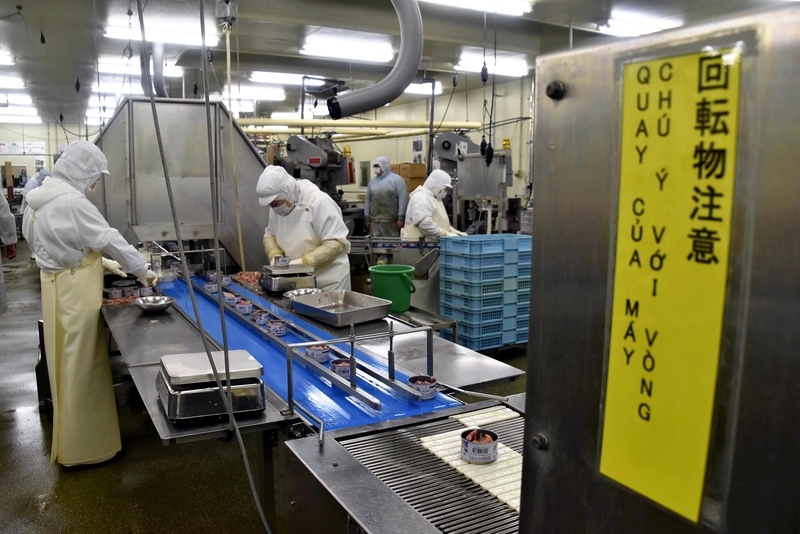
"Caution: slippery surface," and "Watch out for rotating objects."
Warnings in both Japanese and Vietnamese were posted in various places around a factory of seafood processing company Tsuda Shoten in Kamaishi in the prefecture.
At a nearby workbench, technical interns from Vietnam were processing mackerel and saury and packing them into cans. "Without them, we can't sustain our company," Yasuyuki Tsuda, 65-year-old president of the company, said, speaking frankly on the matter.
It was around 2014 that he began noticing a labor shortage, some time after the reconstruction of the factory damaged in the disaster was completed.
Shipments have returned to pre-earthquake levels, but the company now lacks workforce to handle production. Even when wages were raised, the outcome was weak in industries treated comparatively inferior to industries such as construction. So, in May 2016, Tsuda decided to hire interns as an ace in the hole.
Tsuda and his employees went to great lengths to assist the interns with every aspect of their daily lives.
The Japanese employees accompany the interns to the supermarket when they go shopping, teaching them how to choose items and how to pay. If needed, they also accompany them to the hospital and to Japanese language classes.
The dormitory has an internet access, and to prevent homesickness, the company installed video phone system so the interns can communicate with family members in their home country.
The number of interns accepted into the company has grown from 10 to roughly 30. A 21-year-old female technical intern who has been in Japan for three years says, "I understand Japanese now and enjoy every day."
While Tsuda himself said, "We want to create an environment where interns, who are a valuable part of the workforce, can work comfortably."
The labor shortage in coastal areas is serious.
According to the Iwate Labor Bureau, the ratio of job offers to job seekers in the service areas of the four public employment security offices in Kuji, Miyako, Kamaishi and Ofunato is higher than the prefectural average of 1.35 to 1 as of January.
"People who evacuated to inland areas have settled down and have not returned to their hometowns," a bureau official said.
Meanwhile, as of October 2019, there were 1,202 technical interns in the jurisdictions of the four public employment security offices, accounting for about 36% of the prefecture's total.
"More and more firms will accept foreign workers to compensate for the labor shortage," an official at the bureau said.
Some companies have revised their operations to boost productivity with limited human resources.
Ono Foods Co., frozen foods manufacturer and vendor with plants in Kamaishi and Otsuchi, shifted its focus in the wake of the disaster from the wholesale of prepared meals catering to mainly hotels to a more profitable mail order business. The new business features fish boiled in soy sauce and grilled with miso that are frozen, packed and delivered to households. The membership of the mail order business reached about 40,000, an increase of 300 times from the number in 2009.
However, of the roughly 45 employees who've joined since the disaster, 33 are technical interns, and there is a ceiling to how many more they can hire. Therefore, the company decided to outsource the work of gutting and cutting the fish.
"With limited human resources, we cannot survive unless we improve productivity and turn become highly profitable," said Akio Ono, 63, president of the company.
Read more from The Japan News at https://japannews.yomiuri.co.jp/