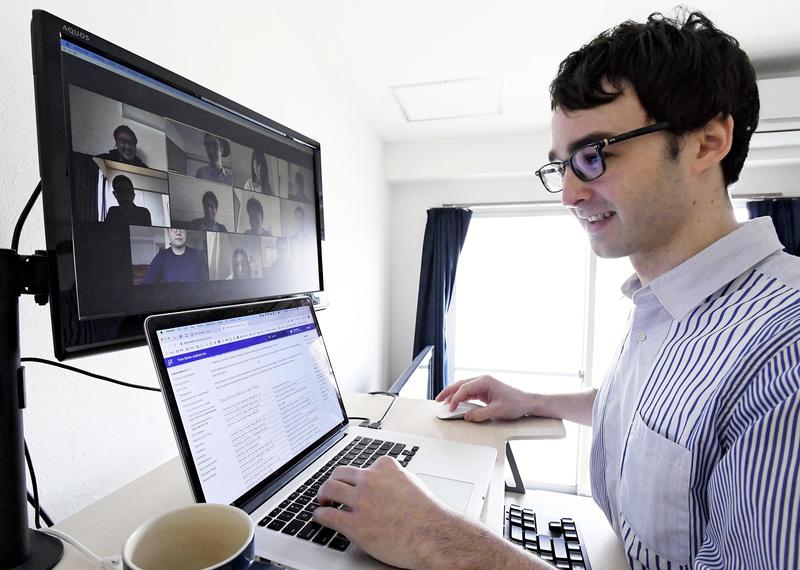
Millions of employees are working from home in Japan as an increasing number of companies adopt telecommuting amid the spread of the new coronavirus.
According to an estimate provided by a private research company, a total of 3.6 million employees nationwide are currently telecommuting, of whom 1.7 million are doing so for the first time.
With the risk of an explosive increase in the number of infections in Japan, companies are beefing up efforts to prevent the spread, fearing "stagnation of the economy could be a matter of life or death."
The chief executive of a Tokyo-based company that operates a utility-fee comparison website on Thursday informed the about 80 employees in the office that telecommuting would start from the day. "I need your support to ensure work continues smoothly," Enechange Ltd. CEO Yohei Kiguchi said in an address to staff.
Various preparations are required before companies can adopt telecommuting, including reviewing business operations, introducing relevant systems and changing the mindsets of both management and rank-and-file personnel.
Enechange considered starting telecommuting in mid-February. Since then, the company has moved ahead with the preparation of personal computers and displays to be lent out to its employees and the strengthening of security systems. Tokyo Gov. Yuriko Koike urged those who can work from home to do so at an emergency press conference on March 25.
"We planned out our measures in advance, so we've been able to make our decisions early," an Enechange employee said.
Market research company Persol Research and Consulting Co. conducted an online survey on March 9-15 to gauge the increase of telecommuting in response to the spread of new coronavirus.
A total of 21,448 regular employees responded to the survey. As the percentage of respondents telecommuting stands at 13.2 percent, it has been estimated that the number of such staffers across the country totals about 3.6 million, based on a national census.
Among those who are not working from home, 33.7% said they "want to work from home but have been unable to do so." Many respondents cited such reasons as: "The relevant systems have yet to be developed (41.1%)" and "our line of business can't be conducted at home (39.5%)."
"Our company is presently considering the implementation of telecommuting for those working in clerical departments," said a 55-year-old employee of a transport company who commuted to his office near Tokyo Station Monday morning by train as usual. "However, our shipments include pharmaceutical products and food, so we can't stop delivery of these goods. I think it would be difficult for our company as a whole to implement telecommuting."
Kunihiko Higa, a professor at Tokyo Institute of Technology who is knowledgeable about telecommuting, said: "It seems to be mainly large companies that have adopted telecommuting at this time. As the great effectiveness of telecommuting has been realized, it will become necessary to examine the challenges that have arisen at workplaces, and improve them from now on."
"Schoolwork and medical examinations at hospitals can also be done via telecommuting. I hope they would explore the possibility of their adopting the program for activities outside the corporate world," Higa said.
Read more from The Japan News at https://japannews.yomiuri.co.jp/