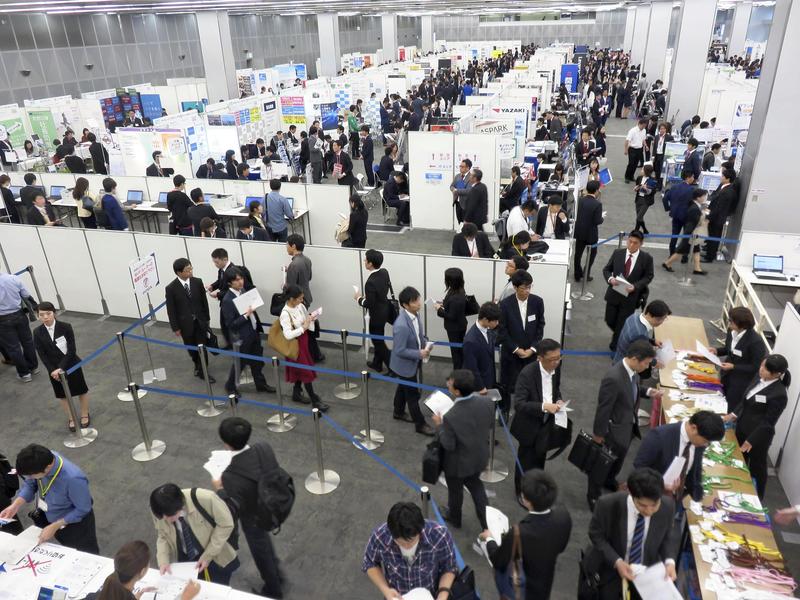
The career-change market is booming, fueled by a recovering economy and a tight labor market in which the number of job openings significantly exceeds that of employees seeking to change jobs.
A series of major companies have begun to recruit such workers by offering them executive positions and yearly salaries of at least 10 million yen. At the same time, however, some mid- and small-sized companies are in danger of losing employees.
10 million yen plus
On the career-change website of leading staffing agency BizReach Inc., a number of companies were seeking job applicants by offering favorable conditions. Listings included a major distribution company "hiring a candidate for sales department head," and a consulting company "paying an annual income of 10 million yen to 12 million yen."
According to BizReach, the number of job openings posted on the website offering an annual income of over 10 million yen in 2017 nearly doubled from the previous year.
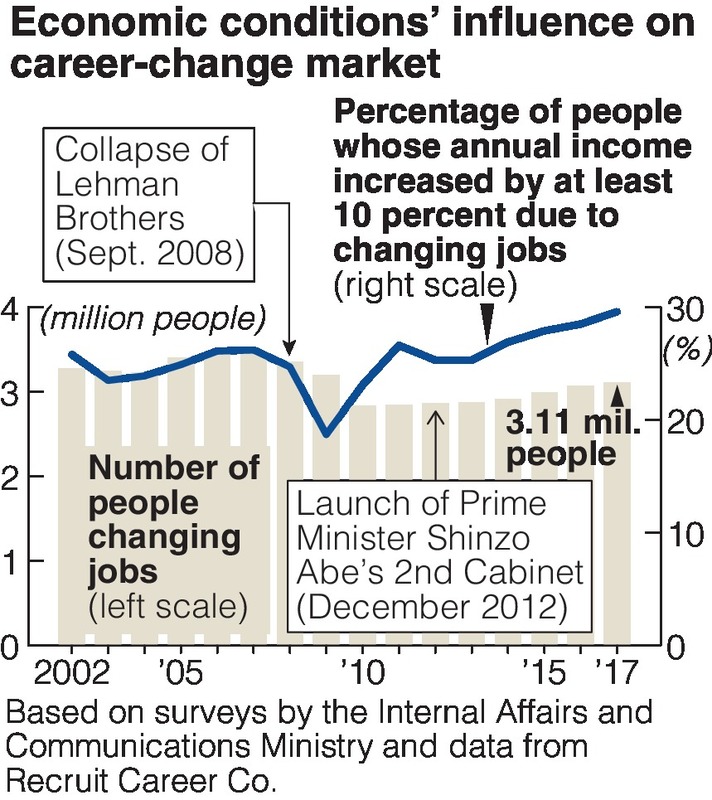
An increasing number of people are securing higher annual salaries by changing jobs. According to statistics compiled by Recruit Career Co., the percentage of job changers whose annual income increased by at least 10 percent was 30.4 percent from October to December 2017, up 2.7 percentage points from a year earlier. The figure is the highest since statistics were first kept in 2002.
One distribution company hires more than 100 job changers each year. "If we offer excessively advantageous conditions for such people, it could increase complaints among employees who've been working for our company since graduation. But there's no other way," an official of the company in charge of personnel affairs said.
Tight labor market
According to a survey by Recruit Career, the job openings-to-applications ratio for workers seeking to change jobs reached 1.92 in December 2017, the highest since October 2008, when its surveys began. In other words, there were slightly less than two job openings per employee seeking to change jobs.
In January 2018, the ratio stood at 1.82. Recruitment is especially active in industries with higher wage levels, such as internet specialists, where the ratio is 6.1, and construction engineers, where the ratio is 4.1.
To deal with increased workloads brought about by economic recovery and other reasons, companies are stepping up recruitment by offering more favorable conditions. However, the number of workers hoping to change jobs is on the decline because people do not want to take on more work. This also contributes to the increasingly tight labor market.
"To hire workers, some companies raise wage levels and lower the level required for applicants. The tight labor market is likely to continue for a while," an official at a major recruiting agency said.
Defensive wage hikes
The booming career-change market could deal a blow to mid- and small-sized companies. Employees of such companies could be poached by large companies offering better conditions such as higher wages, while the competition will intensify to recruit people seeking to change jobs mid-career and others.
According to a survey conducted by the Japan Chamber of Commerce and Industry on 3,868 mainly mid- and small-sized companies, 55.2 percent raised wages this fiscal year. More than half of the increases were "defensive wage hikes" done to prevent employees from changing jobs.
On Saturday, 23 mid- and small-sized companies participated in a joint company information session in Ishikari, Hokkaido. However, only 48 people seeking to change jobs or start their careers visited the session. Not a single person visited the booth of a service company, leading an official of the company in charge of personnel affairs to lament: "Given our business performance, there's a limit on how much we can hike wages. We have no choice but to carry out tasks with a limited number of employees for the time being."
According to statistics compiled by Tokyo Shoko Research, Ltd., 35 companies went bankrupt due to staff shortages caused by difficulty in hiring employees in 2017. The figure was nearly twice the previous year's 17 companies, and all were mid- and small-sized firms.
If it becomes more difficult to secure employees for reasons such as an increase in the number of job changers, the financial situation of mid- and small-sized companies will likely be seriously affected.
Read more from The Japan News at https://japannews.yomiuri.co.jp/