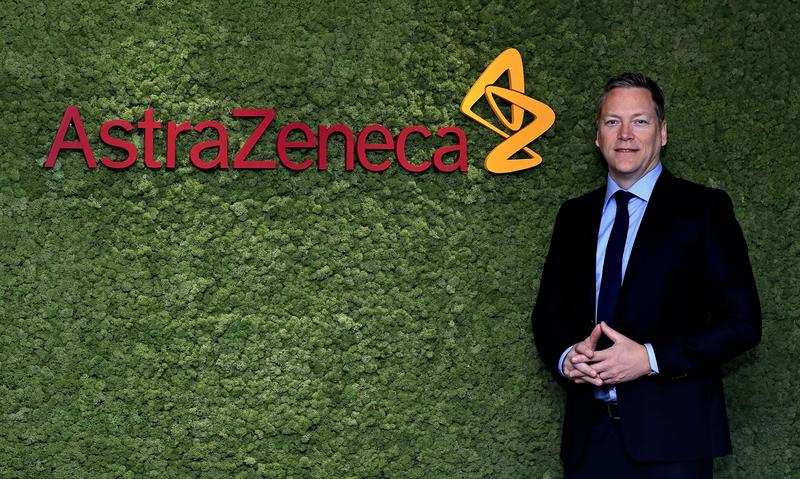
Before Stefan Woxstrom, president of AstraZeneca K.K., came to Japan two years ago, his image of the country was relatively limited to technology. Soon, however, the native of Sweden was impressed by the idea of yasuragi, or peace of mind.
Enamored by the concept, the pharmaceutical company executive has been keen to evoke positive "chemical reactions" among his staff to encourage innovation, through measures such as asking people to "speak up." The Japan News recently sat down with Woxstrom to ask about his views and ideas on business as well as Japanese culture.
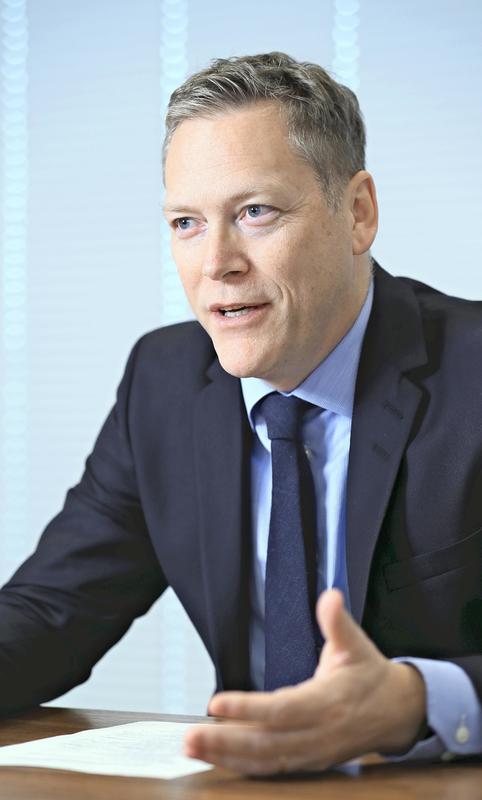
The Japan News: Two years have passed since you assumed your current post. How would you evaluate your company's business in that time?
Woxstrom: It's been a pretty intensive two years. We've had a pretty rare opportunity to launch many new treatments in Japan. In fact, 10 new treatments in two years. I've been in the industry for 24 years and I've never been in such a good position to be able to launch so many.
We're happy when we can help patients. These 10 new treatments are going to disease areas where there is a huge medical need. So there had been nothing for many of those patients. We can open up new areas of treatment and break new ice with those treatments, which has been very good and rewarding for everyone in the company, to help so many patients.
On the financial side, we are the fastest-growing pharma company. We are around No. 5 in Japan, so we're doing very well.
Q: Could you describe the corporate culture?
A: First, we act very much as one team and we think it's very important that we work together because we cannot have [just] a few people doing a lot of initiatives and thinking. We want everyone to be able to contribute and that's the concept of "one team."
For example, we just launched a new medicine for COPD [chronic obstructive pulmonary disease], which is a disease of patients who have been smoking. It's a very severe disease and we were able to accelerate [the development of] that medicine using all our different functions to come up with ideas and see how we could do this. We managed to launch this one first in the world in Japan.
I truly believe that all the solutions to any challenge we have are in our people. The question is just, how do we release that? This is what we're trying to do now in our culture of one team.
Q: Could you elaborate on that?
A: Yes. From my observations of Japan, it's quite a lot of hierarchy, so if you're in the room with some bosses, you may not say what you think. I'm very passionate about [having people] speak up. We need a culture of speaking up. What do I mean by that? You can speak up if you think the company's doing something that's not good -- "I don't like this. I think the company should do things differently." I think that's valuable information for me and for others, but it could also be that someone is saying, "I have a better idea how we can use this medicine."
Q: Some foreign executives in the country perhaps face similar challenges.
A: Yes, but I think all companies also need a boss with a little bit of patience. Not too much, but a little bit. Because things take time and we need to accept that.
Just to give you one example: I gathered all 3,000 employees at the end of November at a football stadium in Kobe. We rented the stadium and we had a full day launching our new strategy. We asked people to come up with ideas on how we can implement this strategy. We had an app in our devices that you could use to put in your own ideas, and I was hoping that 3,000 employees could come with three ideas each, which would give me 10,000.
Do you know how many I got? Twenty-eight thousand ideas we got into that system, which I now have digitally and we can use that. This is an asset for all employees in the whole company.
Q: Some claim that the pharmaceutical industry and administration system are insular in terms of drug pricing or creation of drugs.
A: You can have a lot of opinions, but I think we need to be very frank. Japan is standing in front of a challenge. You have an elderly population, and actually the population is projected to go down in total as well, so it means that fewer working people will take care of a growing elderly population. So, Japan needs a few things. [It needs] new innovative medicines that really can make a difference to patients and can take care of those people with the typical diseases that come when you get old. Also, Japanese people want to have a good quality of life when they get old.
I think these are things we need to solve and Japan needs to [be able to] afford. So, I understand the government needs to have a pricing system that can absorb and afford all these new, innovative medicines with a growing elderly population. I have all the respect for that. The Japan pricing system today rewards new, innovative treatments and I think that's a good thing, and I think they should continue to do that.
What I would like to have in the system are two things. One, more predictability in the pricing system, fewer changes over time. Because when we invest, we do so long-term, and I need to have better predictability. Two is if the systems we have for regulatory approval in medicine could make more medicines come quicker to patients -- accelerated approvals. Some countries are actually a little bit better than Japan on this, and I would like Japan to match that and be perhaps even better and having more accelerated approvals for new medicines. Japanese patients deserve to have medicines first. We try, as I told you before -- we had one recent launch, first in the world in Japan -- but I would like that to happen even more.
Q: Amid many Osaka-based companies moving their headquarters to Tokyo, what advantages do you see in being in Osaka?
A: That was a decision that was taken 20 years ago when we merged. Many pharma companies were in this region at the time and there's been a tradition to be here. Most of them actually moved to Tokyo. We have stayed. We think this is a big region and a very important region. Kansai is a very big region in the world. It's the second largest city area or region in Japan after Tokyo. It is an important place.
We want to contribute to the society around us, so we work very closely with Osaka Prefecture. When we can benefit from collaborating on certain diseases, this is what we do. It is important to try to avoid patients being sick, but if you can reduce the disease burden among patients, that's also something we need to do. This is how we collaborate with Osaka Prefecture.
I need to say that this region is also very important for many reasons because there is a lot of innovation happening here. As you know, the Expo 2025 will be in Osaka, and one of the themes there is "Designing Future Society for Our Lives." Think about that. This is a promise. Here in this Expo, Japan is to showcase how the new smart society and the new smart health care will look because, again, Japan will need that with its rapidly aging population.
The government has this Society 5.0 as their target, which is a little bit later and needs to be implemented by 2030, but I think 2025 is where Osaka can be the role model of the new smart health care and the new smart society. So that's very exciting.
Q: You introduced a cafeteria for people to gather and meet. So far, what kind of chemical reactions have taken place in terms of innovation?
A: I come from Sweden where we have something called "fika." Fika is a word for having just a casual cup of coffee. So everyone in the company is having coffee together. We come together at, I would say, around 10 and at around 2 o'clock in the afternoon. We fika together, we gather in a cafe in the company and we discuss things.
I love this culture because you get the unexpected meetings with people. You bounce into people who you didn't know you were going to bounce into, you talk about things that someone else can build on. These things don't happen in planned meetings. Planned meetings have an agenda, they're set to a certain time and it may not be the most creative environment. But when you meet in a cafe with people and you socialize and you talk about something, all of a sudden someone says, "I also saw something like that," "Actually what we did was this," "Ah, that's a good idea," or "I would like to build on that and maybe we can do it like this."
This is where you get these unexpected meetings, unexpected discussions, and this is the chemical reaction you get. For me, it's a lab. This is where things are happening. You mix people. I think this is why we have it, and people seem to like it.
Q: You are also focusing on reducing plastic bottles.
A: We have a big agenda. My dream is to be carbon-neutral first. Beyond that, go to something called ambition zero, which is basically about no CO2 emissions. We need to hurry up in this world. And we as a company can help. We can inspire people to do more, to reduce carbon dioxide.
One initiative is we have a "war on plastic." We try not to use plastic bottles so all our vending machines have switched to cans instead. We try not to use many vending machines, so we have several water dispensers on every floor. Everyone has a company cup, so we don't have to have plastic bottles.
Since we implemented this, I have never used a plastic bottle in the company, which I think is very good. We need to walk this way.
Q: What were your first impressions of Japan? What images did you have of the country before coming here two years ago?
A: You have to understand this is filtered through my eyes now. When I came, I was just thinking technology.
But if you ask me a bit later, when I have arrived, I see what I would say is more harmony. "Yasuragi" [peace of mind] is what I say to people nowadays.
Because Japan is unique, you have a high population, 126 million people approximately, and you live on a very small area between the mountains and the sea, where you mix industry, housing and everything. And if so many people are going to be in such a small space, you need to create some kind of harmony, and there is harmony in this society because you have very little crime, you have systems for everything. It's extremely well organized. I come from Sweden where things are well organized. In Japan, they are very well organized, which means that you can relax.
Q: What is your favorite characteristic of the Japanese?
A: There's something around dedication and commitment. People are so dedicated. If they work with something, they can dedicate their whole life to that. I've seen scientists, they find a small, little discovery, but they're so committed or dedicated, so they work their whole life, dedicate their whole life to this, to find something that could be beneficial for others. I've never seen that kind of deep dedication anywhere else in the world than in Japan, and I like that.
I think that represents something good and something to be proud of. This is one of the values that I would like to tell others, but also think you should build on in Japan. It makes Japan unique.
AstraZeneca K.K.
The company was formed by merging two Japanese subsidiaries of Sweden's Astra and Britain's Zeneca in 2000, one year after the two pharmaceutical giants merged. The origins of the Japanese subsidiaries date back to the 1970s.
Its headquarters is in Osaka, with a factory in Maibara, Shiga Prefecture. Product sales in Japan in fiscal 2018 reached 2 billion dollars. The number of employees is about 3,000.
Its parent company, AstraZeneca PLC, is focusing on a global science-led business and its total revenue in fiscal 2019 was 24.4 billion dollars.
Profile
Woxstrom assumed his current post in 2018. Prior to this, he served as AstraZeneca's country president in the Nordic Baltic region, leading important treatment launches in the oncology, diabetes, cardiovascular and respiratory pipelines.
He also served as country president for Turkey as well as for Ukraine, Central Asia and the Caucasus region. Woxstrom joined the company in Sweden in 1996 as a member of the sales team.
He earned an MSc in Economics from the University of Stockholm.
Read more from The Japan News at https://japannews.yomiuri.co.jp/