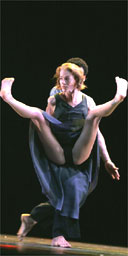
It was more than 10 years ago that British audiences had their first glimpse of Mauro Bigonzetti's work, showcased in a pair of pieces he made for English National Ballet. The pieces danced this week by his troupe Compagnia Aterballetto are more recent, and, on their evidence at least, Bigonzetti seems to have changed his style with the new millennium. Back in the mid-1990s his work was spangled with post-modern attitude, hard-edged, athletic and glossy. Today it looks looser, less driven and, in the case of the 2001 piece Cantata, a lot more human.
The piece is an evocation of southern Italian street life, which takes its tone from the female quartet (Gruppo Musicale Assurd) who perform traditional songs on stage. Alternately feisty and fatalistic, raucous and heart-wrenching, these songs pump out a vernacular, unselfconscious emotion which Bigonzetti aims, rather touchingly, to capture in the bodies of his 18 dancers. With their hair flying and clothes bunched and scruffy they are set loose on a string of larky, gesticulating combative numbers, all nuanced with a very Latin energy.
The fact that the piece has no real structure or argument beyond the songs does not matter; its unfaked charm, its live sense of communality count for enough.
But Bigonzetti is left floundering in the programme's other work, where he tries to pit himself against the spiritual vastness and intellectual brilliance of Stravinsky's Les Noces. You get an inkling that Bigonzetti might not be up to the challenge given the way he tries to tame the score with props.
The cast is lined up on opposite sides of the stage, seated on geometric silver chairs, divided by a long table which functions as a sexual no-man's-land. At regular intervals dancers launch themselves on to the table in desperate bruising attempts to make contact.
To do Bigonzetti justice, the style of these encounters is often evocative, mixing amoeba-like vulnerability and blind, slamming aggression. His appealing dancers also perform with a powerful abandon.
But as the piece progresses it becomes all too predictable that these doomed embraces are merely a rehearsal for the big bride and groom duet. And when this finally comes it adds little. Too rarely does the choreography try to elaborate its emotional vocabulary and too rarely does it attempt to engage with the rhythmic sophistication of the music.
This new-look Bigonzetti may work fine for the street but it is not equipped to deal with the classical canon.
· Until Saturday. Box office: 0870 737 7737.