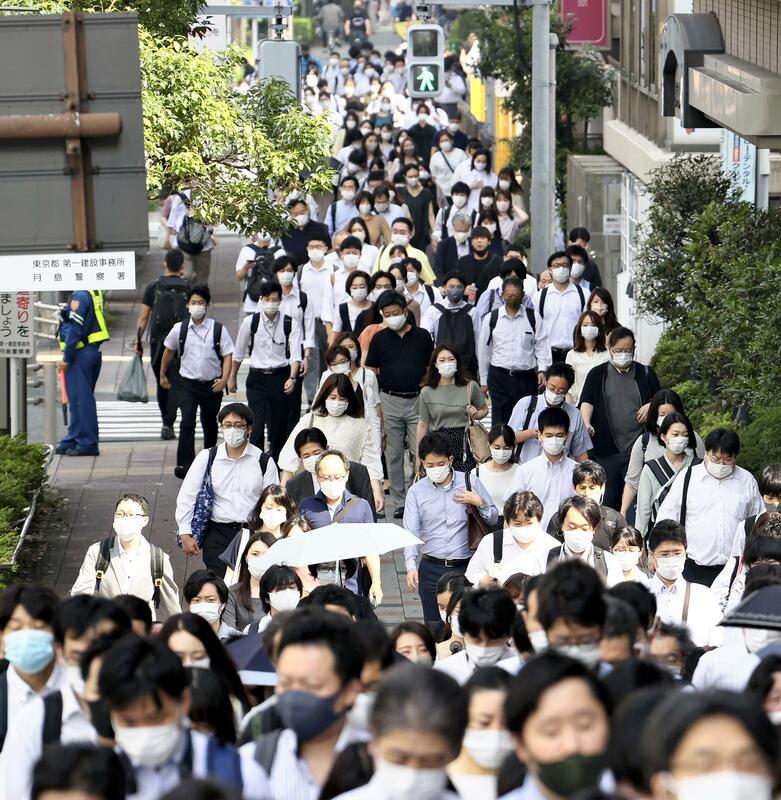
A fourth state of emergency was issued for Tokyo on Monday due to a renewed surge in novel coronavirus infections, but commuter crowds at major stations in the capital were unchanged on the first day despite the central and metropolitan governments' aim to reduce their numbers.
Also Monday, the state of emergency in Okinawa Prefecture and the priority measures applied to four prefectures -- Chiba, Kanagawa, Osaka and Saitama -- were extended. The state of emergency for Tokyo and Okinawa Prefecture, as well as the priority measures, are scheduled to remain in effect through Aug. 22.
At Kachidoki Station on the Toei Oedo subway line in Chuo Ward, Tokyo, many commuters wearing masks were seen passing through ticket gates on Monday morning, heading for work.
"The train was full, and I thought it was more crowded than usual," said a 22 year-old female company employee of Tokyo's Sumida Ward. Another company employee, 63, who lives in Kawasaki, said, "It's become routine for there to be a state of emergency, so I wonder if it does any good."
In Tokyo, establishments serving alcoholic beverages are being asked to close under the new state of emergency. A request remains in place for business operators that do not serve alcohol to shorten their business hours by closing by 8 p.m.
-- Hotels hit by cancellations
In the wake of the decision that Olympic events will be held without spectators in Tokyo and some other areas, hotels in the capital are scrambling to respond to canceled room reservations.
A hotel in Tokyo's Ariake district, which is located close to venues for Olympic events such as gymnastics, volleyball and tennis has been flooded with phone calls to cancel reservations since Thursday night, when the spectator ban was decided.
About 70% of the more than 200 rooms at the hotel had been booked for the period of the Olympics, which is scheduled to be held from July 23 to Aug. 8. Now, however, all the 100-plus reservations made by prospective spectators have been canceled.
The hotel saw its room occupancy drop to 5% at one point as infections spread, and people have refrained from traveling since last spring. With high hopes for demand from the Tokyo Games, the hotel had taken thorough measures to prevent infections, such as temperature checks and disinfection.
"Considering the rise in infection numbers, it can't be helped," a hotel official said. "But we're still despondent."
A hotel in Tokyo's Asakusa area also had more than 20 room reservations canceled. The number of guests had plummeted amid the pandemic, and the hotel had set its room rates at less than half the normal rates in a bid to bring people back. With summer vacation season approaching, guests had been increasing again.
The manager of the hotel seemed at a loss, saying, "I can't imagine how many more cancellations there will be."
Read more from The Japan News at https://japannews.yomiuri.co.jp/