As the novel coronavirus is spreading again just before the arrival of winter, The Yomiuri Shimbun is starting a series on the efforts made by frontline medical workers as well as local governments to bring the pandemic under control.
-- More tests, more cases
"The prime minister is also concerned about the number [of infection cases]. We have to respond with more sense of urgency," Health, Labor and Welfare Minister Norihisa Tamura told reporters after a meeting with Prime Minister Yoshihide Suga on Nov. 18, when the number of virus cases on a single day exceeded 2,000.
The spread of the disease across the country is partly due to the diversification of clusters. According to the Health, Labor and Welfare Ministry, the number of confirmed clusters increased by 153 in the week through Nov. 16, bringing the total to 2,147. During the summer, restaurants and other entertainment establishments in nightlife districts were the most noticeable sites where such clusters occurred. Recently, however, clusters have spread to university dormitories, workplaces, homes and foreign communities, as well as spreading from major cities to regional areas.
The increase in the number of virus cases can also be attributed to a rise in the number of tests. With the enhancement of the testing system, the number of tests conducted per day in Tokyo has increased from a maximum of about 1,700 in April to more than 8,500 on Nov. 16.
Meanwhile, the number of seriously ill patients is on the lower level compared to during the first wave of infection in March and April. According to the ministry, the number of seriously ill patients is 276 as of Nov. 17, down from 328 on April 30, when the total virus cases were lower.
This is partly because treatments are becoming apparent.
"It has become possible to predict the progression of the disease to some extent and we've learned how to use drugs in an effective way," said Makoto Ishii, an associate professor in the Department of Pulmonary Medicine at Keio University Hospital in Tokyo.
According to Ishii, the standard treatment is to administer antiviral drugs, such as Avigan, at an early stage to prevent the virus from multiplying. At the onset of serious symptoms, steroids are given to reduce inflammation throughout the body. He said seriously ill patients who would have lost their lives to the disease during the first wave of infections can now be saved.
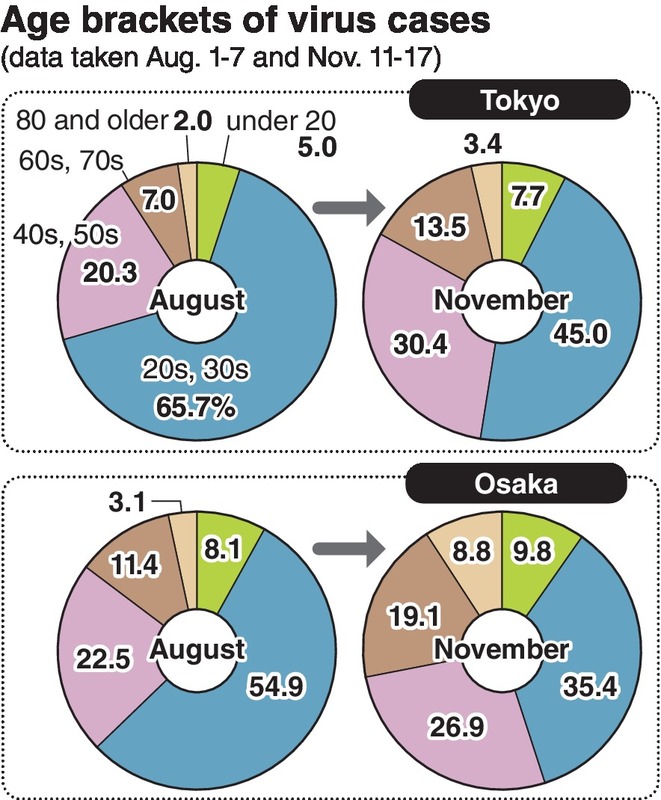
However, the rising age of the infected population is a concern. During the summer, when the infection spread, most of the infected were young people in their 20s and 30s who mainly work in the nightlife districts. Recently, the percentage of people ages 40 and over has risen.
"I'm seeing more and more patients in their 40s on ventilators," said a doctor at a Tokyo hospital.
The government lists five situations that increase the risk of infection and asks people not to drop their guard at times when circumstances might change, such as during get-togethers involving drinking and work breaks.
"Unfortunately, [the information of the five situations] has not been communicated to many people," said Shigeru Omi, chairman of the government's subcommittee on measures against the coronavirus, during a meeting of the House of Representatives' committee on health, welfare and labor on Nov. 18.
He called for measures to be taken to reduce the risk of infection at events such as drinking parties.
"It is too late [to take preventive measures seriously] once the medical system becomes worn out," Omi said. "Now is the last chance."
Read more from The Japan News at https://japannews.yomiuri.co.jp/