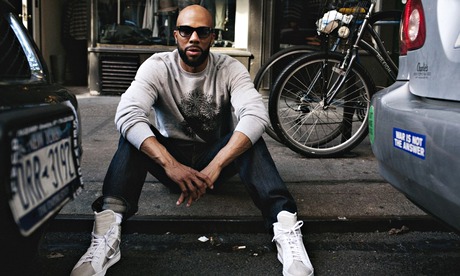
Common, On tour
“If time is money,” as Common says on his new single, “then forever is my salary.” By that estimation, Common is rich indeed. Old (sorry, wealthy) even by the standard of recent returning rappers, the Chicago native has weathered a few different storms and prevailing trends, his peaceful and occasionally preachy vibes (along with Erykah Badu he was one of the affiliates of the “Soulquarians” collective) tempered by his calm baritone flow. In the past decade there have been great Common records, but his most recent album Nobody’s Smiling suggests that social healing in the Marvin Gaye vein isn’t so easy without the killer tunes. On the album, he visits the Chicago streets and tries to understand the issues but his attempt to resume the vernacular makes him sound less streetwise preacher, more undercover cop.
JR
Thurston Moore, On tour
A post-punk polymath, Thurston Moore isn’t only a guitarist and songwriter but a lecturer, record label owner and all-round enthusiast. It’s a wide brief, but his principle challenge recently has been to avoid becoming his own tribute act, replaying the spacious chime he patented in Sonic Youth. Resourcefulness, however, is one of Moore’s key qualities and his solo albums have found new and sideways approaches to the guitar. Now with a British band (he lives in Hackney), Moore’s new one, The Best Day, sees him back on thrilling electric guitar excursions; finding new ways to say something familiar.
JR
Kate Tempest, On tour
The songs on Kate Tempest’s Everybody Down don’t so much form a concept album as a dysfunctional family. A dramatic sequence following a cast of characters revolving around “Becky”, and their various sketchy jobs and aspirations, the album is as ambitious as the individuals it profiles – but while they seem locked into a downward spiral, the record itself is pretty successful. The same might be said of Kate Tempest herself. The south London artist’s work occupies a space between poetry, drama and hip-hop; so much so that you may find her in the literature section of the paper rather than in music. So far this multi-platform talent has seen her self-publish a debut album/poetry volume and win a Brit award, suggesting that even if her work can seem a bit overwrought, there may be less drama ahead.
JR
Valerio Tricoli, London
Made using a classic Revox reel-to-reel tape player and glossy fronds of tape loops, the PAN-signed Valerio Tricoli’s work has its roots in the middle of the last century. Influenced by Bernard Parmegiani, François Bayle, Edgard Varèse and the masses of electro-acoustic soundscapes that came out of France’s INA-GRM studio, it’s a bold project that’s impressive, not least because while most of those composers qualify for a free bus pass, Tricoli hasn’t hit 40 yet. The project works by exploiting the possibilities of analogue tape to maximum effect. Tricoli builds layered worlds of static and ricocheting booms, building to crashing waves of sound – a backdrop for voices reduced to nonsensical, faraway chattering, and the scuttling of giant insects on alien shores. On Sunday he’s joined by Greek electronic improvisor Spyros Polychronopoulos and Michael Speers.
Cafe Oto, E8, Sun
JA
Branford Marsalis, London
The 2014 EFG London jazz festival launches with the kind of all-star firework show that has become the norm. Norwegian sax guru Jan Garbarek, the UK’s folk-steeped maestro John Surman, and vocal legends Kurt Elling and Dee Dee Bridgewater all perform around the city. Meanwhile, Branford Marsalis, the coolly sophisticated sax-playing member of the Marsalis clan, plays two shows on the South Bank with his quartet, featuring pianist Joey Calderazzo, bassist Eric Revis and young drummer Justin Faulkner. The eclectic Marsalis has played plenty of rock and funk - he’s played live with the Grateful Dead -as well as expressively Coltranesque jazz, and always makes himself hard to pigeonhole. His new album though is a quiet solo-sax performance recorded in a cathedral, and these quartet shows will be all about his subtle jazz identity.
Queen Elizabeth Hall, SE1, Fri
JF
Philip Glass Ensemble: Retrospective, On tour
Philip Glass founded his ensemble in 1968 and they have been busy ever since. Over such a length of time Glass’s music has inevitably evolved; what he is composing now is far removed from the austere minimalist scores that first made his name. Here, Glass and his group look back at his first two decades as a composer, including Music In Similar Motion and extracts from the seminal Music In Twelve Parts, stage works The Photographer and Civil Wars, and the music for Godfrey Reggio’s film Koyaanisqatsi. The Bristol gig is the climax of a three-day Glassfest.
AC