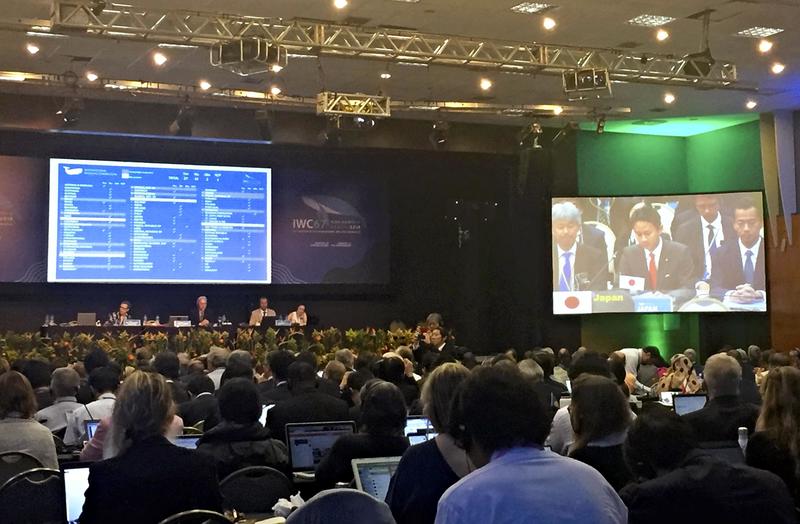
FLORIANOPOLIS, Brazil -- The International Whaling Commission's annual meeting in Florianopolis, Brazil, ended with the divide between pro- and anti-whaling nations as deep as ever.
A Japanese proposal to allow the partial resumption of commercial whaling was rejected. With the commission signaling a strong stance on whale protection, Japan's whaling strategy is at a crossroads.
Japan to withdraw?
Japan's proposal to resume some commercial whaling and change voting rules was voted on soon after proceedings began on Friday, the meeting's final day.
A large screen displayed the votes by the nations in attendance. In the end, the Japanese proposal was rejected with 27 nations voting in favor, 41 opposed and two abstentions.
Japan, which had been hoping for a consensus with no objections from the nations present, failed to even secure a majority. The moment highlighted the unity of the anti-whaling nations and the barriers hindering the resumption of commercial whaling.
"The IWC is no longer an organization for managing cetacean resources. We will explore a variety of options," said Masaaki Taniai, state minister of agriculture, forestry and fisheries, hinting that Japan could withdraw from the commission.
Japan had treated this meeting as a "last chance," approaching member nations to gain support for its position through diplomatic routes and embassies from early this year.
The government sent a team of about 60 people to the meeting, double the size of past delegations. Members had numerous unofficial meetings with other delegations during breaks and lunchtimes.
'Non-functional'
In contrast to how Japan's proposal was received, host nation Brazil's declaration on whale conservation, which emphasized the importance of the moratorium on commercial whaling, was adopted by a majority vote on Thursday, casting the impression that the IWC is becoming even more predisposed to protecting whales.
Anti-whaling nations believe that whales, as the largest and most intelligent marine animal, should be able to swim freely in the world's oceans. Along with dolphins, whales are seen as a symbol of organisms that should be protected.
At the meeting, there were no signs of compromise. A representative of Monaco called cetaceans the shared property of all humankind.
Pro-whaling countries, on the other hand, complained that the IWC is no longer functioning. The commission was founded to protect and promote the sustainable use of whale resources, and to devise conservation policies to ensure whales can continue to be hunted.
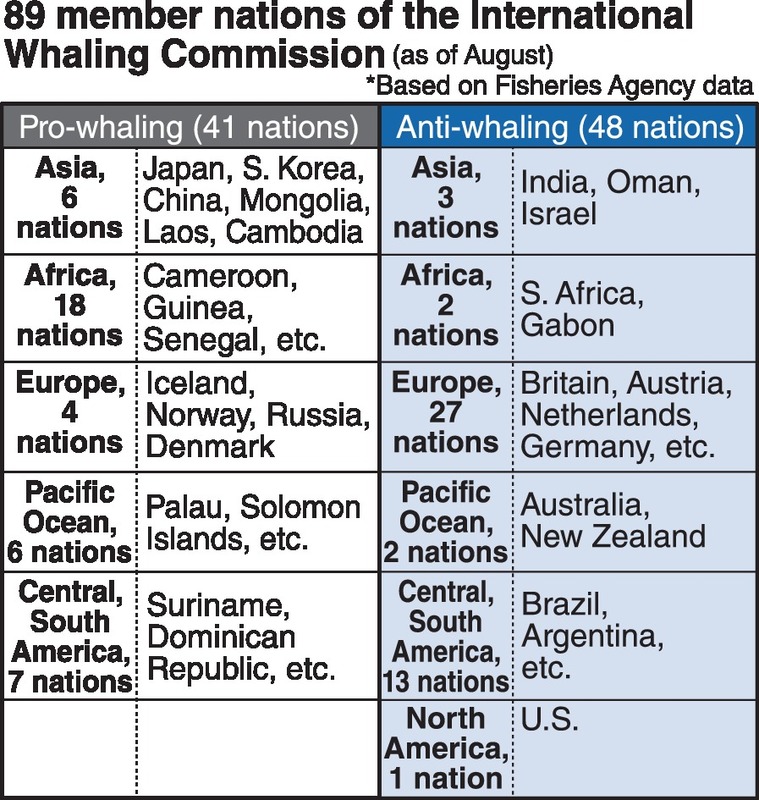
The commission has 89 member nations, of which 48 are against whaling and 41 in favor. This anti-whaling majority has meant that the IWC has gradually become more protective of whales.
Developed countries such as the United States, European nations and Australia make up the core of the anti-whaling contingent.
Their power in international negotiations contrasts with that of the many African and Asian nations that support Japan's stance on the effective use of resources.
Important proposals require the support of at least three-fourths of the nations present at a meeting, which means that both pro- and anti-whaling nations have been unable to pass their proposals for many years.
Japan has submitted proposals to resume commercial whaling before, but this was the first time it tried to change the voting rules.
Japan believed that advancing a view that "parties with differing opinions should respect each other so they can all exist under the same roof" offered a chance at victory.
For the first time in 47 years the IWC chair is Japanese -- Tokyo University of Marine Science and Technology Prof. Joji Morishita. However, he needed to be fair in his role as chairman and could not give favorable treatment to Japan.
At a crossroads
"My impression was that the majority (anti-whaling nations) unilaterally pushed their view. This is supposed to be an international organization that respects a variety of opinions. There's no way commercial whaling can resume now," said Keiko Yagi, 51, director of a film that sought to verify the claims made in the Oscar-winning documentary "The Cove," which takes a critical view of dolphin drive hunting in Taiji, Wakayama Prefecture.
Yagi spent the meeting interviewing members of pro- and anti-whaling delegations.
Yet if Japan were to leave the IWC, it would still face a difficult path toward resuming whaling in the Antarctic Ocean.
Doing so would violate the Antarctic Treaty, which forbids the collection of plants and animals. This provision does not apply to IWC members.
Another option would be to withdraw and form a new international organization with other pro-whaling nations. However, this may be unrealistic due to the time and range of support required.
Read more from The Japan News at https://japannews.yomiuri.co.jp/