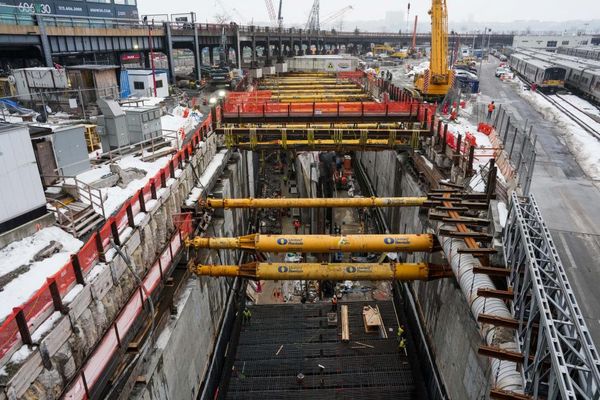
The emergence of a bipartisan infrastructure deal in Washington was rightfully lauded as potentially addressing long-neglected needs around the country.
Predictions that it may lead to more bipartisanship in the future are premature, however. Hopefully, they will be proved correct.
But the divisions between Democrats and Republicans on Capitol Hill are so great it's unlikely this is the dawn of a new era of cooperation.
Let's remember that building roads, expanding transit systems, bolstering water works and the like have been popular for generations. In more recent times, public support has grown to close the digital divide by improving broadband access, which is part of the $1 trillion infrastructure bill.
These types of projects typically aren't fodder for political culture wars, except, perhaps, the cars vs. transit debate.
Reaching agreement on this shouldn't have been as difficult as it was, though negotiating such a big deal under the best of circumstances is by no means easy.
Give credit to the Democratic and Republican negotiators who worked hard to keep this moving forward despite repeated hurdles. Advancing something even as popular and relatively nonpartisan as infrastructure spending in the current political climate certainly is worth celebrating. Notable has been the absence of incendiary partisan rhetoric.
Just wait until social spending and voting rights proposals come to the fore.
Very soon, Democrats will bring up their separate $3.5 trillion "human infrastructure" bill, which focuses on things such as combating climate change, expanding Medicare, providing more in-home assistance for seniors and overhauling the immigration system.
The more traditional infrastructure proposal was separated from the other spending because of its potential for bipartisan appeal.
Democrats will try to go it alone on the larger bill with their narrow Senate majority through reconciliation to sidestep a Republican filibuster. As it stands, though, it appears all Democrats may not be on board.
Republicans already have shifted their attention to fighting that bill, according to The Hill.
When 17 Republicans voted to open debate on the current infrastructure measure, prospects seemed high it would ultimately gain enough support to get out of the Senate. That's only a third of the Senate GOP caucus, but it's more than the 10 needed to avert a filibuster, which takes 60 votes.
It's also important because they went against former President Donald Trump, who urged Republicans to defeat the infrastructure measure.
Trump has threatened to support primary candidates against Republicans who back the bill, but so far there seems to be little concern among Republicans in the Senate. In the House, Republicans vulnerable to an intraparty challenge who might otherwise back the infrastructure bill likely won't have to support it because it can pass with Democratic votes.
Besides, it's hard for Trump to make anything other than a political argument against giving Democrats a victory because he talked a lot about major infrastructure spending as president but wasn't able to deliver. He hasn't specifically said what's wrong with the current proposal.
Further, the bill has broad public support. A recent Quinnipiac University poll said the infrastructure proposal is favored by 65% of U.S. adults, with 28% opposed. Similarly, the $3.5 trillion reconciliation bill is backed by 62%, with 32% opposed.
That has encouraged some Democrats that bipartisan support in Congress for both is possible. But NBC's Sahil Kapur was quick to point out a difference in Republican support.
The poll showed the $1 trillion infrastructure measure had backing from 41% of Republicans — not a majority but substantial. The other bill, with its focus on social programs, was supported by 27% of Republicans surveyed. Democratic backing for both measures was more than 90%.
Success of the initial infrastructure bill would be widely viewed as a win for Biden, not only for the needed public works improvements and jobs it would create, but because it achieves the bipartisanship he said is still possible in Washington.
But that doesn't mean it's a loss for Republicans. On the contrary, many Republicans' districts will benefit from the capital improvements, even if they don't vote for the bill. Besides, a number of Republicans flat out want the bill and openly support it.
Senate Minority Leader Mitch McConnell of Kentucky may reap short- and long-term benefits by not standing in the way of the bill.
"I don't like to speak to what his motives are, but I do think Mitch would like a good thing to happen. And infrastructure is the political safe zone," Sen. Kevin Cramer, R-N.D., told NBC. "Sometimes we forget that in addition to being the minority leader, he's the senior senator from Kentucky and he's got a constituency."
There was potential for Democrats to pass the measure on reconciliation anyway. Passing it with bipartisan support may take some steam out of Democratic calls to do away with the filibuster, which McConnell wants to preserve.
Democratic Sens. Kyrsten Sinema of Arizona and Joe Manchin of West Virginia have been opposed to ditching the filibuster, contending that bipartisanship is not dead. This could take the pressure off them to change their positions.
"It becomes a very clear demonstration that blowing up the filibuster is not necessary to get big things done," Cramer said.
While most of the focus has been about getting Republicans on board, not everything is copacetic among Democrats. Some never liked the two-bill approach to begin with and weren't happy with concessions made.
Further, they are worried about the fate of the "human infrastructure" bill among Democrats in the Senate. All 50 Democratic votes will be needed for reconciliation.
Sinema, who was a key negotiator on the $1 trillion bill, already has said she thinks the $3.5 trillion measure is too expensive.
If Democrats get into a fight over the subsequent bill, that's probably just fine with McConnell.