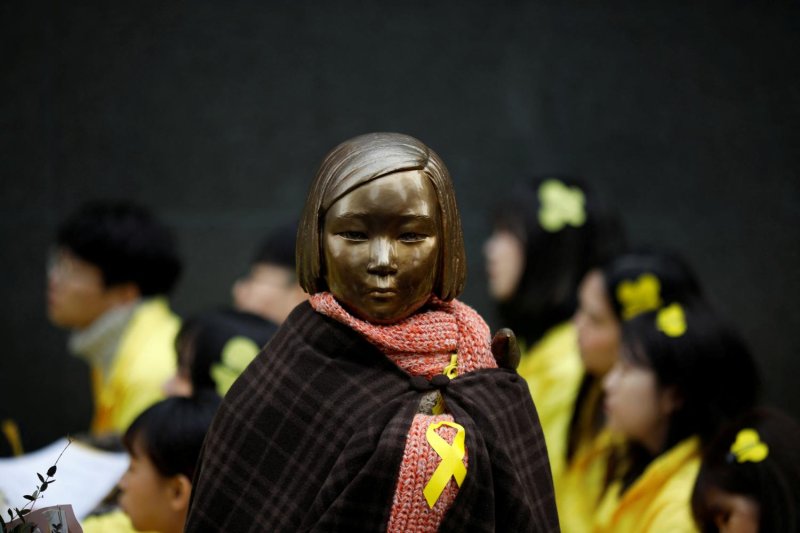
The removal of the comfort women issue from the finalised Senior High School curriculum of the Department of Education (DepEd) in the Philippines is more than a curricular revision. It signals a negation that diminishes public recognition of wartime sexual survivors and risks narrowing collective historical consciousness within the educational system. At stake is not only what is taught, but how the state determines which histories are legitimised, remembered and institutionalised in public memory.
In Southeast Asia's post-colonial societies like the Philippines, curriculum design has always been political. The deliberate omission of the comfort women issue reflects broader geopolitical and diplomatic priorities that shape educational content in ways that extend beyond pedagogy. As the Philippines maintains close security and development relations with Japan, uncomfortable histories of wartime atrocities risk being displaced within state-sanctioned narratives in order to preserve strategic partnerships.
For decades, the lived realities of wartime sexual violence survivors -- known as military comfort women or jugun ianfu -- have remained marginal within Philippine education and across parts of the region.
The system of comfort stations established by the Imperial Japanese Army during the Second World War constituted institutionalised military sexual slavery across occupied Asia. Yet in most World War II curricula, these histories appear only in passing -- reduced to brief references under Japanese occupation or wartime atrocities, with little sustained engagement with survivors' testimonies, gendered violence or ongoing struggles for justice and recognition.
This limited representation is not simply an academic gap. It shapes how generations of learners understand war, violence and accountability, particularly in relation to gendered violence in post-conflict societies. When histories of sexual violence are fragmented or minimised, the broader structures that enabled them are also obscured.
This is not an isolated concern. Globally, debates over wartime memory continue to surface in struggles over textbooks, monuments and international recognition. Efforts to document comfort women records have faced diplomatic resistance. In Japan, ultranationalist groups have been reported to lobby against textbook representations of wartime atrocities. As documented by the Women's Active Museum on War and Peace (WAM) in 2022, these groups pressure publishers and editors through "correction" procedures and textbook review mechanisms that function as forms of censorship, undermining academic freedom and limiting historical inquiry.
A glaring example is within the Philippine curriculum. In earlier K–12 frameworks, comfort women were largely absent from national historical narratives. More recent curricula introduced their experiences but in a constrained form, often emphasising victimhood and suffering while underplaying the broader system of militarised sexual slavery and survivors' collective agency in seeking justice and recognition. This framing risks reducing survivors to passive figures rather than historical actors whose experiences challenge structures of power and impunity.
The Philippines' Republic Act No.10533, which governs the enhanced basic education system, emphasises cultural sensitivity in curriculum development. However, it does not explicitly guarantee gender-responsive historical framing. As a result, inclusion often becomes selective or symbolic, allowing marginalised histories to remain peripheral rather than integrated into core historical understanding.
The exclusion and limited framing of comfort women history also contradict broader commitments to gender justice and human rights education. The Philippines, as a signatory to international human rights frameworks, has obligations to ensure that gross violations of human rights are accurately and sensitively represented in education. Yet the gap between policy commitments and curriculum implementation remains evident.
Educational institutions play a critical role in this process. Schools are not only sites of knowledge inquiry but also spaces where historical consciousness is formed. In this sense, comfort women education becomes an entry point for confronting difficult histories, recognising survivor testimony and fostering critical engagement with questions of justice and memory.
In response to these ongoing gaps, the advocacy petition "Remember, Educate, Resist -- Comfort Women Education Now," launched on April 9, calls attention to the exclusion of comfort women history from the finalised Senior High School curriculum, despite its existence on the earlier draft versions. The petition has gained support from signatories across the Philippines, Thailand, Indonesia, East Timor, the United States, the Netherlands and South Korea, reflecting growing transnational concern over the institutional recognition of these histories.
International frameworks reinforce these calls. The Committee on the Elimination of Discrimination against Women (CEDAW), in its March 8, 2023 recommendations, urged the mainstreaming of Filipina survivors' histories in educational curricula and emphasised the need for accurate and sensitive treatment of gross human rights violations. Similarly, Joint Memorandum Circular No.2025-1 mandates coordination between the Department of Education and relevant agencies, including the Philippine Commission on Women, to strengthen educational campaigns on gender-based violence prevention.
Taken together, these frameworks highlight the gap between international commitments and domestic implementation.
The institutionalisation of comfort women studies across educational systems in the Philippines and beyond Southeast Asia and the Pacific is therefore not simply an academic proposal. It is an act of resistance against historical forgetting and denial. It challenges dominant narratives that obscure gendered violence and asserts the inconvenient truth of historical accountability in shaping the nation's collective memory.
In the study of the foremost comfort women expert Patporn Phoothong, wartime sexual slavery in Thailand remains absent from public discourse due to enduring patriarchal norms that influence how sexual violence is remembered and interpreted.
Thailand's role as a transit and escort corridor within wartime mobility routes and regional military logistics linking Myanmar and Vietnam is supported by historical accounts, and testimonies indicate comfort stations were dispersed across strategic locations such as Bangkok, Kanchanaburi, Chiang Mai, Mae Hong Son, Phuket and Songkhla, to name a few. Yet dominant narratives -- filtered through patriarchal assumptions -- continue to mischaracterise survivors as prostitutes, obscuring the coercion that continues to sustain stigma in contemporary Thai society.
Against this backdrop, studying comfort women stations becomes necessary precisely because these sites expose the spatial and institutional organisation of wartime sexual violence, rather than treating it as isolated or exceptional harm. By democratising information, this approach disrupts the monopolisation of knowledge by organisations and institutions that risk instrumentalising the individual suffering of comfort women survivors to maintain legitimacy. In doing so, it challenges the controlled circulation of survivor narratives that are often filtered, sanitised or selectively amplified within official advocacy and institutional frameworks.
Reframing the comfort women issue as a form of collective suffering is not merely a matter of expanding discourse -- it is a political intervention against fragmented and depoliticised memory. It forces recognition of structural violence rather than isolated testimony and resists the reduction of survivors into symbolic figures mobilised for institutional agendas.
Such a shift does not only broaden historical understanding; it actively destabilises dominant narratives and opens space for sustained collective action rooted in historical accountability, rather than managed remembrance.
Michael Thomas Nelmida is the founding curator of the Markova Archives, a regional initiative dedicated to recognising and advancing justice for comfort women across Southeast Asia and the Pacific. He is currently completing his postgraduate studies in Human Rights and Democratisation at the Institute of Human Rights and Peace Studies (IHRP), Mahidol University.