KYOTO -- It recently came to light that the Kyoto city government paid a total of 1 million yen to comedians as rewards for their tweets highlighting the city government's projects.
Their tweets carried no clear indications that they were sent as advertisements, resulting in criticisms that the comedians' social media messages were a form of stealth marketing.
The fuss raised a question about how local governments' promotion activities using taxpayer money should be conducted.
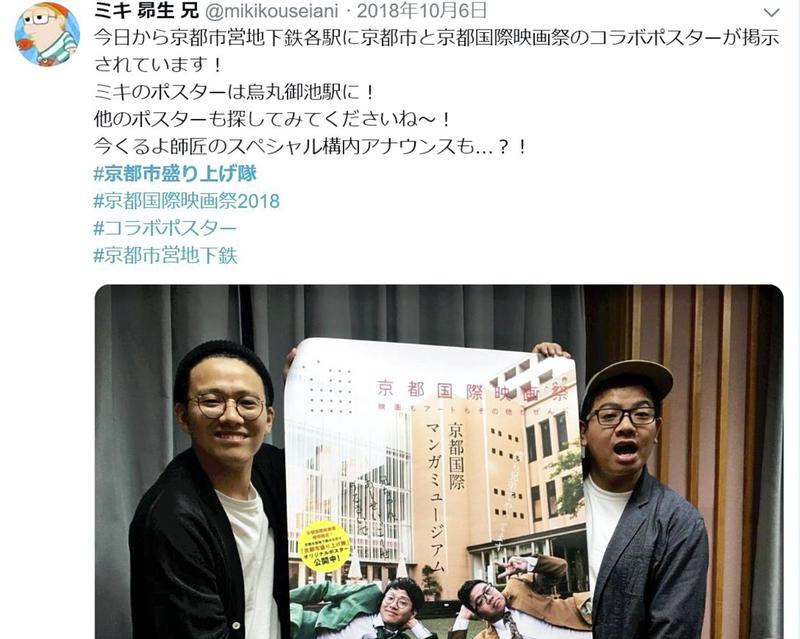
In October last year, Miki, a popular comedian duo from Kyoto, posted messages on Twitter. The tweets said, "From today, posters made in collaboration of the Kyoto city government and the Kyoto International Film and Art Festival go on display in stations of the Kyoto municipal subways," and "Let's boost Kyoto all together."
A month before the tweets, the city government signed an outsourcing contract with Yoshimoto Kogyo Co. worth about 4.2 million yen. Under the contract, entertainers belonging to Yoshimoto Kogyo, including Miki, formed the Kyoto-shi Moriagetai -- team for boosting Kyoto City -- to engage in public relations activities for the film festival and other events.
The contract amount included the 1 million yen for the two tweets. Though Miki's tweets were attached with a hashtag for "Kyoto-shi Moriagetai," there were no words indicating that the tweets were for advertising or public relations.
After it was revealed late last month that money was paid for the tweets as rewards, critical messages appeared online one after another. One of them asked, "Aren't [the tweets] stealth marketing?" while another said, "500,000 yen per tweet is too much."
According to the city government, typical market prices of public relations services via Twitter are 3 yen to 8 yen per follower.
A city government official said, "As the Miki duo has more than 300,000 followers, the amount is not too high as a reward for their tweets."
The sending of advertisement messages over social networking service websites is utilized for various promotions of goods, special sales corners of department stores and promotions of hotel events.
There are spreading moves in which companies ask people with a large number of followers on Twitter, called influencers, to promote their goods and services.
Influencers are often entertainers, athletes and YouTube content providers who have established social networks to spread information.
Yoshihiro Sato, professor emeritus of Musashino University who is an expert of socio-information studies, said: "Twitter is highly effective because messages directly reach followers. Several yen per follower is a decent amount. It is worthy of consideration as a method for public relations by local governments."
Did the tweets in this instance constitute stealth marketing? There is no law regulating stealth marketing and no clear definition for it.
Stealth marketing began attracting attention in the wake of a fraud case involving bidding fee auction websites seven years ago.
On the auction sites, through which bid participants were cheated out of money charged as fees, several entertainers were asked to promote the auction sites in their blogs. As they played the role of human billboard for the sites, they later faced accusations.
In the wake of that incident, advertising businesses created guidelines of measures against stealth marketing to protect consumers' right to know correct information.
A guideline of the Word of Mouth Japan Marketing Association, which manly comprises advertisement agency companies, requires information senders to indicate such wordings as "PR," "Kyosan" (supporter) or "ambassador," which means representatives.
About the tweets in the Kyoto case, the city government insists that the word "Moriagetai" carries the same meaning as ambassador, and thus it did not have intention of hiding that the tweets were for public relations purposes.
Also, because Yoshimoto Kogyo has clearly indicated its cooperative relationship with the city of Kyoto, the city government holds the opinion that the tweets did not constitute stealth marketing.
Takashi Kanai, a lawyer with wide knowledge about SNS activities, said: "Though people who know much about the internet may think that such tweets are advertisements, those who do not may believe that the comedian duo purely supported Kyoto. Public relations [campaigns] of local governments, for which taxpayers' money is spent, need to be more careful than those of private-sector companies."
Prof. Takayoshi Kawai of Tokai University, who is an expert in studies of public relations by administrative entities, said, "Local governments should be careful in transmitting information in ways conforming to the guidelines of business associations, so that a trustful relationship between information senders and receivers will not be broken."
Read more from The Japan News at https://japannews.yomiuri.co.jp/