Josef Nadj's Comedia Tempio announces itself as a homage to the life and work of Hungarian writer Geza Csath - a daunting definition for any UK viewer without an MA in central European literature. But even if the specific works of this early 20th-century polymath are unknown territory (Csath was also artist, composer, critic and psychiatrist), the dark obsessive atmosphere created on stage is pungently redolent of his near contemporaries, Freud and Kafka.
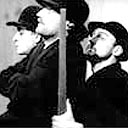
For this UK premiere, part of the London international mime festival, men in ill-fitting frock coats and bowler hats - who could be out-at-elbow clerks, impoverished professors or wandering lunatics - dance with blank-eyed women in elegant gowns. Their world is a crude domestic interior, fashioned from planks and plasterboard, that conceals a maze of secret cubbyholes and trap doors. The 10 performers cruise acrobatically around the set in a sequence of fast-changing comic nightmares.
A table is wheeled on stage, with a man apparently imprisoned inside it, his exposed bald head vulnerable to the tormenting games of a deranged elder. Another man hoists himself on to a chair balanced at the top of a plank and is stranded there by his colleagues, uncertain of whether he is a winner or a victim. In a small attic room a woman on stilts raves and twists her hands; on the floor below a couple scuttle around on bent legs like dwarfs.
Whether these characters are trying to play, work or pair off with each other, their every act is coloured by mild, sometimes sinister dementia. Trapped by physical circumstances, and each other, they belong to a secret tribe of the mad and dispossessed - the inhabitants of psychiatrists' case studies and Kafka's dystopian bureaucracies.
The staging of this show is impressive, with perspective-distorting visuals and deft manipulation of props. And Nadj's choreography (a fusion of modern dance, classic mime and slapstick) allows his extravagantly quirky cast to create bizarre, skewed characters. There appear to be all the ingredients for a fine show, but the heat is never turned high enough to get it cooking.
This is not a work from which we expect a story but, at 80 minutes, it requires more urgent theatrical momentum, more gusty contrast of tone and dynamic to drive it forward. As it is, watching Nadj's disconnected, disturbing snapshots unfold is as casual an experience as rifling through someone's scrapbook. And when the show ends, it's on a note so arbitrary that we are not even sure it's over. It's a frustrating waste. All that expert craft and imagination, and we just walk away with a shrug.