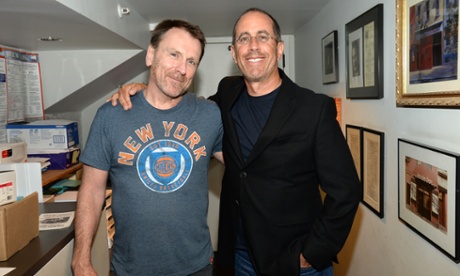
The comedian Colin Quinn is a contrarian, a scrapper, a loudmouth. Dressed in a hoodie, jeans, sneakers and a T-shirt with the old Dutch spelling of Red Hook, stalks the stage of the Cherry Lane theatre with a grumpy hunch and a get-off-my-lawn perma-scowl. In his latest solo show, The New York Story – which follows Long Story Short and Unconstitutional as another dumbed-down, wised-up history lesson – he’s determined to reveal some uncomfortable truths about the Big Apple.
“You can get a better pretzel anywhere in the world,” he says.
Those are fighting words. They are also pretty much correct.
In his chronicle of the city that only occasionally sleeps (usually after a heavy brunch), Quinn speckles his show with scandalous statements that many in the audience will find themselves agreeing with, proudly or shamefully. Many of these claims have to do with race and ethnicity. Some of them have to do with bagels.
Quinn is funny on the colony’s history, as when he riffs on the British taking over from the Dutch: “Keep the street names. Lose the windmills. Lose the shoes.” And he’s even dug up a couple of fun facts, like how the site of Nathan Hale’s hanging now houses a Starbucks: “I regret that I have but one life to live for my raspberry pumpkin scone.”
His thesis is that disparate groups, from the Lenape Indians up through the Germans, Irish, Italians, Jews, Puerto Ricans, Dominicans etc, have helped to consolidate the New York character and to make the city what it is today. Or at least, what it was before gentrification and the stupid internet ruined everything.
Quinn’s manic exasperation and joke-writing chops carry the short show, invisibly directed by Jerry Seinfeld, through its first half nicely. But eventually the format sags and the angry middle-aged schtick sours. “It just gets a little bit phony when suddenly people are colorblind and positive,” Quinn carps. “And now, we’re all just, basically, bland.”
Quinn isn’t. But he isn’t especially daring either. Eventually, his contention that we’re all too scared to talk about race starts bleeds into rehearsing tired stereotypes – blacks are defiant, Jews are pushy, Puerto Ricans are loud. If you like Quinn then he’s saying the unsayable. Otherwise, he’s just another grouchy white guy.
Sure, he has droll ways of illustrating these claims. He acts out an African American student swaggering into a classroom late, “Like the Medici is coming in to check on Michelangelo.” And being Irish himself, he doesn’t let them off the hook either. (His Irish-inspired Law & Order routine is a highlight.) But none of this makes his essentializing fresh.
Toward the end, when eulogizing the old, grimy New York, Quinn complains, “Everybody now is cautious. You have to be cautious.” But Quinn’s familiar material isn’t as brave as he thinks.