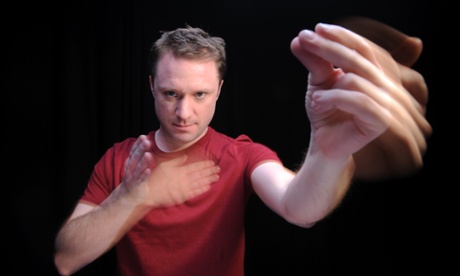
Metal Wood Skin, my percussion festival at London’s Southbank Centre, is a celebration of how far this most diverse, bold and adventurous of art forms has come. With such a vast range of sounds available, composers are using immense skills and imagination in the quest for new sonic experiences. During the festival, as well as using tuned instruments such as the marimba, vibraphone, and the more recently conceived allophone (a new bell-type instrument made of aluminium) I am amplifying (and beating up) my legs, arms and torso as part of my armoury of newfound “body percussion” skills.
I grew up listening to classical music, and my early memories include Bach and Mozart. But it wasn’t until my early teens, when I had my first Stravinsky experience – head-spinningly disquieting in the percussion-driven conclusion of The Rite of Spring – that I started to move in a more modern direction. A world opened up and I discovered postwar modernists such as Karlheinz Stockhausen, Pierre Boulez and Luciano Berio, who all place percussion at the front of their palettes. I remember being drawn to how inventive and picturesque some of their scores could be, so much so that Stockhausen’s Kontakte – which uses wildly graphic notation – became my bedroom wallpaper. I took so much inspiration from the boundaries being pushed, the maverick quality of much of the music, and the excitement of a movement taking hold.
Premiering my first percussion concerto (by Errollyn Wallen) at the BBC Young Musician of the Year concerto final in 1994 gave me my first opportunity to collaborate with a composer and kicked off a lifelong love affair with new music. Studying at the Royal Academy of Music I pretty much centred on orchestral playing (which led me to work freelance in the London Symphony Orchestra, aged 19), but I also started to seek out solo works and present solo recitals – then a rare thing for a percussionist. In 1996, the Royal Scottish National Orchestra took me under their wing and asked me to play James MacMillan’s percussion concerto Veni, Veni, Emmanuel. It’s a work of huge power and emotional impact: it’s been performed more than 500 times (around 150 of them by me) and it has a firm foothold in the orchestral canon.
I have premiered dozens of works, and the most striking thing about them is the vast range of styles they cover. From Louis Andriessen’s Tapdance, which requires me to imitate charleston tap shoes, to Harrison Birtwistle’s sinister and spiky The Axe Manual, which piles up layers of instruments, tuned and untuned. Percussion has given me the good fortune to have been able to work with the very best composers in their fields, from the late American master of modernity Elliott Carter to the ever-youthful and energetic Steve Reich, the father of minimalism and a true friend of percussion, who often places a percussion group at the heart of his works. His new chamber piece written for me, Quartet, is scored for two vibraphones and two pianos.
New works are emanating from every continent and culture, and the Chinese composer Tan Dun is another such inspiration. Of his several solo percussion works, one features water percussion (and waterproofs), while another features instruments made of paper. I never quite know what the next featured instrument will be, and a well-known composer recently sent me several videos of himself performing on a certain metallic bookcase which he felt had much potential: indeed it does.
Increasingly well known for its lyrical qualities, percussion has always held a great dignity for me. Many of the works I have launched have become known for their heartfelt character, often intensely melodic rather than driven by rhythm alone. Percussion works have also drawn on jazz, Latin and, in particular, pop music. Joe Duddell’s Ruby touched many at its BBC Proms premiere in 2003. When I told Joe it reminded me of Poulenc he said that the section in question was inspired by Radiohead’s OK Computer!
The percussion community is now huge, and a plethora of fantastic new pieces are leading us in a giddying array of directions. My travels constantly reveal fresh talent, and giving masterclasses is a joy, as new works are presented by an emerging generation all over the world. I started out not knowing what to play, and now it seems as if I will never have time for everything that I want to programme. Metal Wood Skin is a superb snapshot of where we are – where we’ve come from and, indeed, where we’re heading.
• Metal Wood Skin: The Colin Currie Percussion festival continues until 11 December. The next concert is a tribute to Steve Martland on 11 November. Venue: Southbank Centre, London.