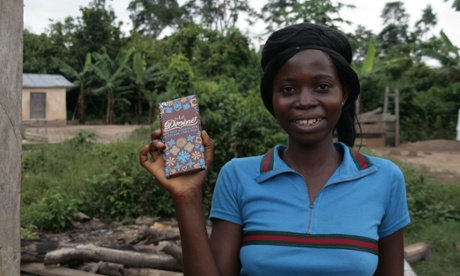
Kuapa Kokoo, a Ghanaian farmers’ co-operative, has an unprecedentedly loud voice in the chocolate industry and is expanding the market for Fairtrade and social enterprise.
The farmers own 45% of Divine Chocolate, sit on the company’s board and sign off its business plans.
Divine Chocolate has shifted farmers higher up the value chain and, in doing so, is changing how business is done. Its ambition is to be a global farmer-owned business that empowers producers and proves a chocolate company can make profits and still give cocoa producers a livelihood.
Since it was established in 1998, Divine Chocolate has reached an annual turnover of £8m in the UK and in 2007 set up a sister company in the US. It was the company’s combination of “visible market disruption”, commercial success, innovation and impact that appealed to the Guardian judges.
For Divine, sustainable means more than an income to survive on. The business is geared to make profit, to invest and to diversify. It is not driven by what Divine calls “tourist investors” but by the men and women from 1,250 Ghanaian villages who in 1997 decided they wanted to make their own chocolate bar with the premium quality cocoa they were growing.
Divine passes 44% of its distributed profit to the Kuapa Kokoo’s 80,000 members and this is one of the co-operative’s four income streams. In addition, they are paid the Fairtrade minimum of $2,000 per tonne for their cocoa, a $200 Fairtrade premium per tonne, plus 2% of the company’s annual turnover for development.
Since Divine’s launch it has made over £100m but it does not have the leverage or scale of some of its competitors. Instead it relies on distinctiveness, and a consistent product and professionalism to win business. It is the only Fairtrade chocolate company in which farmers have such a large shareholding.
Most Ghanaian cocoa is grown on small family farms of two to three hectares and most of the world’s cocoa is produced on smallholdings of less than five acres. Ghana is the second largest producer.
The company’s true success lies in the impact it has had in Ghana, on the chocolate industry and, increasingly, on the world. The Kuapa Kokoo co-operative started with 2,000 members and produces 5% of the country’s cocoa. It was paid its first dividend by Divine in 2007.
Its stake in Divine Chocolate has influenced all aspects of the farmers’ lives. It gives them knowledge of the market, farming techniques and new technology. It extends farmers’ influence throughout the UK, USA and Europe and means they reap the benefit of their chocolate’s reputation.
As sales have grown, Kuapa Kokoo has been able to share profits or plough them back into the business. Success has enabled them to secure loans at highly preferable rates, saving money and helping cash flow. Once, loans were unthinkable for these producers.
Where the co-operative distinguishes itself in particular is in how it has empowered the farmers. Two Kuapa Kokoo representatives sit on Divine’s board and sign off all business plans. Two farmers visit the UK every year to act as ambassadors for Kuapa Kokoo and Divine during “Fairtrade fortnight”. They speak at small events, conferences, on radio and TV. In fact, as Divine’s distribution has grown the farmers have been invited across Europe, the USA, Australia and New Zealand.
At home, farmers can invest in materials and techniques that protect crops from disease, climate change and fluctuating prices. The co-operative’s success encourages their children to stay in cocoa farming rather than move to the cities. They’ve introduced gender equality programmes, set up a model farm and a farmer radio programme.
Within the villages, there are new drinking-water boreholes, new or refurbished schools, mobile clinics and better sanitation. The development programme has helped women improve their literacy and numeracy skills, and offered them training in income generation and leadership. It has introduced a child labour awareness programme. The co-operative is made up of a farmer’s union, trading arm, farmers’ trust to distribute money for community projects and a credit union.
But Divine’s impact goes wider still. It sources other Fairtrade ingredients for its products where it can, extending benefits to other Fairtrade farmers producing sugar in Malawi, almonds in Pakistan and vanilla in Madagascar. Kuapa Kokoo also sells cocoa butter to The Body Shop and Traidcraft uses its cocoa in its products.
Divine Chocolate is the 2015 winner of the innovation award in the social impact category of the Guardian Sustainable Business Awards.