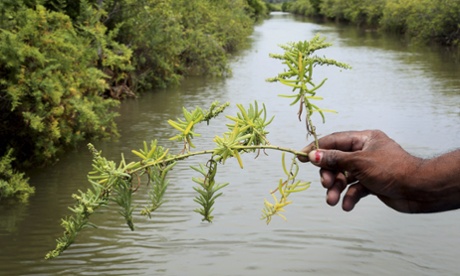
Fishermen and their families living around the Aghnashini estuary on the west coast of India depend on its rich waters for their livelihoods. Now a Goliath of a seaport that ignores environmental laws is about to come up, says Meenakshi Kapoor of Centre for Policy Research-Namati Environment Justice Programme with inputs from Maruti Gouda, a bivalve collector.
“The Karnataka State Industrial and Infrastructural Development Corporation plans to build the state’s largest port at Tadri in Aghnashini.
Every morning, thousands of people, standing chest-deep in water, collect bivalves. These make it to the dining tables of residents in Goa and Bangalore. Bivalve shells are used in poultry feed, cement, and paint industries. Aquaculture, fishing, and salt production are other occupations supported by the estuary.
The Ministry of Shipping first thought of a commercial port at Tadri in 1999, when the Indian navy took over Karwar port, about 25 miles north of Tadri.
In the 1970s, the state government acquired 750 hectares (1,854 acres) of intertidal land for ‘development’ and projects of ‘public interest.’ It offered the land to many industries, including a coal-based thermal power plant. However, the industrialisation plans did not go far due to strong local opposition.
In the meantime, the state forest department has proposed that the thick mangrove forest in the area be declared a ‘biodiversity heritage site’.

Tadri port threatens these mangroves and the livelihoods of local communities. The state declares it will bring benefits to people, but many from the local communities don’t buy it.
The EIA underplayed the number of livelihoods dependent on the estuary and overplayed the benefits of the upcoming port. The communities expressed their concerns through legal notices and formal letters to the district authorities prior to the public hearing on 23 March 2015. But they were ignored.
Neither the state infrastructure development corporation nor the district authorities paid attention to the port’s impact on fishermen and villagers’ livelihoods.
Coastal communities enjoy rights under the Coastal Regulation Zone Notification, a key legislation that governs development of coastal areas, while those who live and depend on Critically Vulnerable Coastal Areas (CVCA) get special protection. In turn they are to participate in the management of these areas.
A group of about 1,800 bivalve collectors submitted a proposal last year to the Karnataka state government to declare the area as a CVCA.
However, before the state could take action on the proposal, the Ministry of Environment, Forests and Climate Change is considering its proposal for environmental clearance for the expansion of Tadri port.
Neither is the Karnataka Coastal Zone Management Authority listening to the communities’ livelihood and conservation concerns.
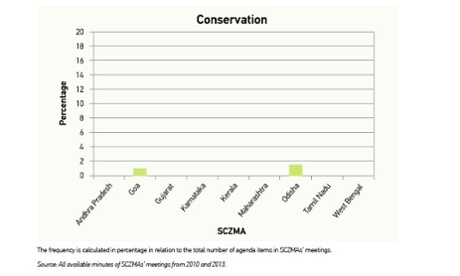
The track record of the coastal zone management authorities across the nine coastal states of India isn’t promising. The Centre for Policy Research and Namati Environment Justice Programme compiled a report, ‘Coastal Zone Management Authorities and Costal Environments: Two decades of regulating land use change on India’s coastline.’ It shows that conservation features the least in the authorities’ meetings. Only Goa and Odisha discussed coastal conservation in its meetings of 2010 and 2013. Even in these two states, conservation matters comprised less than 2% of the total.
If the Karnataka Coastal Zone Management Authority doesn’t heed the communities’ proposal, will the ministry? Legally, the ministry should issue guidelines for identification, notification, and management of CVCAs. Yet, the report says that even four years after the notification, the ministry hasn’t drafted these guidelines.
Ecologically and socially, Tadri qualifies for conservation protection. But what it may get are projects that rip off these very qualifications. Not much hope for Tadri.”
Meenakshi Kapoor highlights Tadri as one case to illustrate how India approaches coastal conservation. While it needs to develop its infrastructure, it also needs to heed citizens’ rights and uphold conservation laws. There’s no point in drafting legislation and not play by its rules. When it appears to unfairly support industries at the cost of people and ecology, these projects get stuck in protests and court cases. There are no shortcuts in fair governance.