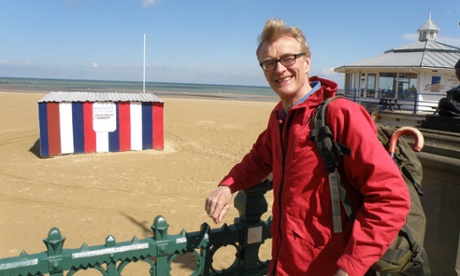
In a televisual equivalent of dress-down or mufti days in schools, there has been a tradition of sending presenters on summer holidays as part of their work. At the end of each run, the Blue Peter presenters would reveal somewhere hot they were heading off to film, and, during the second half of the 1970s, during the vacation months BBC1 screened Seaside Special, a sort of pictorial spin-off from the Radio 1 Roadshow in which DJs hosted variety shows from or near a pier.
Although that show – unlike much of the light entertainment of its era – has not been overshadowed by Operation Yewtree, the idea of sending TV strands to the sands has come to be regarded as tacky. The concept, though, is revived tonight in a more highbrow form by a series perhaps best-placed to take it on. The 10th run of Coast (BBC2, 9pm) begins with an episode called Our Holiday: an exploration of the history of the British beach trip in the theoretically hotter time of year.
Originally a low-key project co-produced by the Open University, Coast rapidly outgrew its boundaries and attracted millions of viewers. It now most resembles a geographical and geological cousin of Springwatch, with the main presenter – the likable and learned explorer Nicholas Crane – linking a series of reports by himself and others on aspects of the UK’s edges.
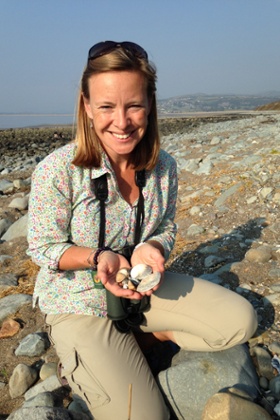
Critics of BBC programming in the media and politics favour the insult “dumbing down” to describe a perceived shift from education to entertainment in contemporary output. But, as Coast: Our Holiday shows, a better and less pejorative term might be “funning up”. As in the most recent editions of Springwatch, serious and surprising information is still given, but the presentation of the material is often nervily perky, as if fearing that viewers will tune out literally or figuratively.
There’s a fascinating segment tonight, for example, about the Royal Sea Bathing Hospital at Margate, in which a retired orthopaedic consultant explains to Crane how, in the 18th century, the Kent coastal town pioneered saline and sea-air treatment for types of tuberculosis. The content of the item is at Radio-4 level intelligence, although a wireless version would miss out on a tremendous visual detail: a set of porcelain dolls that was used to demonstrate to patients the nature of a “full-body splint”: a sort of plaster coffin for the living, in which they might be confined for two years.
Yet, even with this riveting history and satisfying visuals, the producers still don’t quite trust the audience to be enthralled. So the report begins with a gimmicky bit where Crane strips down to floral bathing shorts and submerges himself in the North Sea waves, from which he conducts a bellowed conversation with a medic on the shore.
Crane is in good enough shape for his almost-skinny-dip not to be humiliating, but the interview would surely have been improved if he had been fully clothed and standing next to the expert on the pebbles.
This sequence seemed typical of the generally over-strenuous attempts to keep audience attention. Almost everything Crane and the other presenters say is either alliterative – “Is our beeline for the beach biological?”, “This seaside sojourn” – or even rhyming: “Making the most of the coast.” The scripts sound like the lyrics of a lost Kinks song. The experts featured mainly speak in the breathless present tense that broadcasters believe add urgency to historical précis but that can sound like bewilderingly inaccurate time-checks: “It’s the first of September, 1953 ...”
Taking a tip from holidaymakers, the show should take a breath and relax because the stories it tells are compelling enough already, including an account of an act of suffragette terrorism at St Leonards-on-Sea and an explanation of why summer air shows at the seaside were part of the UK’s cold war strategy.
As the BBC has learned this week – forced by audience pressure to drop all the interactive balls and restore tennis to the core of its revamped Wimbledon 2 Day – a search for a theoretically broader audience risks alienating those already watching.
A fascinating store of history and natural history, Coast really doesn’t need the linguistic, visual and musical gimmicks that are increasingly imposed on it. Crane and his co-hosts should take a stand before they find themselves next year shouting and waving to an audience on the beach, like the presenters of Seaside Special.