The floods that devastated Tasmania and killed three people in early June produced one positive story: Launceston’s flood mitigation strategy had worked.
Damage to the city, while substantial, especially in the suburb of Newstead, was much less than might have been feared in a one-in-200-year flood.
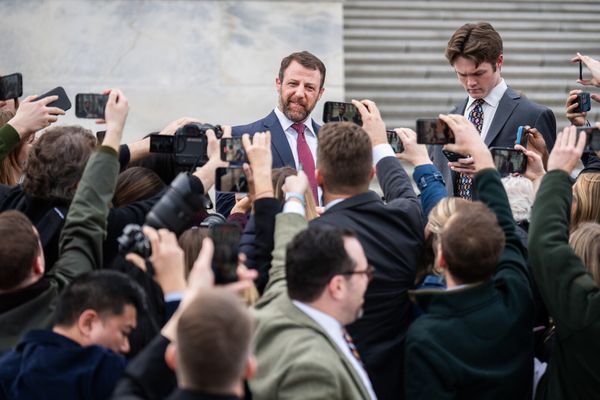
At a crowded election campaign media event on the city’s foreshore two days after the worst of the flooding, the chairman of the Launceston flood authority, Alan Birchmore, gave a ringing endorsement.
The success of the mitigation strategy was contingent on raking built-up silt from the Tamar river, he said. And the silt would not have been raked without federal government funding, procured by the member for Bass, Andrew Nikolic. At a later media conference, Malcolm Turnbull described Nikolic as a “relentless advocate” for the program.
Even some of those who dislike Nikolic for his aggressive approach to politics and Trump-thin skin for criticism (like the time he threatened to contact the employers of people who liked a satirical article about him on Facebook) grudgingly give the ex-military commander credit for his work on the Tamar, although the effectiveness and environmental impact of silt-raking is disputed.
“The perception is that Launceston got off quite lightly in the floods, and that Nikolic had something to do with that,” Tasmanian election analyst Kevin Bonham told Guardian Australia.
“It’s hard to know whether it will have an effect on the poll as such, but it does appear that the flood situation is going to Nikolic’s credit.”
Ten days out from the 2 July poll, the Coalition is predicted to lose anywhere between one and three of the three northern Tasmanian seats it won with a 9.4% statewide swing in 2013.
In any other state, Bass, covering Launceston and the rural north-east, would be considered the safest of the three. Nikolic has a 4% margin and, according to a recent ReachTell poll, the second-highest personal approval rating of any Tasmanian MP, behind independent Andrew Wilkie.
Fellow Liberal Eric Hutchinson holds the neighbouring electorate of Lyons on just 1.2%, and Braddon, in the north-west, is held by Brett Whiteley on 2.6%.
But while the geographically bigger Lyons and Braddon favour incumbency, Bass is capricious.
The last person to hold it through a second term was Labor’s Michelle O’Byrne, who lost in 2004 to Liberal Michael Ferguson. Ferguson lost in turn to Labor’s Jodie Campbell.
Campbell quit politics and was replaced on the 2010 ticket by Geoff Lyons, who held the seat for three years until a thumping loss to Nikolic in 2013.
Bonham says the vote in Bass usually comes down to an arm-wrestle between two camps of rusted-on voters, decided in the swing booths of Launceston’s working-class northern suburbs.
In those crucial areas, Labor’s campaign on Medicare and broad focus on inequality is tracking well; so well that Nikolic has put a lot of energy into rebutting what he called “Labor lies,” chief among which was the suggestion that the Coalition would privatise Medicare, something explicitly ruled out by Turnbull last week.
Bass is also a target electorate for GetUp and the volunteer organisation has been phone-banking on Medicare, although it is unclear who that has helped (“Lots of people dislike GetUp,” Bonham says).
Labor candidate Ross Hart, a local lawyer, is running a textbook ALP campaign anchored in the requisite health and education corners by a focus on emergency waiting times at Launceston general hospital and a $150m promise of moving the University of Tasmania campus from Newstead to the inner city.
The Liberal state government has committed $60m towards the university’s planned move but the federal Coalition is yet to make an announcement. Turnbull, speaking at a Launceston winery on the first of his two visits to Bass in the campaign, said it would “have more to say closer to the election”.
Hart says Bass demands a lot of attention, to the point that even time taken away to attend parliament can count against the incumbent.
That’s a particular challenge for MPs with higher political ambitions, such as Nikolic, who, while still extraordinarily visible, has been unable to maintain the level of ubiquity achieved in his year-long full-time 2013 election campaign.
“Electors in Bass seem to require a very close connection with their member,” Hart tells Guardian Australia. “If it’s as close as I think it is then it’s all hands on deck until the finish line.”
He criticises Nikolic for boycotting a candidates’ debate hosted by the Examiner, until Greens candidate Terrill Riley-Gibson pulled out. Nikolic, who declined to be interviewed, appears to be responding to criticism by ignoring it.
University of Tasmania politics professor Richard Eccleston says Bass, as “kind of a bellwether seat,” is the most likely to fall to Labor. Newspoll on Friday put the two-party preferred vote at 52-48 in Nikolic’s favour.
Bonham tips Braddon to go, arguing that Nikolic’s high personal approval rating makes Bass the safest.
“He is someone who the left really love to hate but a lot of it is over issues like blocking people on Facebook or something that doesn’t really matter to the broader community,” Bonham says. “It doesn’t affect those who say they don’t care who he blocks on Facebook so long as he gets stuff done.”
Greg Howard is in the “don’t care” camp. He is mayor of Dorset council, centred on the forestry town of Scottsdale, about 60km north-east of Launceston. Nikolic, he says, has been “really good” for Dorset, which lost 900 jobs in the forestry downturn.
Forestry is not an issue at this election for the first time in more than a decade, but Howard says people have not forgiven Labor for working with Greens to forge the forest peace deal which coincided with the downturn.
“There’s a lot of people and businesses that are either broke, unemployed, or don’t have a job that they are happy with,” Howard says. “I don’t see them forgiving anyone any time soon.”