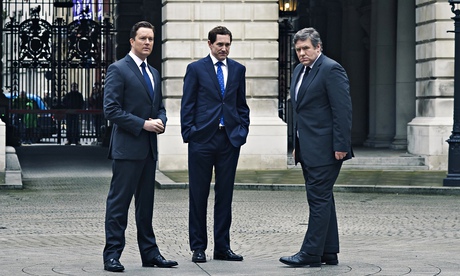
The main problem I had with Saturday night’s drama Coalition (Channel 4), the story of the formation of the government after the 2010 election, had nothing to do with the drama itself. The problem was that I don’t believe in politicians as people. I have to assume I’m not alone here, what with us all being made of essentially the same stuff, living in essentially the same blighted, God-forsaken world. But I don’t, I can’t – and I’m not being flippant here – see them as fully human. I see them as aberrations, born either with important bits missing (compassion, empathy) or dangerously enlarged (ambition, single-mindedness, appetite for power), who have over the centuries developed the perfect playground to allow them to exercise their deviant longings over the captives known as the UK electorate. When I imagine looking out through a politician’s eyes, I imagine seeing thousands upon thousands of little green plastic figures where a normal person would see ... well, other normal people going about their business.
In short, I am not well-placed to receive a political drama that treats its protagonists as complex human beings. It seemed set to be a fictionalisation too far. The opening quarter or so was stuffed full of exposition and stats (Conservatives 19 seats short of a majority! Lib Dems won more votes but lost seats! A pox on the first-past-the-post system! If only there were a better way! Maybe we will come back to this!) so we were up to speed with how the interregnum had begun, but after that the bloodless freaks began to swell with life and humanity, and it was most disconcerting.
Bertie Carvel’s Nick Clegg took – insert your own ironic comment here whenever you have a moment – centre stage, as the somewhere man (after his triumphant TV debates and the rush of popular support that followed) / nowhere man (as the actual Lib Dem votes came in) / somewhere man (as the other parties’ numbers failed to add up). Suddenly a kingmaker, a player in the game, he did the best he could – playing the Tories off against Labour, trading policies, gambling that the lure of “actually mattering” and the promise of voting reform would persuade the party faithful to accept his compromises – while trying to ignore Paddy Ashdown (Donald Sumpter), the ghosts of Lib Demmery past and his own doubts, whispering in his ear. “It’s just going to be let-down after U-turn ... What if people look back on this, at me, and they simply don’t agree? What if I made a mistake?” “Oh, go for it, Nick!” you did not at all feel like shouting. “What’s the worst that can happen?”
The rush of history didn’t allow much time or space for any of them to breathe, but everything seemed to stop when Ian Grieve as Gordon Brown had to face the fact that he had been vanquished – by inches, perhaps, but vanquished nevertheless. Nothing in the previous 80 minutes of his compressed political life became him like the leaving of it, and you couldn’t help but mourn what might have been.
It was a political drama without cynicism, which shouldn’t be possible in this day and age. No wonder it – I – felt awkward at the start. That it was both gripping and moving by the end was a triumph, even if the real life story since was ... not. Ah well. Roll on 7 May. Another chance to get it right.