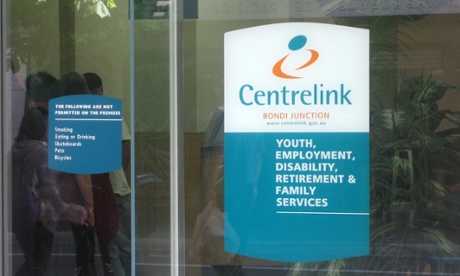
A proposal to make under-30s wait for six months before accessing the dole “remains on the table”, while the government considers the recommendations of a report that endorses a shake-up of the welfare system.
The social services minister, Scott Morrison, on Wednesday released the final report on Australia’s $150bn welfare system authored by the former head of Mission Australia, Patrick McClure.
The report makes a number of recommendations, including:
- Whittling down the 20 forms of income support payment to five separate streams
- Cutting off payments for young people under the age of 22 if they are living at home
- Automatically adjusting payments every six months to keep up with the cost of living
- Reviewing the rate of payment every four years to see if they are in line with cost pressures
- Keeping existing concession card arrangements
- Tightening eligibility for the highest tier of disability payments
- Scrapping income considerations in rent setting for public housing and moving to rent assistance
McClure told ABC Radio on Wednesday that the report was designed to make sure those who were able to work did so.
“That’s what we’re proposing: an income support system with an employment focus. We want incentives there for work. So that’s why we’re trying to break down the barriers to people not having that incentive to work,” McClure said.
“Our welfare system must be based on need not entitlement,” Morrison told journalists at the National Press Club on Wednesday. “Every payment must have a purpose and it must deliver the outcome, the benefit that the taxpayer is paying to provide.”
The report recommends simplifying the current complex system of payments into five areas: a tiered working-age payment that would allot dole money according to ability to work; a supported living pension that would replace the disability support pension; a child and youth payment; a carer payment and the aged pension.
Morrison said all of the government’s previous budget savings measures, including cutting off payments for under-30s for the first six months of their unemployment, were being considered in conjunction with the report’s recommendations.
“Every measure that’s on the table in the Senate remains on the table,” he said. “I want to be really clear about that and if someone wants me to take one of those measures off I’m going to put something else on.”
Welfare groups cautiously welcomed the McClure review’s proposed changes.
“It is good that the government has signalled its interest in some measures that would improve the targeting of spending, such as means-testing childcare payments. We encourage the government to take a similar approach to all areas of welfare spend, including the aged pension,” national director of UnitingCare Australia Lin Hatfield Dodds said.
The report explicitly states that those on income support payments now should not see a reduction when the recommended measures are phased in.
“People currently receiving income support should not receive a reduction in the rate of payment when the new system comes into effect,” McClure said.
But the tightening of eligibility requirements, including means-testing, could mean existing welfare recipients are cut off altogether.
People with disabilities who can work a minimum of eight hours a week will not be eligible for the supported living pension.
“Much will depend on implementation,” the president of People with Disability, Craig Wallace, said.
“Above all, the government must not cherry-pick the report and implement the harsh, punitive savings measures and ignore the investments we need to make to help people with disability find a pathway back to work.”
He was also concerned that moving people off income-based public housing – which allows low-income earners to pay a proportion of their income in rent – to rent assistance may be counterproductive.
Commonwealth rent assistance is only available to people who receive welfare or family payments.
“You have to have an income support payment already, and that actually provides a perverse outcome and a disincentive to accessing work,” Wallace said.
Forcing low-income people to pay market price for their rent would have a massive impact on their budgets, Wallace said.
The head of the Australian Council of Social Services (Acoss), Cassandra Goldie, welcomed the recommendation to have a jobs plan for people with mental illness and disability.
But, Goldie said: “While the report recommends setting higher rates for people with limited capacity to work who are less able or unable to supplement their payments through earned income, this assumes people can get paid work. Yet as we know from the current job market, this is very difficult at the moment.”
The head of the St Vincent de Paul Society, John Falzon said: “Poverty is not a personal choice. Neither is unemployment. The people who are unemployed are not the problem. The problem is that there are not enough jobs.”
The Business Council of Australia said the welfare system needed to be financially sustainable.
“Our welfare and employment systems need to be in sync so that assistance is targeted to people who need it most. The right incentives and supports have to be in place to ensure people who want and are able to work can do so,” chief executive Jennifer Westacott said.
Labor said the Coalition must reverse cuts it made in its last federal budget.
“I have no doubt that given this government’s track record, they will just be looking to cost-cut vulnerable people who can’t protect themselves from a mean, promise-breaking government,” opposition leader Bill Shorten said.
Morrison has extended an olive branch to Labor and the crossbench, saying he’s “open for business” on welfare reform, but said all parties must negotiate in good faith.
“All of this is absolutely moot unless we can upgrade the political debate when it comes to areas of important change for the country,” he said.