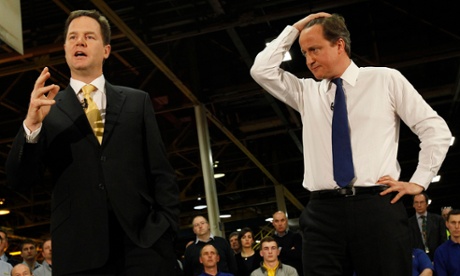
How has Britain fared under the coalition? On the surface the economic data shows the coalition has been a success, but digging deeper reveals an uneven recovery that has left many behind, a series of unmet promises and a divided country with a smaller standing on the world stage.
These 12 graphs summarise how Britain has fared since May 2010. The overall picture? A country with the chassis of a Jaguar with the engine of a Morris Minor hiding under the bonnet.
1. Employment is at a record high
There are 1.85 million more people in work today than there were when David Cameron entered Downing Street five years ago. This is helped by the fact that the UK population is also at a record 64.1 million.
2. The unemployment rate is the third lowest in the EU
After a slow start in the early part of the coalition years, the unemployment rate has dropped to below 6%, the lowest rate since the second quarter of 2008. Only Germany and Austria have a lower rate of joblessness among the 28 members of the EU.
But the unemployment rate among 16-to-24-year-olds is far higher, at 16.2%. Although this is lower than the 2011 peak (22.5%), it remains higher than it was pre-crisis, and well above comparable EU economies such as Germany.
3. Britain struggled to return to pre-crisis growth levels
The British economy may have returned to growth a few months before the last election, but it was relatively anaemic for most of the parliament. Growth only returned to healthy, pre-crisis levels last year. As a result, the overall size of the UK economy only surpassed pre-crash levels at the end of 2014.
But while other countries recovered earlier than the UK (Germany in 2010, the US and France the following year), Britain’s economy is now one of the fastest growing among the world’s richer nations.
4. Wages consistently fell in real terms until last year
Wage growth has been modest throughout the last five years, and until 2014 what little increases people have received in their pay have been consistently lower than the rate of inflation, meaning that in real terms incomes have been falling. A recovery only occurred in the middle of last year.
All age groups suffered a drop in pay, but the squeeze on living standards has hit young people most acutely. The wages of 22-to-29-year-olds plummeted by 12.5% between 2009 and 2014.
5. The budget deficit has not been eliminated
Before the 2010 election, Cameron and George Osborne pledged to eliminate the headline budget deficit - the amount of money needed by government to balance the books. A large portion of their failure to do so can be explained by the weak economic recovery.
A consequence of the drop in wages has been lower-than-expected tax revenues - and this has had an impact on the government’s efforts to cut the deficit. As a percentage of GDP, by the end of this parliament, the deficit will have only been halved.
6. Student debts soared after the tuition fee hike
Before the last election the Lib Dems pledged to oppose any increase in tuition fees, yet one of the coalition’s first motions was to nearly triple university fees to a maximum of £9,000 a year.
The hike in fees may have not made a noticeable difference to enrolment numbers in England, but an analysis of Office for Budget Responsibility figures reveals the amount of student debt that is eventually expected to be written off in 30 years is expected to be 10 times greater.
Whether it be on households or on the government’s coffers, the increased fees will place more pressure on the country’s total debt burden. The total debt owed by students is already £54.4bn.
7. Immigration rates have not tumbled, despite Cameron’s pledge
In 2011, Cameron promised to reduce immigration to the “tens of thousands” – “no ifs, no buts”. However, net migration to Britain was 298,000 in 2014 – higher than when the government took office – and the issue is a top priority for voters.
8. Hospitals are struggling to keep on top of waiting times
The proportion of people being seen within four hours in England’s major A&E departments is at its lowest since targets were introduced, reflecting increased public demands on the service as public confidence in GPs has eroded.
9. The greenest government ever? Not in the EU
Britain aims to produce 15% of its total energy – heating and electricity – from renewable sources by 2020. However, the most recent figures show that there is still some way to go if that target is to be met. Compared to other EU member states, only the Netherlands, Malta and Luxembourg produce a lower share of energy from renewables than the UK.
That said, Britain did manage to produce 15% of its electricity from renewable sources in 2013.
10. Same-sex marriages are taking place at a rate of 100 a week
It was controversial in some parts of the Conservative party, but the same-sex marriage bill passed in 2013 will come to be seen as one of the coalition’s most substantial cultural legacies.
11. Britain does have a role on the world stage
Ever since Cameron lost a vote to support air strikes in Syria, there have been mumblings that Britain is “disappearing from the world stage”. When it comes to the crisis in Ukraine, the prime minister appears to have taken a back seat – he was not invited, for example, to critical negotiations in Minsk between Angela Merkel, François Hollande, Petro Poroshenko and Vladimir Putin.
Nevertheless, between May 2010 and the end of March 2014 the PM visited 47 different countries. The number may seem high even to frequent flyers, but consider this: in the first two weeks of February this year alone the German chancellor, Merkel, visited eight European countries, plus the US and Canada. By comparison, in the first three months of 2014 Cameron visited six different countries.
12. The United Kingdom’s future remains uncertain
Scotland is staying in the UK – for now. But after last summer’s vote support for the Scottish nationalists has soared, and the SNP is currently predicted to win 50 out of the 59 seats at the general election.
It is possible that another Cameron referendum pledge – a vote over EU membership – could trigger a second Scottish independence vote. We may have to wait a while longer before being able to pen the longer-term legacy of Coalition Britain.