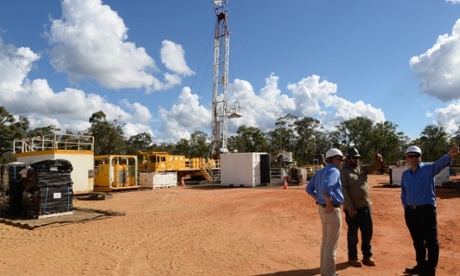
The contentious expansion of coal seam gas operations in New South Wales will not drive down gas prices as the state and federal governments have claimed, according to a NSW parliamentary report.
The committee report into NSW’s gas markets states that exploitation of coal seam gas reserves “will not, on its own, act to address the challenges facing the gas market in New South Wales.”
The report predicts that gas prices will actually be driven up due to gas export operations in Queensland, which will connect Australia with a global market. As consumers in Asia pay up to five times as much for gas, the price in Australia will invariably rise.
Both the state and federal governments have indicated that the opening up of new CSG activity will solve a gas shortage in NSW and help curb power bills. The average consumer’s gas bill has risen $180 on average over the past year.
But the report states that gas producers “will increase their wholesale gas prices, under the spectre of being able to export.”
“The evidence to this committee is clear” that the production of gas in Australia completely eclipses any domestic demand, whether from residential or commercial users.
“Any difficulty with supply or cost can only occur if private commercial interests place the maximisation of their own profits above the energy security and affordability of the community.”
The committee, made up of Liberal party, Labor party, National party, Greens and Shooters and Fishers members, recommends an “Australia-wide gas reservation policy, to assist in containing gas prices and ensure security of supply.”
It also calls for a halt to new CSG activity until the NSW chief scientist’s recommendations are fully implemented.
Critics of NSW’s plans for coal seam gas exploration have seized upon the report as justification for a halt to new CSG drilling. A number of controversial projects have faced resolute opposition from activists and locals in NSW, due to concerns over land access and the impact of fracking, where water and chemicals are fired deep underground to open up pockets of gas.
Lock the Gate national coordinator Phil Laird said: “The government must take these recommendations to heart and act now to put the Gloucester and Narrabri projects on hold before any more damage is done.
“We are calling for [NSW premier] Mike Baird to immediately announce a completely new approach which puts CSG mining on hold in NSW.
“The pain that is being experienced by landholders, manufacturers and gas consumers is being caused by the greed and secrecy of the gas giants, and the national interest is suffering.”
But Anthony Roberts, NSW’s energy minister, said the state imports 95% of its gas and that other states had rejected reserving gas for domestic, rather than export, use.
“An east-coast reservation policy would require other states, such as South Australia and Queensland, to effectively sign up to a deal whereby they would subsidise NSW gas supplies without receiving anything in return,” he said.
Meanwhile in Victoria, the Nationals have strengthened their stance on coal seam gas fracking ahead of the Gippsland South by-election in Victoria’s south-east, an area where drilling and exploration for the unconventional natural gas is a key community concern.
The seat was previously held by former deputy premier Peter Ryan, who resigned in the aftermath of the Coalition’s loss in the state election last November.
Prior to the election, the National, Liberal and Labor parties avoided stating a clear position on fracking, with the industry claiming it is safe, and environmental groups saying it risks contaminating water tables and damaging land.
But the Nationals upper house candidate for Eastern Victoria, Danny O’Brien, who will contest the by-election against the Liberal party’s Scott Rosetti, said he believed landowners should have the right to reject coal seam gas extraction on their property.
Unlike Queensland and New South Wales, Victoria has no unconventional gas industry, but O’Brien said the Nationals would demand stronger safeguards for landholders should the industry ever develop.
The local community and the landowners should also get a share of the wealth, O’Brien said.
“This is an evolution of our policy and what we are saying is we will not support anything that risks damaging our land and water resources,” O’Brien said. “But if the government does decide fracking should go ahead and the science proves it is safe, then we need to ensure a number of safeguards are in place.”
Following a large grassroots campaign by farmers and other traditionally conservative voters, the former Victorian Coalition government introduced Australia’s first moratorium on coal seam gas exploration licences and fracking approvals in 2012, which is due to expire in July.
The current Labor government has said this moratorium would remain until a parliamentary inquiry into fracking hands down its findings this year.
Indigenous, environmental, farming and other rural groups have united in their opposition to natural gas exploration, making it a key issue for voters in Gippsland South, which has traditionally been a fairly safe Nationals seat. Greens MP for Melbourne Ellen Sandel said the Gippsland South byelection was shaping up as a referendum on coal seam gas fracking.
“With no Labor candidate running, the Nationals and Liberals will be fighting for Greens’ voters second preferences, which has likely led to this change of Nationals policy,” Sandell said. “In the last state election we saw the Greens’ vote double and triple in some rural communities because we’re the only party calling for a permanent moratorium on coal seam gas.”