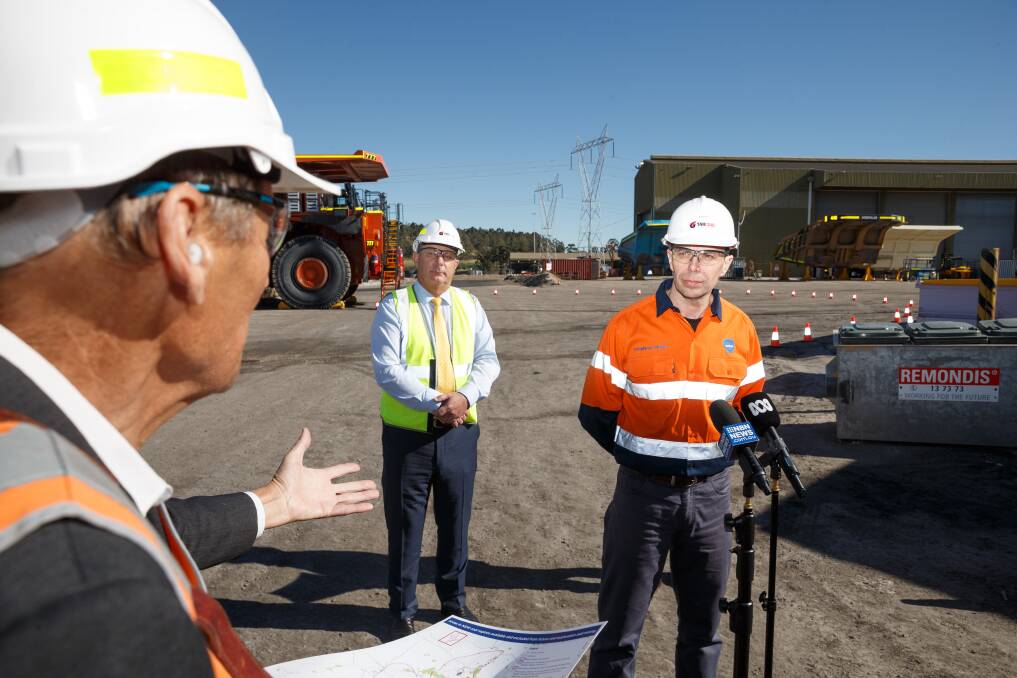
Coal mining continues to inject billions into the NSW economy, despite China's trade block and global moves towards renewable energy.
A NSW Minerals Council expenditure survey of 27 participating mining companies found they injected $14.9 billion into the NSW economy in 2019-20.
NSW Minerals Council chief executive Stephen Galilee said this represented an increase of $1.2 billion on the previous financial year.
This supported "tens of thousands of jobs" and generated "billions in additional spending" across NSW, particularly in regional communities.
The figures reaffirm the coal sector's socio-economic importance to the Hunter, along with state and federal budgets.
Mr Galilee said the companies surveyed supported 27,500 mining jobs, a rise of about 1300 jobs compared to the previous financial year.
"These survey results confirm that much of regional NSW continues to depend on mining projects for local jobs, investment and economic growth," he said.
The survey's release on Tuesday coincided with the National Farmers Federation releasing a policy paper, calling for renewable energy zones to be "at the centre of any regionalisation agenda".
Nonetheless, Mr Galilee said the "right policy settings" were needed in the post COVID-19 recovery to support "miners, their families and our mining communities over the long term".
Prime Minister Scott Morrison said earlier this month that "our goal is to reach net zero emissions as soon as possible, preferably by 2050".
It was reported on Tuesday that demand for Australian coal from markets including Japan, Taiwan, Korea, Vietnam and India remained strong at the end of last year, despite sales to China falling over Beijing's ban.
University of Newcastle Associate Professor Hao Tan recently told the Newcastle Herald that demand from these East Asian countries for coal from the Port of Newcastle "will fall in the long run". "All these countries are undertaking transitions towards low-carbon energy. However, it won't be a linear trend. We might see ups and downs in coal exports along the way," Dr Tan said.