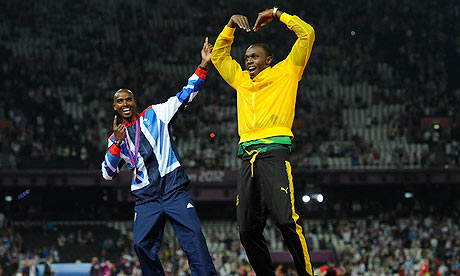
When Mo Farah won his double Olympic gold this summer, his coach Alberto Salazar said: "Mo dug deeper than I have seen any athlete do. You're talking about a man who has more heart, more guts and more soul than any athlete I've ever seen."
Mo's sheer determination undoubtedly contributed to his victory. But what may be less well known is Salazar's revelation that Mo Farah was: "... the weakest athlete I'd ever trained – in terms of core strength and being able to do push-ups, sit-ups and single-leg squats. He was a 90lb weakling. He was a skinny distance runner with a great engine but no upper body. At the end of races, he would tire and his head would bob around and his arms would flail."
Although Mo may have endeared himself as one of the darlings of Team GB, he didn't do it on his own. As well as the talent they had helped to nurture, a roll call of inspiring coaches emerged from behind the scenes at the Olympics.
After being questioned about running 10.04 seconds in Ostrava in the run up to the London 2012, Usain Bolt laughed away concerns about his form. There was no hiding his faith in his coach, Glen Mills: "I'm confident that myself and my coach can put together a programme to be a champion. I will focus on that. My coach is the greatest coach ever and knows exactly what to do to get me to the top. I'm not worried."
Comparisons between the world of sport and business are commonplace. But while the coolest sportsman in the world espouses the virtues of his coach, why does coaching still meet such resistance in the professional arena?
I still feel disappointed by the level of embarrassment that often accompanies having a professional coach. To some extent, this comes from the assumption that employing support may be a sign of weakness, or a broader suspicion of what professional coaches actually do.
Although the David Brent parodies of professional development seem to hold less sway as coaches have raised their game, a negative stigma still seems to remain about the role of the professional coach. While for some it would never be their choice, for others it can be transformative.
Professional coaches are trained to help us find the answers within ourselves to tackle most problems. They offer us the space and opportunity in our busy lives to look at ourselves from an almost bird's eye view. Caught in the crossfire of daily pressures, it is easy to lose track of our broader aspirations and goals. Asking key questions, challenging our assumptions, or what some refer to as 'self-limiting beliefs', coaches can help us to get clear about where it is we want to be. This helps us to think and act strategically, so that our behaviours tie in with where we want to be in terms of our careers, our teams or our business.
Clarity is the key – to help us keep an eye on the big picture stuff, to have a clearer sense of the importance of managing our stress levels and staying 'in flow' with whatever life throws at us. Coaches can help us to help ourselves and keep us focused and confident about our abilities.
Choosing your coach is a very personal decision. If you are interested in finding out more you could contact Association for Coaching or the International Coaching Federation. Alternatively, word of mouth can be a good way to find potential coaches. You need someone who suits you – so maybe try out three different people before you decide. Lots of coaches will offer a free introductory session so you have a real chance to get a feel for their approach and how inspiring they may be.
When you speak, there will be lots of questions you might have – and many more suggested on the websites mentioned. Ultimately you will want to follow your gut instincts. Most coaches will design a contract with you about how things will work, as well as what won't. Remember it is in your hands to ask for what you want. It is not therapy – you play an active role in the whole process and you are investing your money, time and trust in this relationship.
Certainly raw talent and dedication will get you a long way, whether you want to run faster or achieve your career ambitions. But maybe it's time business followed the Olympic example and acknowledged the benefits of the right-hand man or woman in offering a helping hand. Certainly, if this were to be one of the legacies of our Olympic summer it might also be one of our better baton changeovers.
This content is brought to you by Guardian Professional. To get more content and advice like this direct to your inbox, sign up for our weekly Careers update.