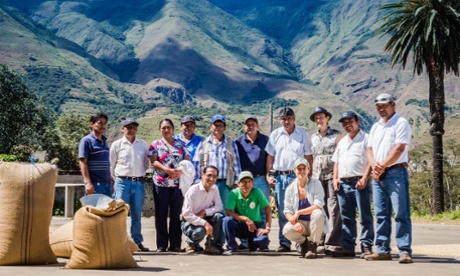
Many Fairtrade coffee smallholders use what they call the “closed loop” system. This means that everything they need to keep their soil healthy and fertile is right there on the farm. So, the foliage from banana trees that are grown for shade can be an ingredient in a home-made organic compost. Manure from the animals they keep to feed their families or sell at the local market can be used to fertilise the coffee trees. This is recycling in its most natural and creative form – and it also happens to produce delicious coffee.
Thanks to this method, most coffee smallholders who are Fairtrade certified can also apply for organic certification and many do. Yet when UK consumers think of organic products, we at Cafédirect have found that most think of meat, milk, fruit and vegetables, usually produced locally by UK farmers. Some people also mention skincare, but that’s as far as an immediate answer goes.
So in the run up to Organic September, Cafédirect has decided to place a focus on organic coffee and look at what it means for farmers, consumers and the environment, and its place in the market at the moment. In the US, organic coffee is hugely popular. In the UK there is definitely still room for it to grow.
As the UK’s first and largest 100% Fairtrade hot drinks brand, Fairtrade is obviously part of Cafédirect’s DNA, but it’s less well known that our top selling product, Machu Picchu ground coffee, is Fairtrade and organic. According to Cafédirect’s procurement manager, Joanna Lawson, “Our consumers love the quality and the taste, but we also believe that the fact that it sells so well shows that people engage strongly with both Fairtrade and organic certifications.
“The two certifications sit extremely well together” she adds. “Fairtrade standards are about protecting a minimum price for the farmer and about high environmental standards. Many smallholder farmers are already organic producers because they care about their farms and want to protect them. The land is usually passed down through the family, so it’s important that it stays fertile and rich to make sure there are good harvests and steady income for the next generation.”
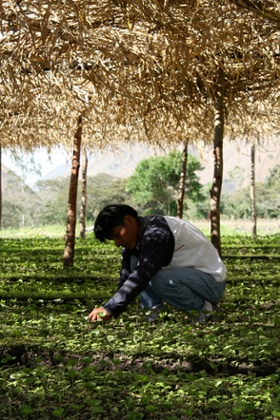
Organic farming offers smallholders economic, environmental and social benefits. Organic certified producers can get a higher premium for their coffee and a higher price in the market, while building long term sustainability and farms with healthy yields for years to come.
The Cafedirect Producers’ Foundation (CPF) also works with smallholder farmers in east Africa and Latin America to try to tackle these issues. It establishes demonstration farms, showcasing farmer-led innovations in organic farming and low-cost methods to create organic fertiliser. This helps promote bio-diversity, preserve the environment, increase soil quality and increase crop quality.
One of these initiatives is the CPF’s Coffee Quality Centre of Excellence hosted by coffee co-op ACPCU in Uganda. To date it has established nearly 20 demonstration sites focused on increasing organic farming, including the use of bio slurry and compost manure.
“There are numerous benefits to organic farming, especially as it is related to coffee quality,” says Sylvia Ng’eno, the CPF’s east Africa programme manager. “The organic techniques that we promote through our network of 210,000 smallholders in east Africa are much cheaper for farmers as all ingredients are found on the farm. There are also increased health benefits to organic farming since no chemicals or pesticides are being used and it improves the taste of coffee.”
Cafédirect believes that organic certification makes a difference to consumers as well as farmers, in part because of the difference in taste. For example, most of the Machu Picchu coffee comes from the Huaquiña cooperative in the Cusco area of Peru. The community is called Santa Teresa and is located at the foot of Machu Picchu, in a beautiful, lush landscape. The coffee produced here has a nutty and chocolatey taste profile which consumers love. This profile is particular for the Cusco area because of its altitude and the rich, fertile soils.
According to Lawson, “People forget that most coffee farmers are smallholders and they own their farms. They look after them and are always seeking to diversify in order to build a sustainable ecosystem. On our recent trip to Peru, we visited the farm of the president of the Huadquina coop, Nieves Delgado Perez. He had a great diversification system in place, cultivating strawberries and bananas, and breeding guinea pigs which they eat in Peru.
“Ultimately it’s all about harmony with nature and there’s a very strong argument that this is what makes coffee taste really good,” she adds. “If the farming damages the local biodiversity and richness of the soil, in time this will affect the quality of the crop. Fairtrade organic coffee is good for everything that makes up the beautiful world of coffee: the farmers who produce it, the environment where it grows and the people who enjoy it in their cup.”
Content on this page is paid for and provided by Fairtrade Foundation, sponsor of the spotlight on commodities series