NEW YORK _ Circus folk never bid each other "goodbye," according to tradition. At the end of each show, when scaffoldings are dismantled and animals and performers board the mile-long trains they call home, there's always a next stop in another town. Circus folk prefer to say: "See you down the road."
Things will be different when the Ringling Bros. and Barnum & Bailey circus performs at the renovated Nassau Coliseum on Sunday, May 21. That show will be its last. For the Ringling circus, which has spent 146 years entertaining people across the country and around the world, there is no more road.
The closing marks not only the end of an American institution but the end of an era. For generations, Ringling's famous slogan _ "The Greatest Show on Earth" _ seemed indisputable. During the 19th century, Ringling traveled by train across a still-expanding America, bringing world-class spectacle to small towns, often shutting down local streets as acrobats and exotic animals paraded toward the showgrounds.
During the 20th century, Ringling survived as movies, television and personal computers competed for the public's attention. In the 21st century, however, it was the loss of the circus' most emblematic performers _ the elephants _ that proved too much for Ringling to overcome.
"There have been points in time when fans mourned the loss of the circus parade, or the horse-drawn wagons," says Gary Payne, president of the nearly century-old Circus Fans Association of America. The removal of Ringling's elephants, though, was a far greater blow.
"For tried-and-true, dyed-in-the-wool fans like myself," Payne says, "we knew in our hearts that you could never remove the star of a show like this and expect to survive."
For many animal rights groups, including Long Island Orchestrating for Nature (LION), the closure of Ringling is a hard-won triumph, the result of years of protests. The group's founder and president, John Di Leonardo, says he and his team will rally outside Ringling's final performance as well. "The show is over for Ringling, but it's not over for the animals," says Di Leonardo, who also works as a campaigner for the national group People For the Ethical Treatment of Animals.
With or without its pachyderms, Ringling clearly faced an increasingly competitive entertainment landscape.
"In the 19th century, just getting to the circus was an adventure in itself," says Kathleen Maher, who serves as executive director of the Barnum Museum in Bridgeport, Connecticut _ P.T. Barnum's home state _ and still recalls her first Ringling show as a 10-year-old growing up in Levittown. Today, our entertainment options are "massive," she says. "It's a home computer, it's a 14-movie multiplex _ it's even just the mall or Saturday morning soccer. There's so much for people to choose from."
The name on Maher's museum has become synonymous with the circus even though the legendary entrepreneur and showman didn't enter the business until the age of 60, long after he had become famous as the owner of Barnum's American Museum in lower Manhattan. Opened in 1842 near what is now the World Trade Center site, it was a harbinger of the circus: a semi-educational and much-sensationalized amalgam of zoo, aquarium, freak show, flea circus, wax museum and performance space. Barnum's museum became a showplace for the famous Siamese twins Chang and Eng, the trained bears of Grizzly Adams and the 25-inch-tall General Tom Thumb.
After the museum was gutted by a fire in 1865, Barnum essentially took the concept on the road, billing it under such names as "P.T. Barnum's Travelling Museum, Menagerie, Caravan, and Hippodrome" and "Greatest Show On Earth." By the early 1870s he was transporting his circus along a transcontinental railroad that had only recently been inaugurated by the famous "golden spike" of 1869. The circus also went through a series of what would now be called mergers and acquisitions, teaming up first with James Bailey's well-known show and then, years after Barnum's death, selling to the Ringling brothers in 1907.
"The whole process is also what makes the circus so American," says Janet M. Davis, associate professor of American Studies and History at the University of Texas at Austin. The circus grew in size and scope just as the country did, taking advantage of such burgeoning infrastructure as roads, canals and railroads. "The history of the circus in America is really telling us the history of us."
During its turn-of-the-20th-century peak, Ringling grew rapidly. According to Linda Simon's 2014 book, "The Greatest Shows on Earth," by the mid-1920s Ringling had become a traveling city with a population of 1,600 _ including 100 clowns; nearly 200 acrobats, aerialists and riders; 800 horses; and more than 40 elephants. The famous clown Emmett Kelly was a Ringling performer, as were the daredevil "flying" Wallendas and lion tamer Clyde Beatty, with his iconic whip and chair.
Even today, "It's just such a big machine," says Alex Ramon, a former Ringling ringmaster who performed on the magic-themed "Zing Zang Zoom" tour in the late 2000s. Ramon recalls his awe at joining a sprawling operation requiring hundreds of hotel rooms in each city and the expense of maintaining railroad cars while on tour. "You can't just go to Auto Zone for a train problem," says Ramon. "These are the things people don't think about."
The Ringling circus survived World War I and the Great Depression. It survived World War II, when it received a special dispensation from President Franklin D. Roosevelt to travel the railroads despite wartime restrictions. It survived a ghastly 1944 fire in Hartford, Connecticut, when a burning tent fell onto a packed audience and killed 160 people. Ringling persevered even after it abandoned the use of the big-top _ seemingly the very definition of a circus � in 1956 and began performing in permanent structures such as arenas and stadiums.
"Every year we went to the circus. It's just what we did," says Meryl Meisler, a retired art teacher who recalls seeing the Ringling show as a child growing up in Massapequa during the late 1950s and early 1960s. "The lights, the costumes _ there was nothing as big as the circus," she says. "It was like having fireflies around you all the time. Everything was alive, and to be experienced in person."
In 1967, Ringling was purchased by business partners including two concert-promoting brothers, Irvin and Israel Feld, and today remains under the control of the family-run company Feld Entertainment, which owns several other live touring shows, including Disney on Ice and Marvel Universe Live! A major change to Ringling came relatively recently, in 2006, when the circus abandoned its iconic three-ring format in favor of one large space. That show, titled "Circus of Dreams," also incorporated a narrative into the performance for the first time.
They were looking for something "outside the realm of circus, because they wanted a fresh take," says Shanda Sawyer, a choreographer and television director tapped by the Felds to help create "Circus of Dreams." Sawyer says she came up with the story of a normal "family" that is plucked from the audience to join the circus, focusing particularly on the little boy who struggles to find his talent.
The elephants, so closely identified with the very concept of the circus, became a liability in recent years. In 2000, a former Ringling employee and animal-rights groups filed a lawsuit alleging that Ringling mistreated its elephants, launching a series of legal battles that stretched for more than a decade.
After the former employee was found to have been paid by the animal-rights groups to back their charges, Feld filed a suit of its own to recover legal costs. In the end, the advocacy groups paid a total of $25 million in settlements for bringing what U.S. District Court judge Emmet G. Sullivan characterized as "groundless and unreasonable" litigation. But by then the allegations of caged, cramped, frightened elephants had sunk into the public consciousness. In May 2016, Ringling stopped using the animals in performances and sent them to its Center for Elephant Conservation, a breeding farm and retirement facility in central Florida.
It was the beginning of the end. "Following the transition of the elephants off the circus, the company saw a decline in ticket sales greater than could have been anticipated," Feld Entertainment stated in the January news release that announced the circus' closure. Executives declined to comment further on the show's demise or its last run at the Coliseum.
The Felds told The Associated Press that the remaining animals _ lions, tigers, camels, donkeys, alpacas, kangaroos and llamas _ "will go to suitable homes," and that the company will keep its elephant center.
There are still at least 20 professional circuses on tour this year, according to the Circus Fans Association, including one called Circus 1903, which features massive elephant puppets (designed by the same team that created the animals for stage play "War Horse"). Simon Painter, the executive and creative director of Circus 1903, says he's heard from 60 or 70 performers looking for work since Ringling's closure was announced.
"Circus is a very small industry in terms of the talent," says Painter. "There's an army of unemployed performers, and it really hurts circus in the long run. These are people who have been doing it for generations."
Johnathan Lee Iverson, who in 1998 became Ringling's first African-American ringmaster _ and will be the last person to wear the spangled top hat and long-tailed coat _ had no firm plans in place when he spoke before a performance at Brooklyn's Barclays Center in March. "Obviously, it's a loss of employment, but it's much bigger than that," Iverson said. "As a fan, I'm definitely sore about it. It's one of those last innocent delights you have."
He added, "I hope the public continues to support all the circuses that are still around. The American circus isn't dead."
Performing in the circus is often a family tradition carried through many generations. In Ringling Bros. and Barnum & Bailey's final tour, "Out of This World!," parents perform beside their children, couples share the spotlight and entire extended families _ cousins, siblings, childhood friends _ live, travel and perform as a troupe.
DAVIS VASSALLO
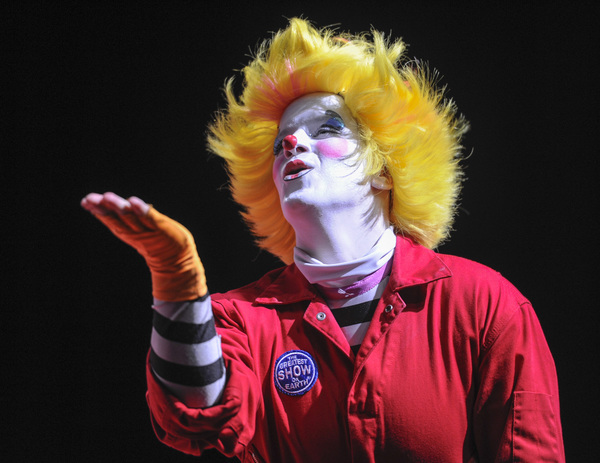
Clown
When Davis Vassallo says he's been a clown all his life, he isn't kidding.
"My father was a clown, my grandfather was a clown," says Vassallo, who grew up performing in Italy beginning at the age of 7, when his father made him his first costume. "I am four generations of clown."
Vassallo is now the star clown of the current edition of the Ringling Bros. and Barnum & Bailey Circus show titled "Out of This World!" He plays the bumbling henchman of a wicked queen, which means his attempts at evildoing usually end in harmless pratfalls _ or potentially dangerous acrobatics. In this show, Vassallo sways atop a dizzyingly high pole, performs a triple-somersault on a rubbery high wire and engages in an activity entirely for him: ice skating.
"I was born in the circus," he says, "so for me it's normal."
Although the circus' roots in Italy go back long before such showmen as P.T. Barnum turned it into an American pastime, Vassallo readily admits he had set his sights on the Greatest Show on Earth even as a child. "When I was little, one of my dreams was to come to America and see one of the Ringling shows," he says. Tickets for a Ringling show were ordinarily out of his family's reach, Vassallo says, and the one year his father found the money, their local train suffered a mechanical problem. Their tickets went to waste.
"I said, 'Don't worry about it,' " Vassallo recalls. " 'Someday I'm going to work for them.' " Vassallo still savors the moment he called his father, four years ago, to say that his childhood boast had finally come true.
Today, Vassallo shows no bitterness about Ringling's closure. The day after the performers heard the announcement, "we woke up and said: You know what, we're just going to give everything, and put all our energy into the show. Because this going to be memorable," says Vassallo. "For me to be one of the last clowns in the Greatest Show on Earth _ I just want to give everything to show them what it is."
AANIYA RAPHIEL
Unicycle basketball
It won't be difficult to spot Aaniya Raphiel at the final circus. Just look for the only woman who's playing basketball. While riding a unicycle.
"It's awesome," says Raphiel, 22, who is surely one of the few in her peer group to choose such a rarefied career. "A lot of people went to college, and when I tell them I joined the circus, they're like, 'Why?' I'm like, 'Why not? Everybody wants to join the circus!' "
Raphiel is part of the King Charles Troupe, an all-black team of one-wheeled hoop shooters founded in the late 1960s by Jerry King. The official story goes that a very young King became captivated by the unicyclists he saw at a Barnum & Bailey Circus in Tampa, Florida, in 1918. Years later, as a father, he taught the skill to his 6-year-old son, Charles. That helped inspire King to start a unicycle youth group in the South Bronx, where he was living in the late 1950s. Finally, in 1968, he took his colorfully named King Charles Troupe for an audition at Ringling Bros., which put them in the show the following year.
Like so many circus performers, Raphiel comes by her talent honestly: Her grandfather Floyd "Sweets" Harrison was a founding member of the Troupe. She also joins two family members in the company: a cousin, Harvey Harrison, and a stepcousin, Amir Ismail. "My grandpa would always tell me these stories" about being in the Troupe, says Raphiel, who grew up in Las Vegas. "And now I think, 'Wow, this is what it felt like. "
The young unicyclist's first year with Ringling, it turns out, will be her last. "A lot of people are looking to join other circuses," says Raphiel. "The majority of us are hoping to go overseas, like Spain or China." There's a chance, however, that Raphiel will wind up taking her unusual resume right back to her hometown. "A lot of people are going to Las Vegas," she says. "That's where the majority of the shows are."
JOHNATHAN LEE IVERSON
Ringmaster
When Ringling tapped Johnathan Lee Iverson to become its new ringmaster in 1998, he never imagined the short-term job would turn into a long-term career.
"I didn't intend to do more than a year," Iverson, 41, says today. "I thought, 'ringmaster' sounds like a nice pickup line. And then I'd leave."
Eighteen years after becoming Ringling's first African-American ringmaster, Iverson now has the poignant honor of hosting the circus' last-ever show. For Iverson, Ringling has become his family in a very literal sense: His wife, Priscilla, is the show's production manager, and they live on the Ringling train with their children, Matthew, 12, and Lila, who are also in the show. Matthew performs as a miniature version of his father; Lila is his understudy.
"Living with your family, working with your family, traveling with your family _ it's part of your career, your life," Iverson says. "Everybody gets a check."
A Manhattan native raised by a single mother, Iverson sang in the prestigious Harlem Boys Choir, attended Fiorello H. La Guardia High School of Music & Art and Performing Arts, and then studied at the The Hartt School, a performing arts conservatory at the University of Hartford in Connecticut. It was while acting in a summer dinner theater show in far-flung Wisconsin that Iverson heard from his director that Ringling needed a new ringmaster. Iverson auditioned and got the gig, partly because of his impressive tenor voice.
"I understood what it meant when I got here," says Iverson, who remembers seeing his first Ringling show at the age of 8 at Madison Square Garden. "I really embraced what it means to children of all ages, and different stripes."
Iverson says he'll miss the camaraderie of a circus that functions almost as a social utopia, where a performer's capability and artistry far outweigh any notions of ethnicity or sexuality. "All this stuff about race, and who's American," Iverson says dismissively. "People have been coming here for 146 years, and they've seen _ and been wowed by _ Muslims on high wires and gay men on the trapeze. And a black guy in the middle of it all."
He adds, "And nobody's ever thought about it. They're just caught up in the wonder of it all."